The Step Count That Actually Matters: Forget 10,000

The 10,000-step target came from a 1960s Japanese pedometer marketing campaign — not science. The device was called manpo-kei ('10,000 steps meter'), and the number was chosen for its memorable roundness, not for any health evidence. When researchers finally studied mortality across step counts, the picture was both humbler and more encouraging than the marketing implied.
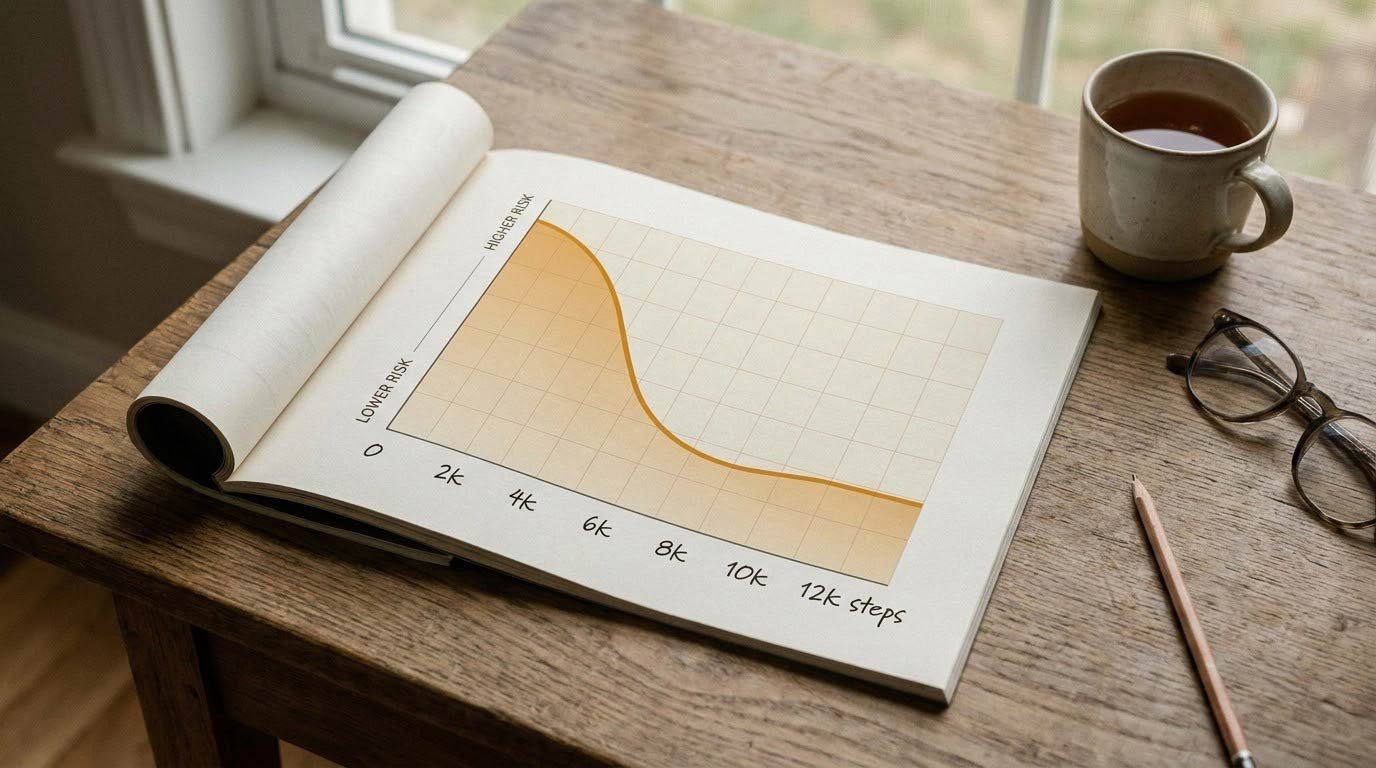
Mortality benefits plateau at roughly 7,000–8,000 steps for most adults — meaning the biggest health gains hide in the first few thousand steps above sedentary. If you're at 2,000 daily, reaching 4,000 matters more than reaching 10,000.
What the step studies actually found
A landmark 2022 meta-analysis published in JAMA Internal Medicine pooled data from 15 international cohort studies — over 47,000 adults across multiple countries. The findings were remarkably consistent:
- Every additional 1,000 steps was associated with progressively lower all-cause mortality — but with diminishing returns at higher counts.
- For adults under 60: benefits continued accruing up to roughly 8,000–10,000 steps, then plateaued.
- For adults 60 and over: benefits plateaued at roughly 6,000–8,000 steps. Walking more than this didn't show additional mortality benefit.
- The steepest gains were in the transition from sedentary (under 4,000) to moderately active (4,000–8,000). This is where the survival curves separate most sharply.
An earlier study of older women (average age 72) found that those averaging just 4,400 steps per day had a 41% lower mortality rate than those averaging 2,700 or fewer. The benefit continued increasing through about 7,500 steps, then leveled.

The dose-response curve
The relationship between steps and mortality follows a diminishing-returns curve — steep gains early, gradual flattening later. Picture a hockey stick lying sideways: the blade (biggest benefit) is in the first few thousand steps above sedentary, and the handle (diminishing returns) extends toward 10,000+.
This shape matters for how you target your effort. If you're at 2,000 steps daily, adding 2,000 more produces a larger mortality-risk reduction than adding 2,000 to an existing 8,000. The people who gain the most from more steps are the people currently taking the fewest.
The best step count is the one you'll actually sustain. A 4,000-step day you repeat for years beats a 12,000-step day you burn out on by February.— The adherence principle
Every step counts — the hidden benefits of incidental movement
Steps don't need to come from 'exercise.' In fact, the research on non-exercise activity thermogenesis (NEAT) — the calories burned through everyday movement — suggests that incidental walking may be just as valuable as structured workouts.
- Walking to the store instead of driving — 2,000 round-trip steps.
- Taking the stairs instead of the elevator — 15–30 steps per flight.
- Pacing during phone calls — 100+ steps in a 10-minute call.
- Parking farther away — 200–400 steps per errand.
- Household chores — 1,000–3,000 steps for active cleaning or gardening.
- Getting off transit one stop early — 500–1,000 bonus steps.
The people with the healthiest metabolic profiles in observational studies aren't necessarily the ones doing gym workouts — they're often the ones who simply move more throughout the day. A lifestyle that accumulates 8,000 incidental steps may be metabolically healthier than one with a 45-minute gym session followed by 10 hours of sitting.

The intensity bonus — real but modest
Step pace adds a smaller but measurable benefit on top of step volume. Studies that measured both consistently find:
- Higher cadence (steps per minute) is associated with additional mortality benefit at any given step count — but the effect is modest compared to simply taking more total steps.
- A brisk pace (roughly 100+ steps per minute, or about 3 mph) is sufficient. You don't need race-walking intensity.
- 30 minutes of brisk walking within your day counts toward the CDC's 150-minute moderate-activity guideline — but you don't need to do it all at once. Three 10-minute brisk segments work.
If you already walk daily: pick up the pace for 10 minutes of your walk. If you don't walk daily: start with 20 minutes at whatever pace feels sustainable. The volume matters more than the speed — build the habit first, then add intensity.
What about cardiovascular fitness?
Steps measure movement volume, not fitness. Cardiorespiratory fitness (VO₂ max) is a different and arguably stronger predictor of longevity — but it requires more deliberate training than walking alone provides. The two are complementary:
Walking builds the activity base — the movement volume that keeps metabolism, glucose handling, and circulation healthy. Resistance training and more intense cardio build the fitness ceiling — the VO₂ max and strength reserve that determines how you respond to stress and illness. Both matter. Walking is the foundation; training is the structure above it.

The practical protocol
Bringing the evidence together — here's the realistic, sustainable approach to step-based health:
- Know your baseline. Most smartphones track steps by default. Find your average — no judgment, just data.
- If sedentary (under 4,000): add 1,000 steps per week. This is where the biggest health gains live.
- If moderately active (4,000–7,000): add brisk-pace segments and build toward 7,000–8,000.
- If already at 8,000+: you've captured most of the mortality benefit. Add intensity, not volume.
- Don't chase 10,000 if it makes walking feel like a chore. The adherence evidence consistently shows that sustainable beats heroic.
- Pair with resistance training 2× weekly — steps alone won't preserve muscle or bone.
This week: find your current daily average. If it's under 4,000, add one 20-minute walk — roughly 2,000 steps. That single change captures more mortality-risk reduction than any other upgrade you could make.
When this article is not enough
If you have joint pain, cardiovascular limitations, or a condition that makes walking difficult, the step conversation belongs with your clinician or a physical therapist. Movement matters for everyone — but the safest and most effective form varies by individual health status.
CoQ10: The Cellular Energy Catalyst
The molecule your mitochondria use to generate ATP — the full evidence journey: how it works, what trials show for heart and statin users, and honest grades for energy and performance.
Explore the CoQ10 journey →Where this information comes from
- meta-analysis of 15 cohort studies, 47,000+ adults
- mortality benefit plateau at 6,000–8,000 steps for adults 60+
- dose-response curve shape
- 4,400 steps associated with 41% lower mortality vs sedentary
- benefits accruing well before 10,000
- older women cohort
- age-specific step targets
- population-level physical activity data
- 150 minutes moderate activity recommendation
- how steps translate to guideline minutes
Our evidence principles
How we evaluated the claims on this page
- Prefer government health agencies, major medical organizations, clinical guidelines, systematic reviews, and well-designed human studies.
- Distinguish established evidence from popular belief and marketing origins.
- Avoid presenting a single step count as a universal threshold for everyone.
- Use numbers only when the population, context, and evidence are clear.
- Encourage clinician involvement when starting an exercise program with existing health conditions.
Educational information — not medical advice
This article is for educational purposes and does not diagnose, treat, or prevent any medical condition. If you have joint problems, cardiovascular disease, or a condition that limits physical activity, consult your healthcare provider about appropriate movement. BodyFinds should display its medical disclaimer and source methodology alongside this article.