Nutrition Fundamentals
Nutrition advice is loud, contradictory, and mostly wrong in the same direction: it obsesses over single foods while the evidence lives in patterns — and it sells certainty the research doesn't have. This page holds to a stricter standard: Mediterranean-style eating is here because a randomized trial (PREDIMED, published in the New England Journal of Medicine) tested it; the fiber gap is here because national survey data measures it; and where the evidence is observational only, this page says so. The fundamentals that survive every study — stated with their actual strength.
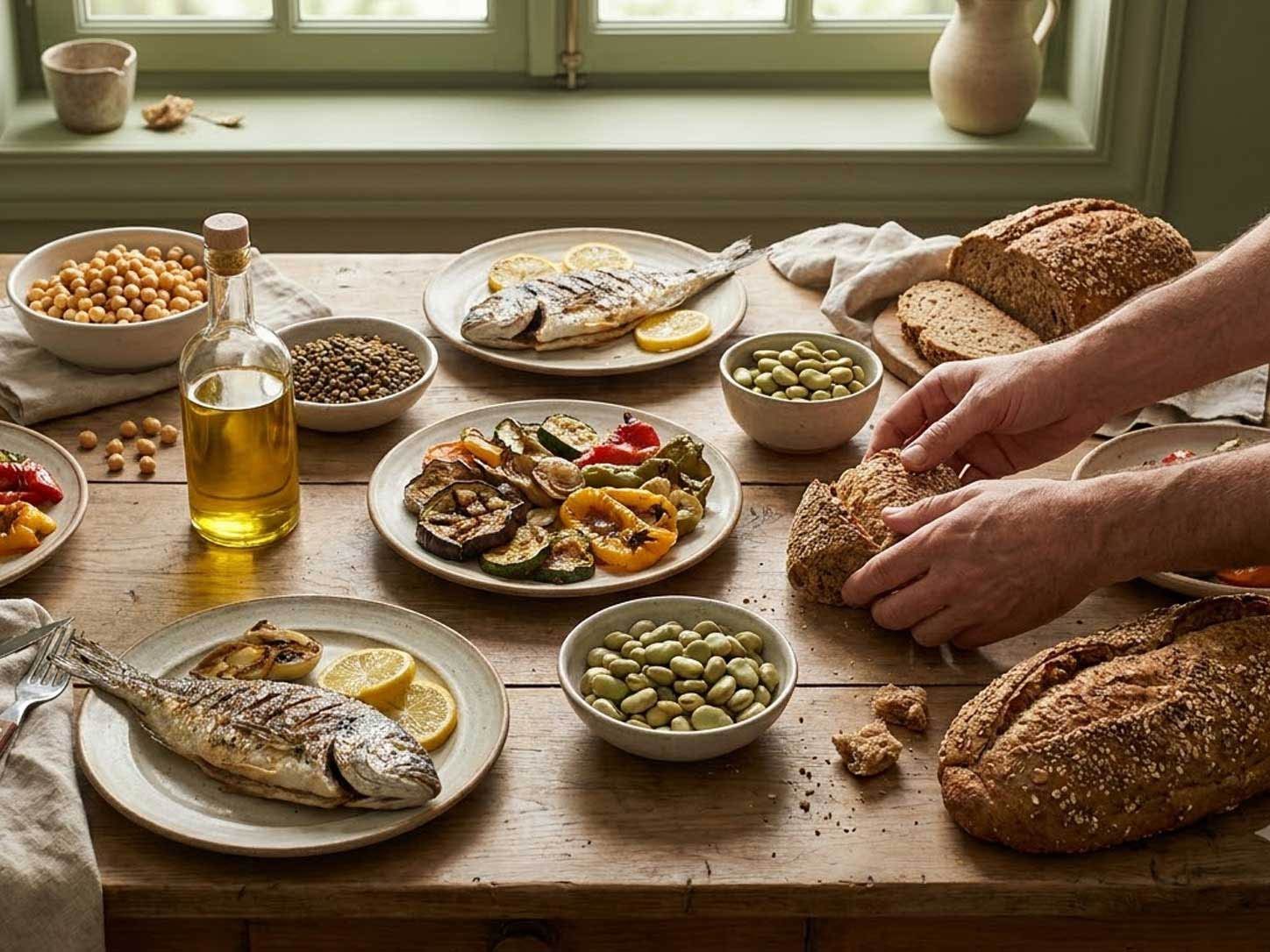
The pattern, the anchors, and the honest evidence
The pattern principle, and its actual strength: every major study of long-term eating lands on the same direction — overall patterns predict outcomes; single foods barely register. The evidence tiers matter here: Mediterranean-style eating holds the strongest card, a randomized trial (PREDIMED, NEJM) showing reduced cardiovascular events, and the DASH pattern carries randomized blood-pressure trials behind it. The broader pattern research is observational — large cohorts, consistent direction, but unable to prove causation and vulnerable to healthy-user bias (people who eat well also smoke less, move more, and see doctors). The honest read: strong directional evidence, one landmark trial, and a recommendation you can act on without pretending the certainty is higher than it is. Build a pattern around vegetables, legumes, whole grains, fish or other proteins, and olive-oil-grade fats — one you can sustain — then stop micro-optimizing. Adherence research is unambiguous: the pattern you keep beats the perfect one you quit.
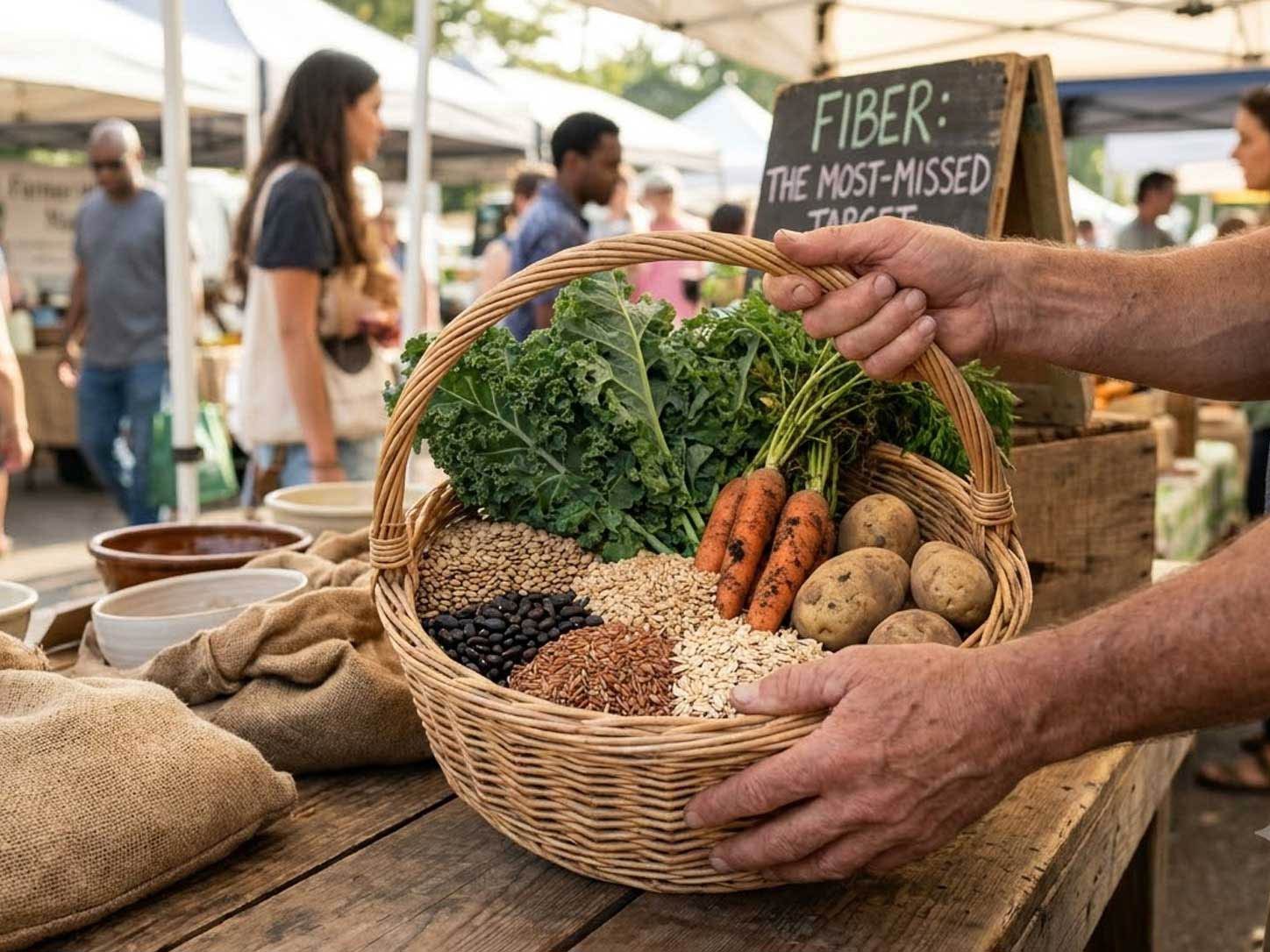
The two anchors: protein and fiber, the macros modern eating gets wrong in opposite directions. Protein is the satiety anchor — the 1.2–1.6 g/kg range for active adults reflects sports-nutrition position stands, supported by trials on muscle maintenance and appetite, and the distribution matters: spread it across meals rather than backloading at dinner, because muscle responds to per-meal triggers. Fiber is the most-missed target — national dietary survey data (NHANES-based analyses) finds fewer than 10% of adults meet the recommendation, while fiber feeds the microbiome, moderates glucose response, and predicts long-term outcomes in cohort research. The honest caveat: the long-term disease links are observational; the mechanism work (fermentation, short-chain fatty acids, glycemic moderation) is where the biology is solid. Practically: legumes, whole grains, vegetables, fruit, repeated daily — the cheapest upgrade in the modern diet.
The sensible middle: hydration needs no liter-counting — thirst is a reliable guide for most healthy people, urine color is the practical gauge, and needs genuinely vary with body size, climate, and activity. The same middle-position honesty applies to the plate: no food is poison, no food is magic, and the 80/20 reality outperforms perfectionism in every adherence study. Diet culture sells extremes; the evidence lives in the unglamorous middle, and the fundamentals' real advantage is that they're livable for decades — which is the only timescale the outcomes research measures.
Where supplements fit — the three-scenario shortlist: at the end of the line, filling specific gaps, never the vehicle. Per the NIH Office of Dietary Supplements evidence base: vitamin D if deficient (mostly a sun-supply problem, confirmed by a blood test), B12 if plant-based or over 50 (structural absence in plants; age-related absorption decline), and iron if deficient and tested — ferritin before any bottle, because overload is real disease and self-treatment based on fatigue harms in both directions. Everything else on the shelf is gap-insurance at best. Food first, testing before bottles, supplements as the last mile — and every supplement you take belongs on the list you show whoever orders your labs.
- Pattern evidence, honestly tiered: Mediterranean carries a randomized trial (PREDIMED); most pattern research is observational.
- Protein at 1.2–1.6 g/kg for active adults, distributed across meals — per sports-nutrition position stands.
- Fewer than 10% of adults meet the fiber target in national survey data — the cheapest upgrade available.
- Hydration by thirst and urine color; needs vary — arbitrary liter targets add nothing.
- The supplement shortlist, per NIH ODS: D if deficient, B12 if plant-based or 50+, iron if deficient and tested.
- Food first, testing before bottles — supplements fill gaps; they never replace the pattern.
“Build a pattern you can sustain, then stop micro-optimizing. The plate you keep beats the perfect one you quit.”
— The fundamentals principleThe factor families
The satiety anchor
Protein steadies hunger, keeps muscle, and supports recovery — the macro to build meals around.
Explore Protein →The fiber customers
Fiber feeds the microbiome — the city that runs on the part of plants you can't digest.
Explore Gut Health & Microbiome →The meal design
Intact grains, fiber and protein first, carbs never alone — the food-level glucose levers.
Explore Blood Sugar & Nutrition →The appetite system
Hunger runs on hormones the pattern can work with — protein, fiber, volume, slower meals.
Explore Appetite & Metabolism →The story, frame by frame


The fundamentals' players — evidence-graded
Every card links to a full BodyFinds journey, graded by evidence strength. Established means randomized-trial or systematic-review backing; foundational means a system-level factor.
The satiety anchor — trial-backed for muscle and appetite, with per-meal distribution evidence.
supplementThe meal-design layer — sequencing and structure effects on glucose, replicated across trials.
research-topicThe fiber destination — mechanism solid, microbiome outcomes still developing, honestly graded.
research-topicThe appetite system — the hormones the pattern works with rather than against.
research-topicThe testing ladder — what's measurable, who runs short, and why testing precedes bottles.
research-topicWhy are vitamins and minerals important?
The complete BodyFinds fundamentals journey — the spark-plug model, the food foundation, the testing ladder, and the short list of who actually runs short.
Where this information comes from
- NEJM — Primary Prevention of Cardiovascular Disease with a Mediterranean Diet (PREDIMED, Estruch et al.) journal
- Dietary Guidelines for Americans, 2020–2025 (USDA/HHS) Government
- WHO — Healthy Diet Fact Sheet Government
- NIH Office of Dietary Supplements — Dietary Supplements: What You Need to Know Government
- NHLBI — DASH Eating Plan Government
- CDC — Nutrition Basics Government
- Harvard T.H. Chan School of Public Health — The Nutrition Source Institution