Muscle & Aging
Muscle aging runs on three separate clocks: power fades first, strength next, and visible size last — which is why the scale's stability hides the decline until function slips. Beneath it: motor neurons dying at about a percent a year, fast-twitch fibers losing their wiring, and a muscle that answers protein and load more faintly. The honest counterstory: resistance training built measurable strength in ninety-year-olds. This is the mechanism page — what actually ages, what reads it, and what reverses it.

The wiring, the cascade, the proof
The decline, decomposed: three clocks run at different speeds — muscle power (speed × force) declines earliest and fastest; strength follows, measurably ahead of mass — the visible 1–2% yearly loss arrives last, meaning function erodes while the mirror still looks fine. The wiring explains it: motor neurons die at roughly one percent per year after 60, fast-twitch (type II) fibers lose their innervation first — reinnervation leaves the characteristic fiber grouping of aged muscle. And the response dulls: anabolic resistance means older muscle needs roughly double the protein per meal and genuinely heavy loading to hear the same signal (the Healthy Aging page's threshold story, told here from the muscle side).
The readout and the stakes: grip strength has emerged as one of the most powerful objective biomarkers of aging — large cohorts find it predicts all-cause mortality and future disability better than most blood panels; gait speed is similarly respected, to the point clinicians call it the sixth vital sign. The functional stakes are the frailty cascade: strength fades → balance thins → falls arrive → fractures follow → immobility compounds everything (the Bone page's fall story, driven from the muscle end). The cascade is why muscle is aging's load-bearing wall — not cosmetic.
The reversibility — the proof that reframes everything: the training trials in the very old are among the most encouraging in exercise science: frail ninety-year-olds doubling leg strength in months of progressive resistance work; muscle biopsies confirming new fiber growth at ages once written off. The prescription is specific: load heavy enough to matter — light activity is health, but aged muscle needs genuine resistance to hear the signal — with the risen protein threshold met at each meal, leucine included. Twice weekly, progressive, forever: the pattern that turns compound disuse into compound capability.
The reframe that closes the page: what's popularly called 'aging' in muscle is a blend — the wiring loss is biology, but a large share of the functional decline is compound disuse, decades of the load never arriving. Disuse responds to loading at every age tested. The screening story exists too (grip, gait, and mass make the clinical criteria), and the annual-visit conversation about grip strength is one worth requesting — an objective readout of the one system whose decline is negotiable.
- Three clocks: power fades first, then strength, then size — the mirror lies last.
- Motor neurons die ~1%/yr after 60; fast-twitch fibers fade first.
- Grip strength predicts mortality better than most blood panels.
- The frailty cascade runs strength → balance → falls → fractures → immobility.
- Frail 90-year-olds doubled leg strength in progressive-training trials.
- Aged muscle needs heavy load — light activity alone doesn't reach the threshold.
“Sarcopenia isn't destiny. It's compound disuse — and loading reverses it.”
— The muscle-aging principleThe factor families
Motor unit loss
The wiring that fades first — neurons dying yearly, fast-twitch fibers losing their connection.
The three clocks
Power before strength before size — why function slips while the mirror holds.
Grip as biomarker
The objective readout — mortality-grade prediction from a handshake's machinery.
The reversibility
Gains at every age tested — the compound-disuse reframe with trials behind it.
The story, frame by frame


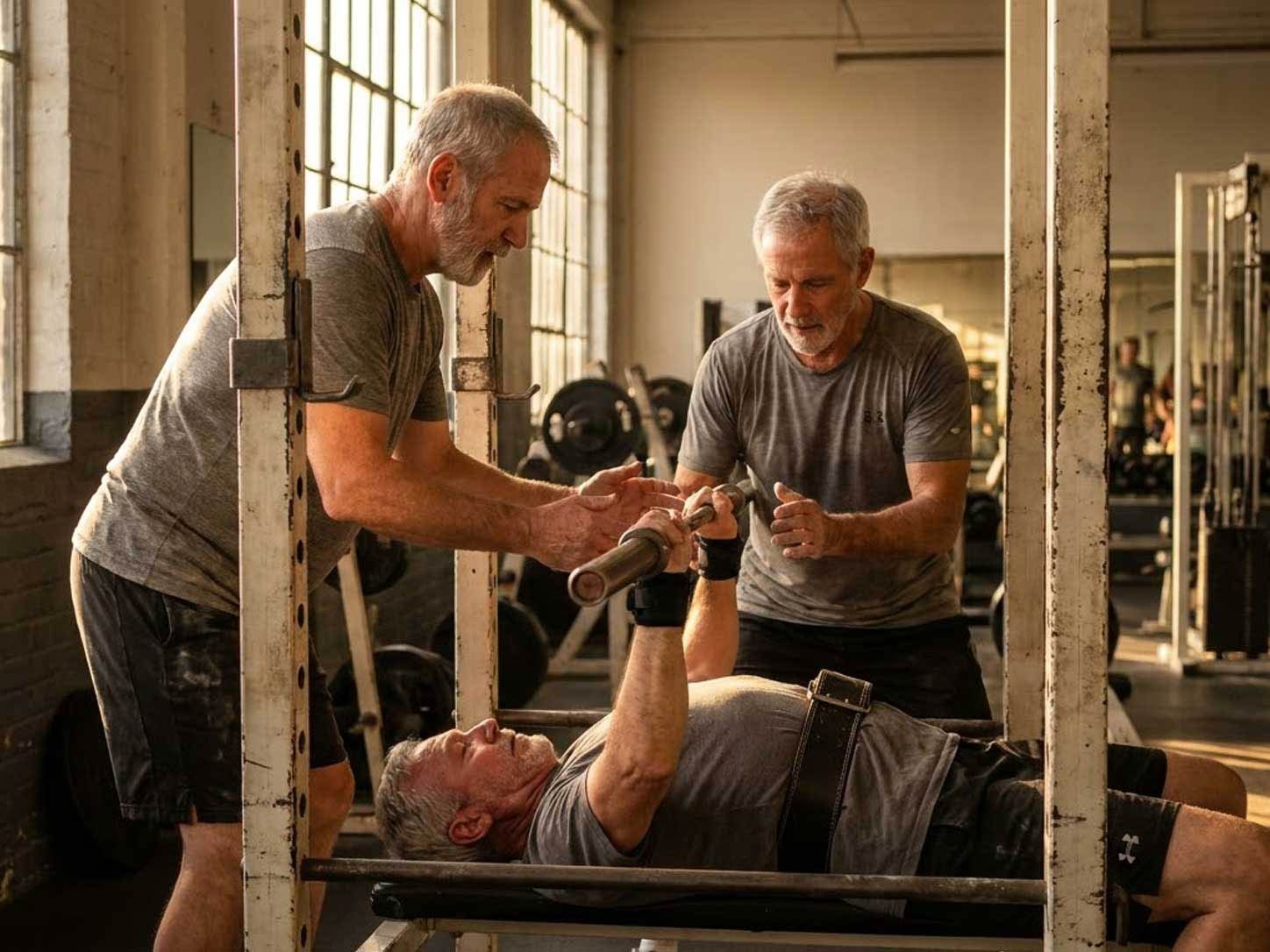
The aging-muscle players — and the routes
Every card links to a full BodyFinds journey. The muscle-aging story routes to the training, protein, and aging-systems pages.
The training page — the build-repair cycle, the loading story, the recovery system.
research-topicThe decade playbook — the rising protein thresholds and the master-lever framing.
research-topicThe outcomes view — grip strength and muscle as lifespan's compounding currency.
research-topicThe material at the risen threshold — the anabolic-resistance answer in full.
supplementThe loading pair — muscle pulls, bone answers: the fracture cascade's other end.
research-topicThe moving pair — muscle as the aging joint's shock absorber.
research-topicHow does the muscle answer the load?
The Muscle & Recovery page — the build-repair cycle, the pillars, the recovery system that makes loading work.
Where this information comes from
- NIA — Exercise and Physical Activity Government
- MedlinePlus — Muscle Weakness Government
- CDC — Older Adult Falls Government
- WHO — Ageing and Health Government
- PubMed — Sarcopenia Progression (FAST trial) Database