Desk Posture: Why 'Sitting Straight' Is the Wrong Advice

The classic advice — shoulders back, spine straight, sit up tall — turns out to be less important than anyone thought. Research on back and neck pain consistently finds that how long you hold any single position matters far more than which position you choose. Your body's tissues tolerate variety far better than even perfect stillness.
The best posture is the next posture. Your body doesn't need you to sit perfectly — it needs you to move often. Tissues get their nutrition through movement, not through holding an idealized position. The 'perfect posture' industry sells chairs and advice; the evidence sells movement breaks and strength.
What the research actually found
A growing body of research has examined the relationship between sitting posture and pain. The results challenge conventional wisdom. Systematic reviews that compared 'good' postures with 'bad' postures found weak or no correlation between how people sit and whether they develop back or neck pain. Slouchers didn't have more pain than upright sitters. People with 'perfect' ergonomic setups still developed pain.
What did correlate strongly with pain? How long people held any single position — regardless of whether that position was 'good' or 'bad.' Workers who changed positions frequently had less pain than those who maintained any posture (including an idealized one) for extended periods.
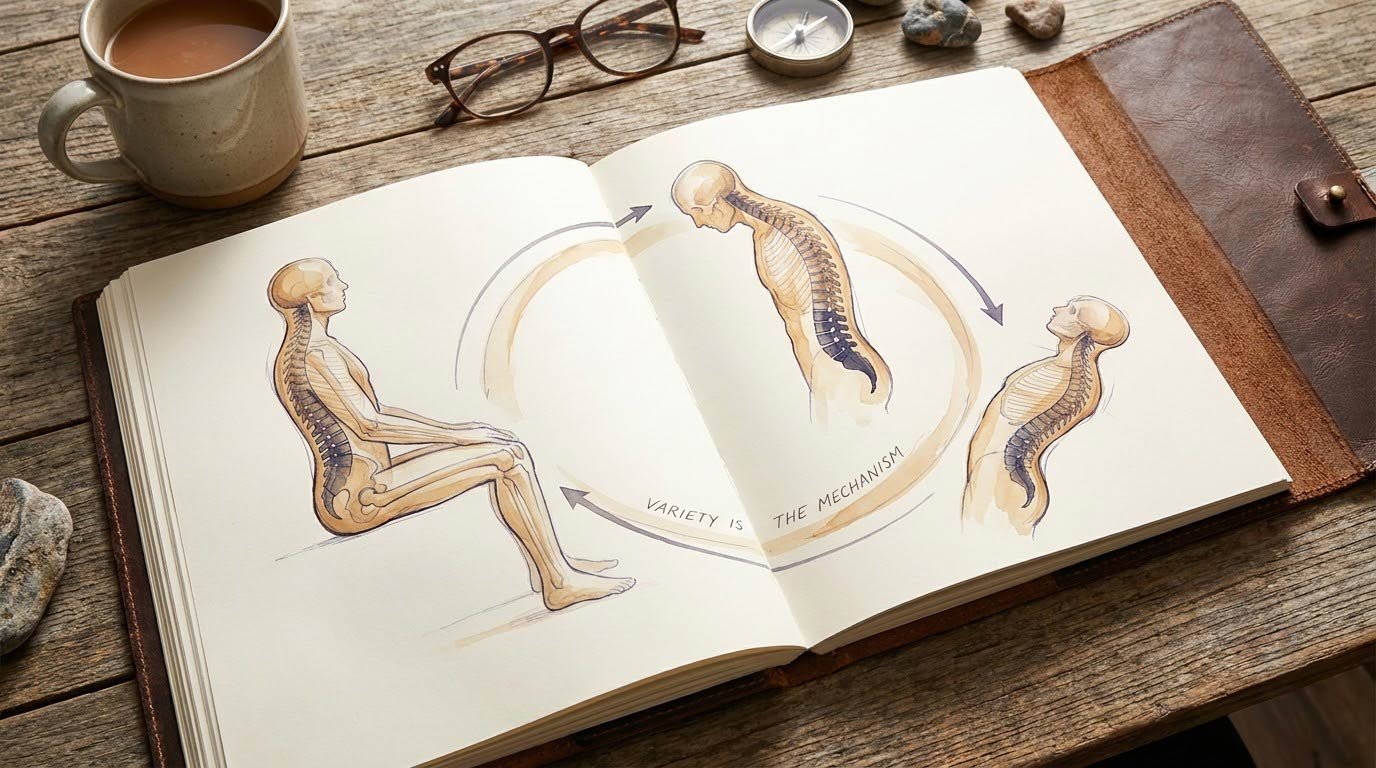
The best posture is the next posture. Your spine craves variety, not perfection.— The evidence-based summary
Why stillness hurts — the tissue physiology
The reason variety beats alignment comes down to how your tissues stay healthy. Intervertebral discs (the cushions between your vertebrae) have no direct blood supply — they get their nutrition through movement. Each time you shift position, compressive forces change, fluid moves through the disc, and waste products flush out. When you hold one position for hours, that exchange stops.
Muscles tell a similar story. Static loading — holding one position — reduces blood flow, causes metabolic waste to accumulate, and leads to the deep, achy discomfort you feel after a long session. This isn't damage — it's your body telling you it needs a position change. The signal is real, even if the 'perfect posture' framework for responding to it is wrong.
What actually works: the evidence hierarchy
From strongest to weakest evidence, here's what the research supports for preventing and reducing desk-related discomfort:
- Strength training (strongest evidence). Resistance training builds the muscular endurance that makes any position more sustainable. Strong back, core, and hip muscles support your spine in whatever position you choose. This is the single strongest evidence-based posture intervention — not stretching, not chairs.
- Position changes every 20–30 minutes (strong evidence). Set a timer. Stand up, sit differently, walk to get water. The act of changing position — not the destination position — is what matters. Even 30 seconds of movement counts.
- Movement breaks of 2–3 minutes per hour (strong evidence). Brief walks, stretching, or simply standing and moving. Studies show this reduces discomfort and improves productivity without disrupting workflow.
- Screen at eye height (moderate evidence). Monitor positioning matters more than chair or posture — craning your neck downward for hours creates real cervical loading. The top of your screen should be at or slightly below eye level.
- Ergonomic equipment (moderate evidence). A good chair and desk setup helps — but the evidence shows it's complementary, not primary. An expensive chair won't fix a body that never moves.
- Sitting 'perfectly' upright (weak evidence). The traditional advice — the one everyone repeats — has surprisingly little trial support. Don't stress about it.
The practical desk protocol
Here's what the evidence actually supports — a protocol that takes almost no effort and addresses the real problem:
- Set a 20-minute timer. When it fires, change something: stand, sit differently, shift your weight, lean back, lean forward. Any change counts. The destination doesn't matter — the transition does.
- Take one 2–3 minute movement break per hour. Walk to the kitchen, do 10 bodyweight squats, stretch your hip flexors. Set a second timer if needed. This is the single highest-leverage habit.
- Position your screen correctly. Top of the monitor at eye level, about an arm's length away. If you work on a laptop, consider a stand and external keyboard — the built-in design forces a neck compromise.
- Do resistance training 2× weekly. This is the strongest posture intervention in the evidence base. Focus on back (rows, pull-downs), core (planks, dead bugs), and hips (squats, lunges). Strong muscles make every position easier to hold.
- Stand or walk during calls. Phone calls and virtual meetings are the easiest time to add movement without disrupting work. Pace, stand, stretch.
- Stop stressing about sitting straight. The research doesn't support it as a primary factor. You'll get more benefit from one hourly walk than from hours of rigid self-correction.
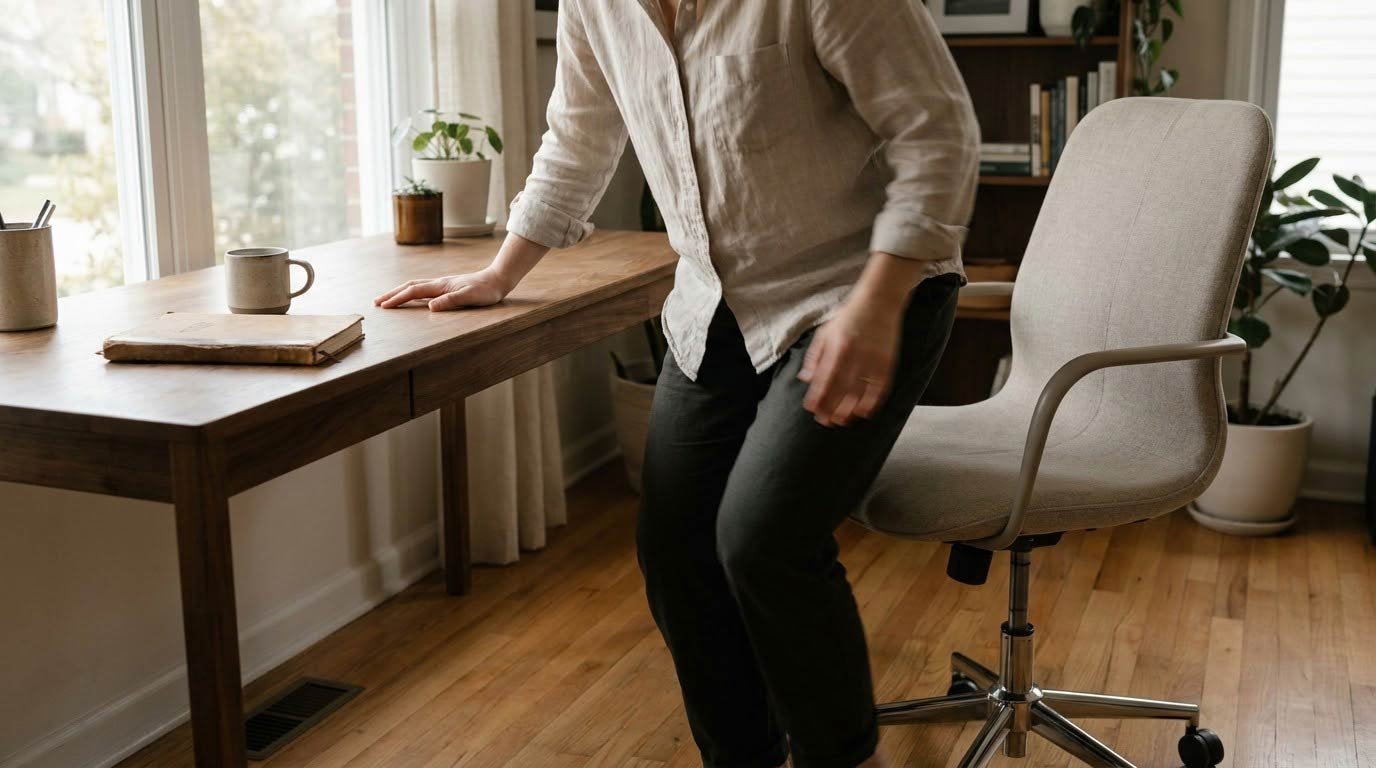
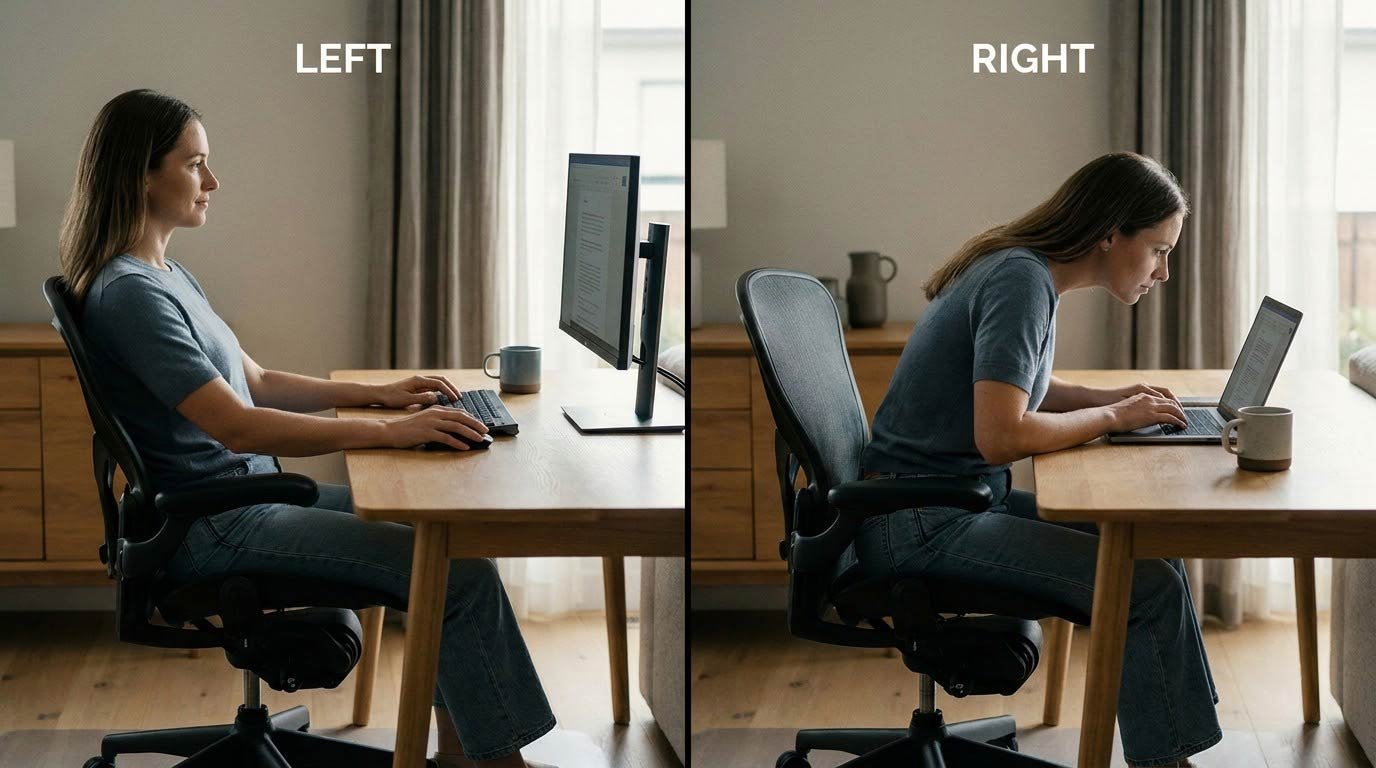
If you do only one thing: set a timer to stand up and move for 2 minutes every hour. That single habit addresses the root cause — sustained static loading — better than any ergonomic equipment or postural discipline.
The standing desk caveat
Standing desks solved one problem and created another. Standing all day is still static loading — just in a different position. Research on standing desks shows initial enthusiasm that often fades when users develop foot, knee, and lower-back discomfort from prolonged standing. The evidence supports sit-stand variability, not standing as the new ideal.
If you have a standing desk, the best protocol is alternating: 30 minutes sitting, 30 minutes standing, with movement breaks in both. The problem was never sitting — it was stillness.
When discomfort is something more
Most desk-related discomfort is benign — positional, muscle-related, and relieved by movement. But some symptoms deserve professional evaluation:
- Pain that radiates down an arm or leg — suggests nerve involvement, not just muscle fatigue. That's a clinician's assessment.
- Numbness or tingling in the hands or feet — especially if it persists after changing position. Could indicate nerve compression.
- Pain that wakes you from sleep — inflammatory pain doesn't follow the mechanical pattern of positional discomfort.
- Weakness in the hands or legs — dropping objects, difficulty with grip, or a feeling that a limb 'doesn't cooperate' warrants prompt evaluation.
- Pain with fever, unexplained weight loss, or night sweats — systemic symptoms that accompany musculoskeletal pain require medical attention.
Movement helps positional discomfort. It does not fix nerve compression, disc herniation, or inflammatory conditions. If pain is sharp, radiating, persistent despite movement changes, or accompanied by neurological symptoms — that's a clinician's job, not a posture protocol.
The bottom line
The 'sit up straight' advice that dominated posture discourse for decades doesn't survive contact with the evidence. What works is simpler and harder: move more often, build strength, and stop worrying about alignment. Your spine is designed for variety — give it some.

This week: set a 20-minute position-change timer. Take one 2-minute walk per hour. Check that your screen is at eye height. And schedule two strength sessions — the single strongest posture intervention the research supports.
When this article is not enough
If you have persistent pain, radiating symptoms, neurological changes (numbness, tingling, weakness), or pain with systemic symptoms, seek professional evaluation. A physical therapist can assess your specific movement patterns and design a targeted program. A physician can rule out structural causes. Don't self-treat with internet advice when a proper evaluation is available.
Magnesium: The Muscle Relaxation Mineral
The cofactor behind muscle relaxation and cramp prevention — the full evidence journey: which forms absorb best, the sleep connection, and honest grades for muscle tension and stress.
Explore the magnesium journey →Where this information comes from
- weak correlation between static posture and pain
- posture variability as a stronger predictor than posture quality
- systematic review findings on posture-pain relationship
- workplace ergonomic recommendations
- neutral position guidance
- screen height and monitor positioning
- exercise as the strongest intervention for preventing recurrent back pain
- comparison of exercise vs ergonomic modifications
- strength training evidence for desk workers
- strength training as the strongest posture intervention
- specific exercise programs and postural outcomes
- comparison with stretching-only approaches
Our evidence principles
How we evaluated the claims on this page
- Prefer government health agencies, major medical organizations, clinical guidelines, systematic reviews, and well-designed human studies.
- Distinguish established evidence from common belief and conventional wisdom.
- Avoid presenting a single posture, chair, or exercise as a universal solution for all desk-related pain.
- Use numbers only when the population, context, and evidence are clear.
- Encourage clinician involvement when pain is persistent, severe, radiating, or accompanied by neurological symptoms.
Educational information — not medical advice
This article is for educational purposes and does not diagnose, treat, or prevent any medical condition. Persistent pain, radiating symptoms, neurological changes (numbness, tingling, weakness), or pain with systemic symptoms warrant professional medical evaluation. If you have a diagnosed musculoskeletal condition, work with your healthcare provider on an appropriate treatment plan. BodyFinds should display its medical disclaimer and source methodology alongside this article.