What is Osteoarthritis?
A whole-joint disease where cartilage breaks down — and the body remodels around the loss.
Osteoarthritis is the most common form of arthritis — a disease of the entire joint in which protective cartilage gradually thins and erodes, the bone beneath stiffens and grows spurs, and the synovial lining adds low-grade inflammation. It affects over 500 million people worldwide, has more than doubled in prevalence since 1990 as populations age, and remains the leading cause of chronic pain and disability in older adults. The old name was 'wear and tear' — the modern understanding is more interesting: OA is an active, whole-joint disease with a metabolic and inflammatory dimension, and its most effective treatments are the ones the old framing would have forbidden: movement, loading, and strength.
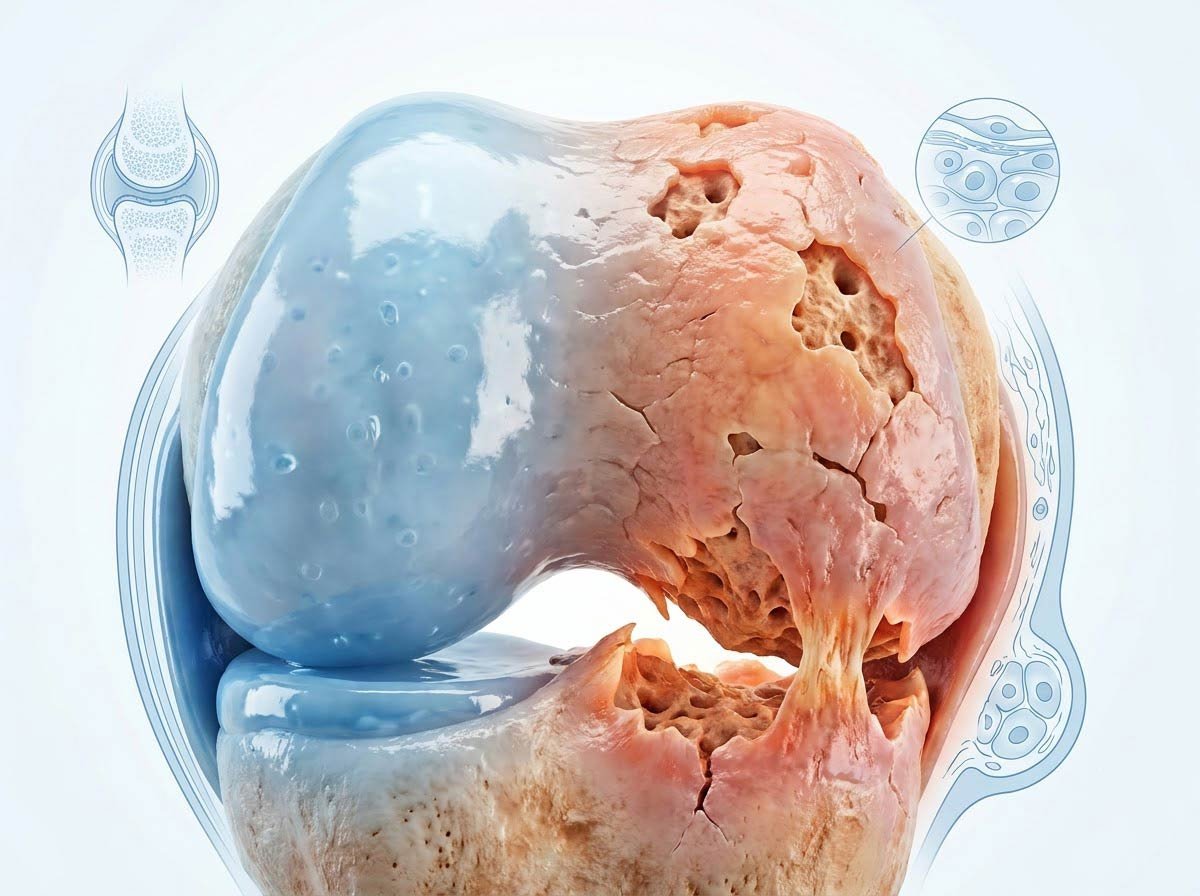
How Osteoarthritis Connects
Understanding the Osteoarthritis Spectrum
The single most important correction this page can make: osteoarthritis is not passive mechanical grinding — the 'wearing out like a brake pad' model was retired by research. OA is a whole-joint, biologically active disease. Cartilage cells (chondrocytes) release inflammatory enzymes; the synovial lining contributes low-grade inflammation; the bone beneath remodels and stiffens; and the nervous system amplifies or dampens the pain signal. The proof that it isn't purely mechanical: obesity raises the risk of OA in hand joints that carry no body weight — fat tissue's inflammatory signals reach cartilage everywhere, not just the load-bearing knees.
The disease runs a decades-long course. Cartilage thins and fissures, joint space narrows, the body grows bony spurs (osteophytes) at the joint edges in an attempt to stabilize, and pain shifts from after-activity to with-activity to at-rest. But severity on imaging and severity of pain are only loosely related — some X-ray-terrible knees hurt little, some mild X-rays hurt enormously — which is why treatment targets function and pain, not pictures.
- Primary OA (most common): the gradual, age-and-load driven form — knees, hips, hands, spine — shaped by genetics, weight, injury history, and muscle strength.
- Post-traumatic OA: the accelerated form after joint injury — an ACL tear at 20 can seed knee OA by 40. The clock starts at injury.
- Early-stage: intermittent pain after activity, minimal stiffness — the window where exercise and weight management work best.
- Moderate-stage: pain with daily activity, crepitus, some function loss — the full treatment ladder comes into play.
- End-stage: rest and night pain, marked limitation — where injection therapy and joint replacement enter the conversation.
The Hand Clue That Retired the 'Wear and Tear' Model
For a century, OA was taught as simple mechanics: joints wear out like tires. The model had one fatal problem — obesity predicts osteoarthritis of the hands. Hands don't bear body weight. No tire model explains that.
The resolution: visceral fat is an endocrine organ, pumping out inflammatory cytokines that circulate to every joint's cartilage and synovium. Obesity roughly doubles OA risk in weight-bearing joints — but it also elevates risk in the non-load-bearing ones. OA is a mechanical disease plus a metabolic one, which is why weight management treats it through two channels at once: less load on the knee, fewer inflammatory signals in the blood.
Persistent joint pain deserves an evaluation — because osteoarthritis is a diagnosis of the whole picture: symptom pattern (pain worse with use, morning stiffness under 30 minutes), examination, and imaging where indicated. A hot, swollen joint; pain that's worst in the morning beyond an hour; symmetric small-joint swelling — these are inflammatory patterns that point elsewhere and change everything about treatment. Get the diagnosis before you adopt the disease.
Healthy joint cartilage is slipperier than ice gliding on ice — a friction coefficient as low as 0.001. And it manages this with no blood supply, feeding itself entirely from joint fluid pumped in by movement. Motion is not the enemy. Motion is the delivery system.
- Every pound of body weight adds roughly four pounds of load to the knee per step — climbing stairs, more.
- Exercise therapy reduces knee OA pain by amounts comparable to NSAIDs — with benefits instead of GI risks.
- Cartilage has no nerves — OA pain comes from bone, synovium, and capsule, not the cartilage itself.
- X-ray severity and pain severity correlate only loosely — treatment follows function, not pictures.