Senolytics & Zombie Cells
Some damaged cells choose a third path between dividing and dying: they shut down replication permanently but refuse to leave — and they broadcast inflammatory signals that corrupt their neighbors. These are senescent cells, popularly 'zombie cells,' and they accumulate with age. When researchers cleared them from genetically engineered mice in a landmark 2016 Nature study, median lifespan extended by roughly 25% — one of the most striking findings in aging biology. The honest part of the story: that's mice. Human research is real, early, small, and biomarker-focused, and no senolytic therapy exists for people. This page covers the biology, the landmark, and the gap — all stated at their actual strength.

The biology, the landmark, and the honest gap
The biology — and why the 'zombie' nickname is half-right: when a cell accumulates enough damage — DNA breaks, telomere shortening, oxidative stress — it faces a choice. Division would risk passing on the damage, potentially toward cancer. So healthy systems force a third path: irreversible cell-cycle arrest. The cell stops dividing but resists the programmed death (apoptosis) that would normally recycle it. That's senescence — and it's a protective mechanism, not a design flaw: it's tumor suppression doing its job, and senescent cells also assist wound healing and tissue remodeling. The problem is what happens next: these cells release the SASP — a cocktail of inflammatory cytokines, proteases, and growth factors that damages neighboring tissue, promotes chronic inflammation, and pushes nearby cells toward senescence themselves. Young immune systems clear senescent cells efficiently; aging immune surveillance slows, the cells accumulate, and the inflammatory load compounds. One zombie is contained. A crowd is a problem.
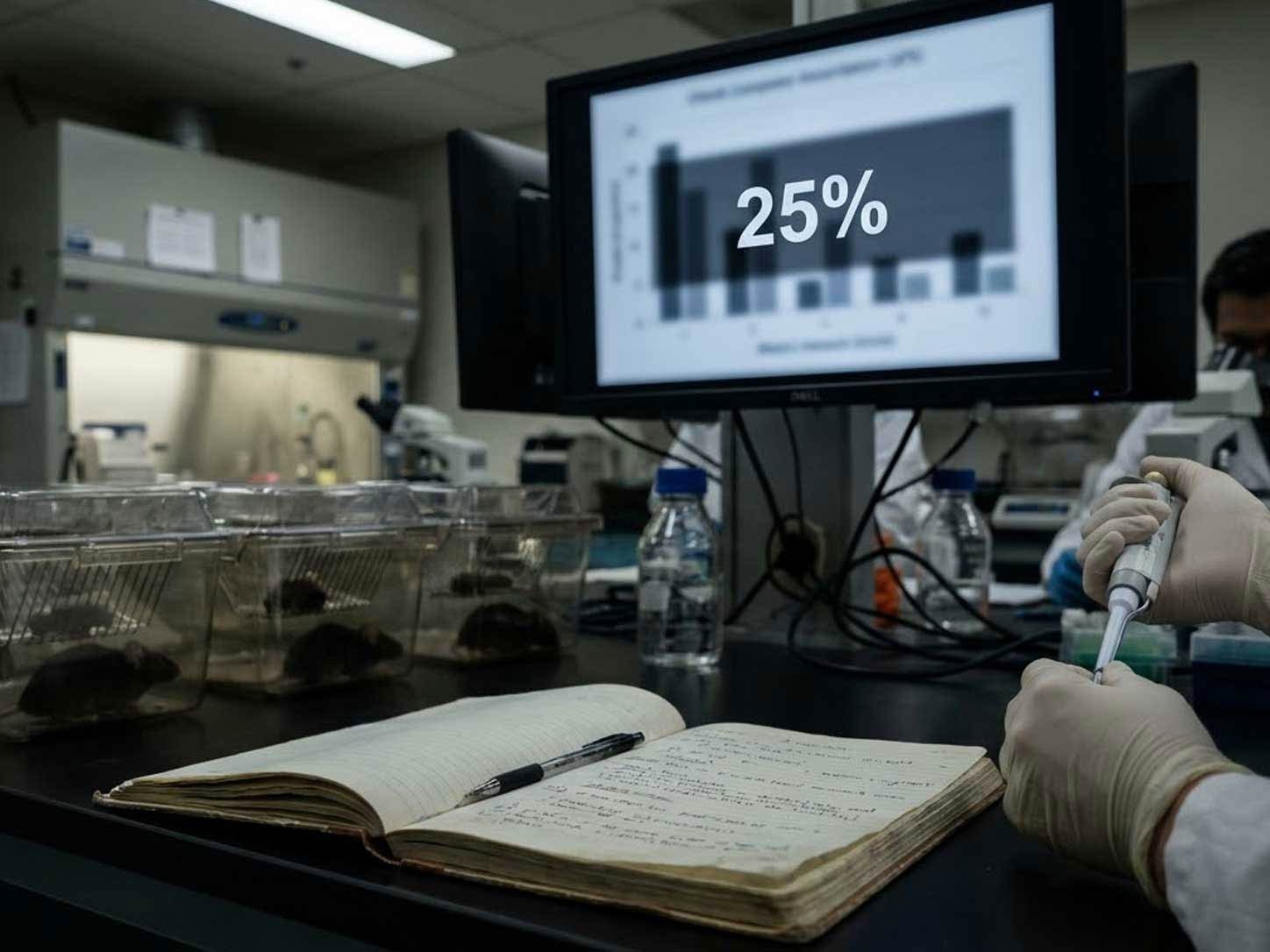
The landmark — mice, and what they showed: in 2016, a Mayo Clinic-led team (Baker et al., published in Nature) used genetically engineered mice whose senescent cells could be selectively eliminated on demand — and clearing them extended median lifespan by roughly 25%, alongside improvements in heart and kidney function and physical performance. Follow-up work (Xu et al., Nature Medicine, 2018) tested a pharmaceutical approach: the dasatinib-plus-quercetin combination, given intermittently — brief dosing windows, then weeks off, because senescent cells are slow to re-accumulate. Intermittent clearing improved physical function in aged mice. These are genuinely important results, and they launched the field. They are also, entirely, preclinical — engineered mice, controlled conditions, and mechanisms that do not automatically transfer to humans.
The human story, at its actual size: early-phase trials exist and are honest about being small — dozens of participants, conditions like idiopathic pulmonary fibrosis and diabetic kidney disease, endpoints dominated by biomarkers and walking speed rather than disease events. The signals are interesting enough to continue; the field's own researchers describe the clinical evidence as preliminary. Fisetin, another plant compound, has been prioritized for testing by the translational geroscience network. And the field's flagship public trial, TAME, targets aging with metformin — related geroscience, not a senolytic. The state of play, plainly: strong mouse biology, small suggestive human studies, no approved therapy, and long-term human safety entirely uncharacterized.
The shelf, and what's actually actionable: quercetin and fisetin are sold as supplements — sometimes explicitly branded 'senolytic' — and the honest distance between the shelf and the science is wide: research protocols used specific compounds, doses, and intermittent schedules, with bioavailability handled deliberately, and none of that transfers to a daily capsule with a marketing label. Dasatinib is a chemotherapy drug with serious known toxicities — the D+Q combination belongs to research settings and clinician-supervised trials, never to self-sourcing. What the evidence currently supports for people: the boring frontier. Physical activity influences senescence markers in human research, the lifestyle pillars remain the only proven healthspan levers, and the genuinely exciting option for most readers is participating in legitimate research — the trials need people more than people need unproven bottles.
- Senescent cells stop dividing but resist dying — and their SASP secretions inflame and corrupt neighbors.
- Senescence is partly tumor suppression working: the trade-off, not simply a defect.
- The 2016 Nature mouse study: clearing senescent cells extended median lifespan ~25% — preclinical, striking, foundational.
- Human trials exist and are small, early-phase, and biomarker-focused — the field's own characterization.
- No senolytic therapy is approved for aging; TAME tests metformin, which is not a senolytic.
- Shelf 'senolytic' products don't replicate research protocols — and dasatinib is a chemotherapy drug, never DIY.
“The mice got 25% more life. The people, so far, got interesting biomarkers and a waiting room — the gap between those two sentences is the whole field.”
— The translational realityThe factor families
The sibling frontier
NAD+ research is the other major cellular-aging program — different mechanism, same honest mouse-to-human gap.
Explore NAD+ & Cellular Aging →The muscle application
Where mouse function improvements showed — and where human translation remains pending.
Explore Muscle & Aging →The joint trials
Osteoarthritis is among the clinical areas where senolytic research is closest to patients — senescent cells accumulate in joints.
Explore Osteoarthritis →The cleanup crew
Immune surveillance normally clears senescent cells — its age-related decline is half the accumulation story.
Explore Immune Health →The story, frame by frame


The zombie-cell story's players — evidence-graded
Every card links to a full BodyFinds journey, graded by evidence strength. On this topic, the grades matter more than usual: mouse-strong is not human-strong, and the map says so.
The healthspan frame the whole field serves — living well longer, not just longer.
research-topicThe sibling program — NAD+ and cellular energy, graded with the same mouse-to-human honesty.
research-topicThe function endpoint — mouse improvements were real; human translation is pending.
research-topicThe clinical-adjacent area — senescent cells in joints, among the nearest-to-patient research.
conditionThe clearance system — immune surveillance is what fails first in the accumulation story.
research-topicThe proven contrast — lifestyle levers with human evidence, while the pill waits for its trials.
research-topicWhy is healthy aging more than just living longer?
The complete BodyFinds healthspan journey — the lifespan-healthspan gap, the metrics that predict independence, and the pillars that compress decline.
Where this information comes from
- Nature — Naturally occurring p16Ink4a-positive cells shorten healthy lifespan (Baker et al., 2016) journal
- Nature Medicine — Senolytics improve physical function and increase lifespan in old age (Xu et al., 2018) journal
- Mayo Clinic — Robert and Arlene Kogod Center on Aging Institution
- National Institute on Aging — Geroscience and Aging Biology Research Government
- PubMed — Senolytics: peer-reviewed literature Database