What is Acid Reflux (GERD)?
A chronic condition where stomach acid escapes upward into the unprotected esophagus.
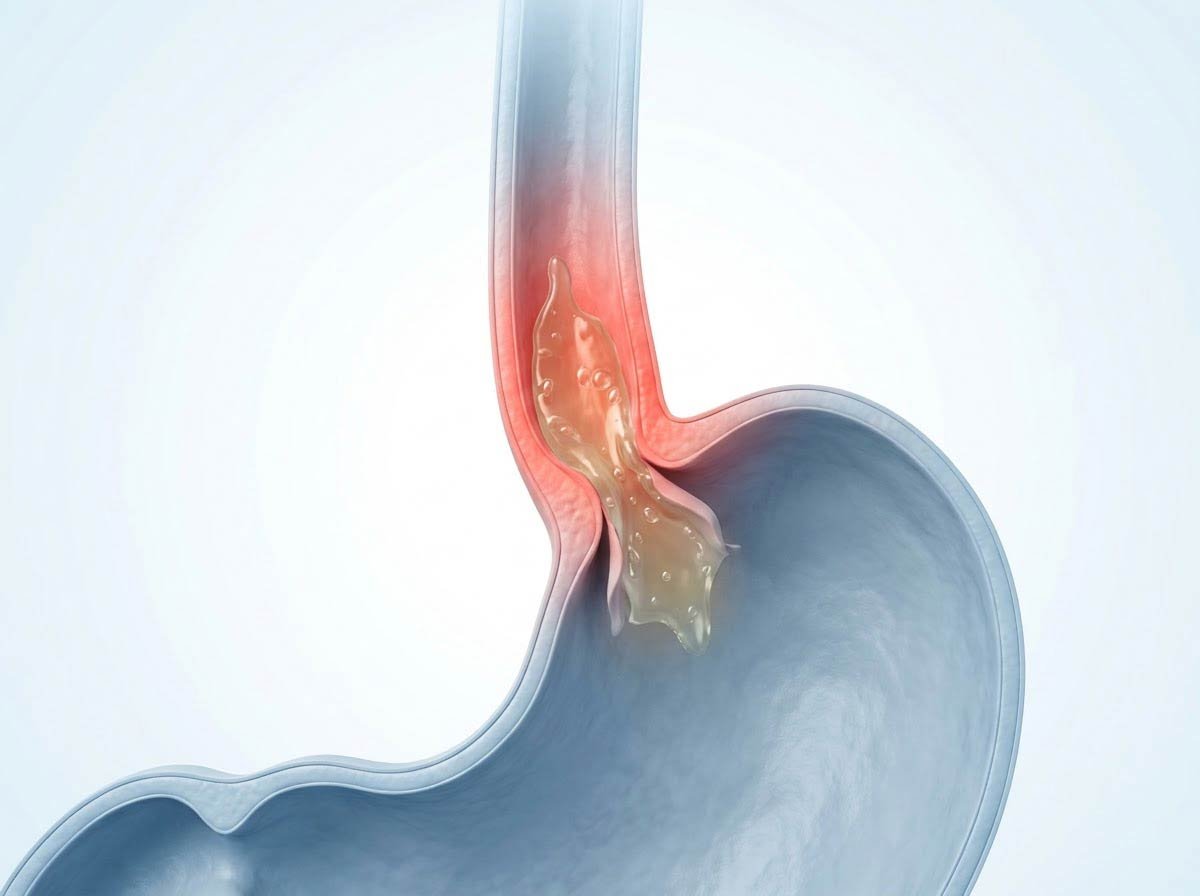
Acid reflux is what happens when the one-way valve at the bottom of your esophagus — the lower esophageal sphincter — fails to stay closed. The stomach's contents, including hydrochloric acid at pH ~1.5, wash upward into a tube that was never built to meet them. Occasional reflux is nearly universal; GERD (gastroesophageal reflux disease) is the chronic form — heartburn twice a week or more, affecting roughly 20% of US adults, one of the most common digestive complaints on earth. The modern message: GERD is highly manageable — with the strongest lifestyle evidence of any digestive condition, effective medication when indicated — and it has a short list of alarm symptoms that always warrant a doctor's visit.
How Acid Reflux Connects
Understanding the Barrier & Why It Fails
The anti-reflux barrier is a three-part seal: the lower esophageal sphincter (LES) — a ring of muscle at the valve; the crural diaphragm — the muscular pinchcock the esophagus passes through; and the angle of His — the sharp fold where the esophagus enters the stomach, acting as a one-way flap. GERD is barrier failure, and it usually fails in a specific way: not a permanently open valve, but transient LES relaxations — brief, inappropriate openings that account for the majority of reflux episodes, most often after meals.
Two compounding factors complete the picture. A hiatal hernia — part of the stomach sliding above the diaphragm — dismantles the diaphragm's contribution to the seal and is common in severe GERD. And clearance matters as much as the leak: healthy esophagus clears each acid splash within minutes by peristalsis and bicarbonate-rich saliva. Nighttime reflux is the worst of both worlds — lying down removes gravity, swallowing (and saliva) nearly stops, and acid sits against the lining for hours. That nocturnal dwell time is what drives the serious complications.
- Occasional reflux: nearly everyone; antacid-level management, no disease.
- GERD: heartburn and/or regurgitation twice weekly or more, or complications — the clinical threshold.
- Erosive esophagitis: reflux visible as breaks in the esophageal lining — heals well on acid suppression.
- Barrett's esophagus: the lining, injured for years, remodels into stomach-type cells — a precancerous change warranting surveillance.
- Extraesophageal GERD: chronic cough, laryngitis, and asthma symptoms driven by nighttime reflux — the atypical face of the disease.
The PPI Era: How the World's Best-Selling Drug Taught Us About Overuse
When omeprazole launched in 1989, it reset gastroenterology: by blocking the stomach acid pump itself — not just the histamine signal, as older H2 blockers did — it healed erosive esophagitis in over 80% of patients, a class of drug powerful enough that Losec/Prilosec became the best-selling pharmaceutical in the world by the 1990s.
The sequel is the instructive part. Success bred indications creep — PPIs prescribed for vague symptoms, started and never stopped, continued for years without re-evaluation — and a de-prescribing movement formed inside gastroenterology itself, complete with taper protocols. The lesson this page carries: PPIs are excellent medicine when indicated, and overused when not. The correct question is never 'are PPIs bad?' — it is 'is there an indication, and what's the lowest effective dose?'
Most heartburn is routine. Five symptoms are never routine: difficulty swallowing (food sticking), unintended weight loss, vomiting blood or coffee-ground material, black tarry stools, and new reflux onset after age 50 — each one moves the conversation from antacids to endoscopy. And the rule that overrides everything else: chest pain is cardiac until a physician says otherwise, because reflux and heart attacks can feel identical. If you use over-the-counter acid medications more than twice weekly for more than a few weeks, that is the appointment to make.
Your stomach lining is armored against hydrochloric acid strong enough to etch metal. Your esophagus has no armor at all — one cell thick and designed never to meet the acid it hangs above. Reflux disease is what happens when that design contract is broken.
- Most reflux episodes come from brief, inappropriate valve relaxations — not a permanently broken valve.
- Nighttime reflux is the dangerous kind: no gravity, almost no saliva, acid sitting for hours.
- Reflux and asthma are linked in both directions — acid triggers airways, and asthma medications can relax the valve.
- Stopping a PPI abruptly causes rebound acid hypersecretion — tapering is part of the prescription.