Inside the anti-reflux barrier.
Where does reflux actually happen in the body?
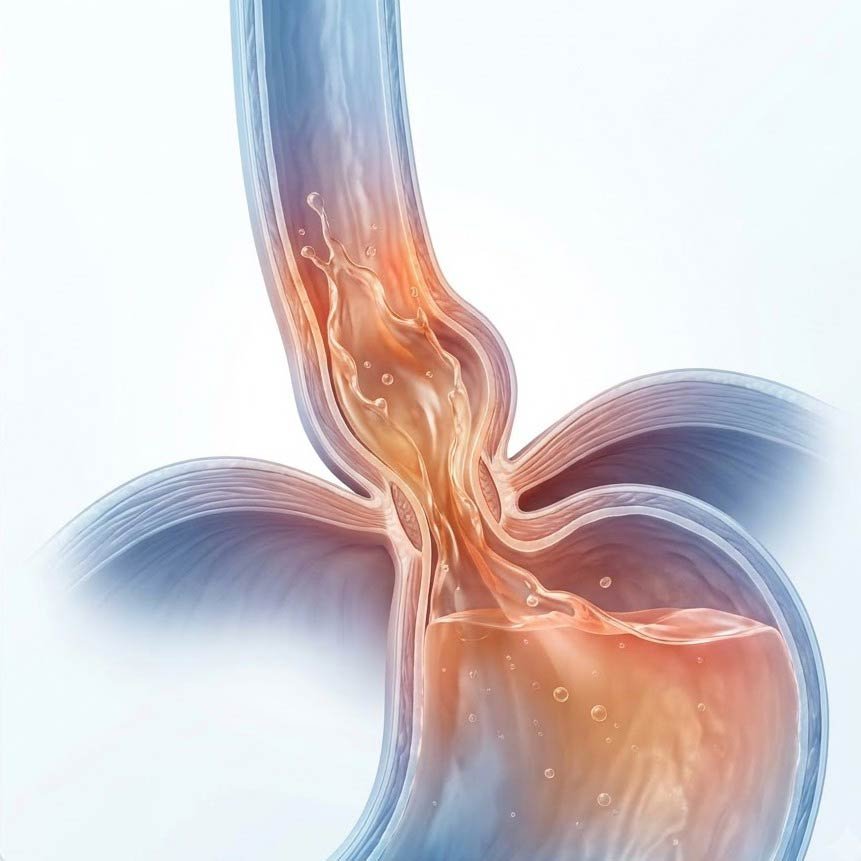
Reflux happens at a precise anatomical address: the gastroesophageal junction — where the esophagus passes through the diaphragm, meets a muscular valve, and enters the stomach at a sharp angle. The engineering is a three-part seal, each component reinforcing the others, and GERD is the failure of that engineering — a valve that relaxes when it shouldn't, a pinchcock pushed open by a hernia, and a flap that loses its angle. Understanding the three components explains every treatment on this page, from surgery to sleeping position.
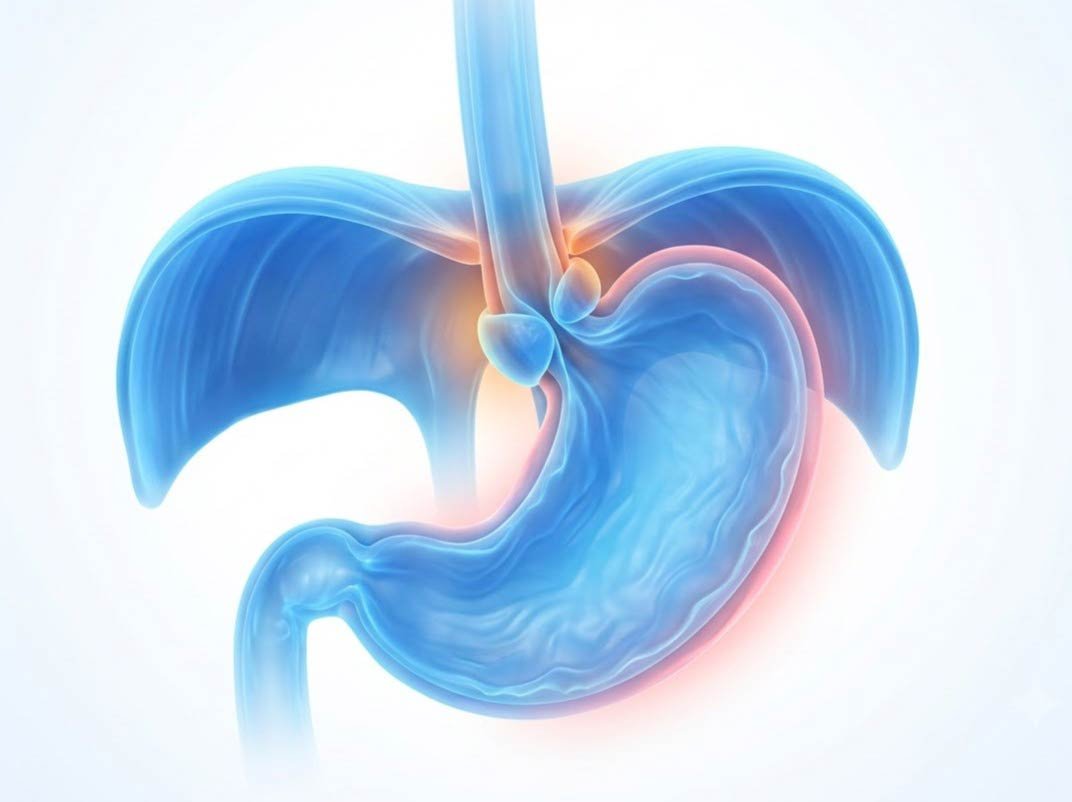
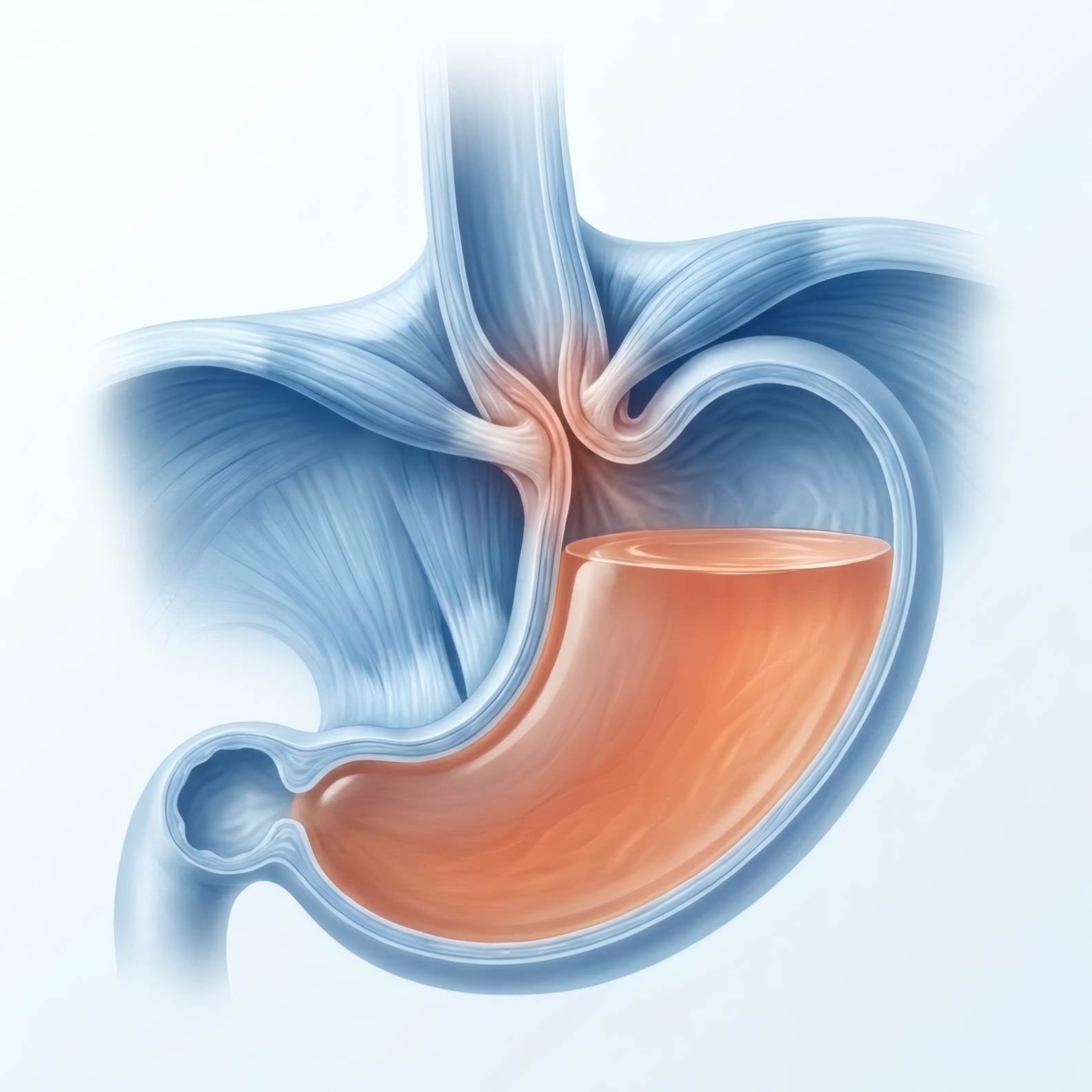
A ring of sphincter muscle (the LES) holding 10–30 mmHg of resting pressure; the diaphragm's crural fibers clamping the junction from outside; and the angle of His — the acute fold where esophagus meets stomach — forming a one-way flap that closes tighter as the stomach fills.
The Anatomy of the Seal
The LES is the primary valve: a specialized ring of smooth muscle that maintains resting pressure around the clock and relaxes only for the two seconds it takes to swallow food or liquid. In GERD, it relaxes at the wrong times — transient LES relaxations triggered by stomach distension after meals, the mechanism behind the majority of reflux episodes. The crural diaphragm is the backup: the same muscle you breathe with clamps the junction from outside, which is why deep inspiration raises barrier pressure — and why a hernia, sliding the junction above the diaphragm, removes that backup entirely.
Below the valve, the angle of His completes the design: because the esophagus enters the stomach at an acute angle, a full stomach presses the fold closed — the fuller the stomach, the tighter the flap. This is one reason large meals cause reflux mechanically, independent of any food chemistry. And above it all, the clearance system: peristaltic waves strip acid back down with each swallow, and saliva — rich in bicarbonate — neutralizes what remains. Nighttime is when every defense simultaneously weakens: the valve relaxes, gravity is gone, and saliva production nearly stops.
Lower Esophageal Sphincter
The primary valve — relaxes only to swallow
Crural Diaphragm
The external pinchcock — backup pressure on every breath
Angle of His
The one-way flap — a full stomach seals it tighter
Esophageal Clearance
Peristalsis and bicarbonate saliva — the cleanup crew
From Leak to Remodeling: The Injury Sequence
What acid contact does next depends on frequency, dwell time, and years:
- Reflux esophagitis: acute inflammation — heartburn's visible signature, healing well when acid exposure falls.
- Ulceration and stricture: deeper injury heals as scar tissue, which contracts — narrowed esophagus, food sticking.
- Barrett's metaplasia: after years of injury, the lining switches strategy — rebuilding itself as acid-resistant stomach-type tissue. A survival adaptation with a precancerous cost.
- Airway reflux: nocturnal micro-aspiration and vagal reflexes carry reflux's reach into the bronchi and larynx — the cough, the hoarse mornings, the asthma flare.
- The sleep connection: nocturnal reflux fragments sleep and clusters with obstructive sleep apnea — the two night diseases aggravating each other.
Your esophagus is one cell thick — a lining designed for a world where it never meets stomach acid. Everything about GERD treatment, from surgery to sleeping on your left side, is engineering to restore that world.