Recovery & Performance
Training doesn't build performance — it schedules the question. The answer arrives between sessions, on the curve sport science calls supercompensation: dip, recovery, overshoot, decay — and the timing of the next stimulus decides whether you compound adaptation or compound fatigue. This page covers the programming of the peak: the model, the structure, the taper, the sleep trials, and the two ergogenics that actually earned their evidence.

The programming of adaptation
The model: a training stimulus temporarily lowers capacity; recovery rebuilds past baseline (the overshoot); without the next stimulus, adaptation decays. Three timing mistakes live on this curve: too early — the next session lands in the dip, compounding fatigue into overreaching (the previous page's syndrome); too late — the overshoot fades; right on time — adaptation stacks. The honest caveat: the textbook curve is a single-system simplification — muscle, nerves, and tendons recover on different clocks (the 48–72h tissue window from the Recovery page; collagen slower still), which is why hard-easy structure beats precise single-system math.
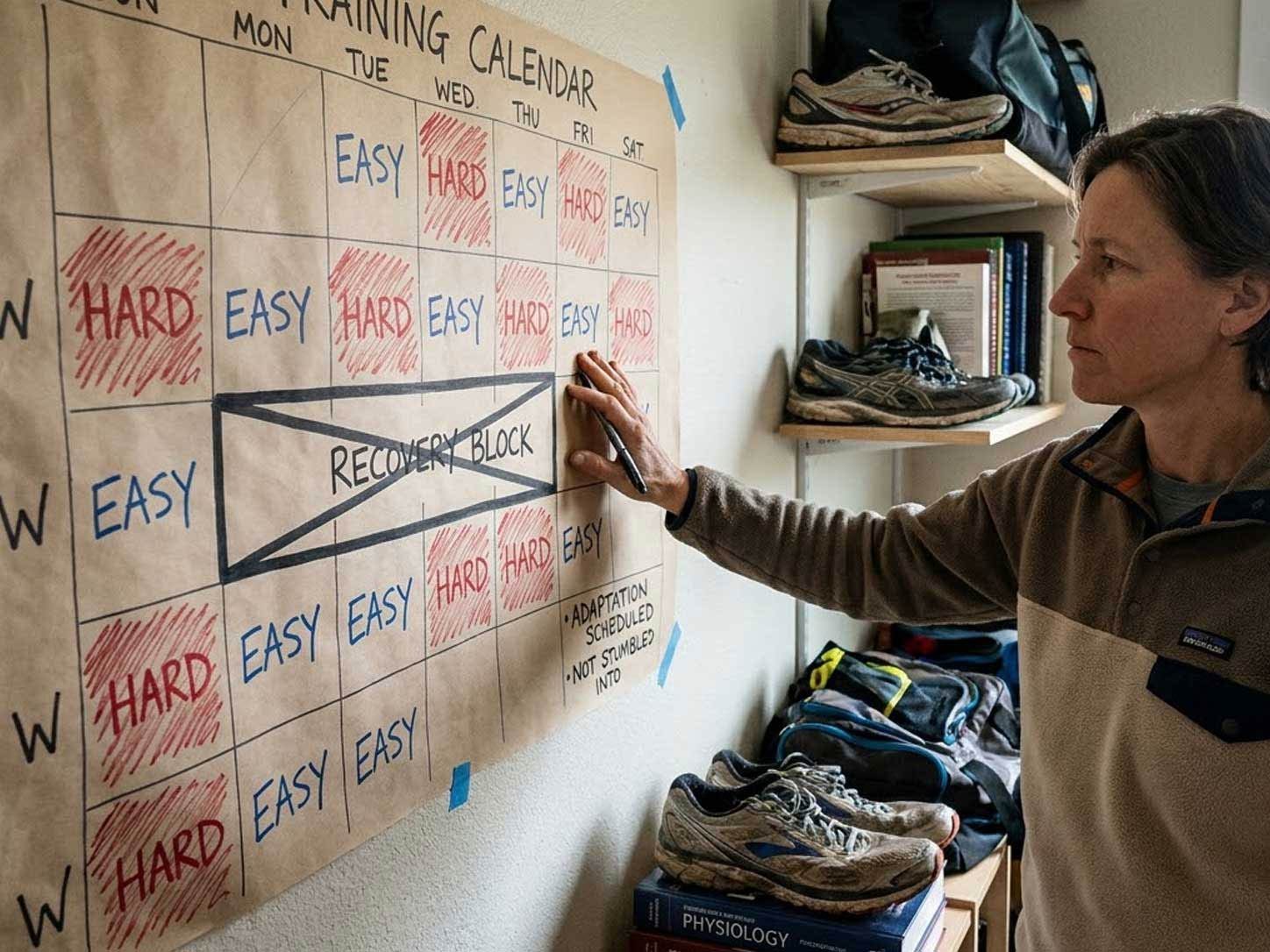
The structure: periodization — the deliberate alternation of stress and recovery across weeks and months: hard/easy within the week, accumulation blocks followed by intensification and a realize/peak phase, and the deload programmed before flatness arrives (volume cut 40–60%, roughly one week in four to six — the Overtraining page's reset, here as scheduled maintenance). The principle underneath all schools: stress and recovery are programmed, not stumbled into — the calendar is a training variable as real as the barbell.
The taper — the richest recovery science in sport: before competition, cut volume 40–60% over 7–21 days while maintaining intensity — the detail that preserves fitness while fatigue drains away; keep frequency high, cut duration. The pooled performance gains — a few percent — are decisive at the levels where percent decides places. The honest difficulty is psychological: taper blues — feeling flat, restless, and 'undertrained' while the body is banking capacity — the week the discipline is doing less, well.
The sleep trials and the honest shelf: the Stanford extension studies — athletes sleeping toward ten hours for weeks — measured faster sprint times, better free-throw accuracy, and quicker reaction: the largest performance lever available for free. The ergogenic shelf, graded without romance: caffeine — the most proven performance aid in existence (timed, dosed ~3–6 mg/kg, with its half-life tax — the Focus page's honest middle); creatine — the most proven supplement (strength and lean mass, safe, cheap — its chapter still a standing offer); beta-alanine — niche-buffering, real but narrow; everything else on the 'performance' shelf grades below their labels. The honest hierarchy: sleep > programming > caffeine > creatine > the rest.
- Supercompensation: the next stimulus's timing decides compounding vs. collapse.
- Tissues recover on different clocks — hard-easy structure beats single-system math.
- Periodization: stress and recovery programmed across weeks, not stumbled into.
- The taper: volume −40–60%, intensity kept, 7–21 days — percent decides places.
- Taper blues are the discipline week: doing less, well, while capacity banks.
- The hierarchy: sleep > programming > caffeine > creatine > the rest.
“Training asks the question. Recovery answers it — on a schedule.”
— The performance principleThe factor families
Supercompensation
The overshoot curve and the timing of the next stimulus — the model underneath all programming.
Periodization
Hard-easy weeks, blocks, and the scheduled deload — adaptation as a calendar variable.
The taper
Volume cut, intensity kept, 7–21 days — the pre-competition peak, and its psychological trick.
Sleep extension
The Stanford trials: ~10 hours, measurably faster and sharper — the largest free lever.
Explore Sleep →The story, frame by frame


The peak's players — and the routes
Every card links to a full BodyFinds journey. The programming story routes to the mechanics, the failure mode, and the levers.
The mechanics — the build-repair cycle this page schedules for output.
research-topicThe failure mode — what mistimed programming compounds into.
research-topicThe performance shift — the extension trials' engine, in full.
research-topicThe material's timing — thresholds and the day's total over the window myth.
supplementCaffeine's evidence home — the proven ergogenic, dosed and timed honestly.
research-topicWhat happens when the timing fails?
The Overtraining & Under-Recovery page — the syndrome mistimed programming compounds into: the spectrum, the signals, the reset.
Where this information comes from
- PubMed — Extended Sleep and Athletic Performance (Mah et al.) Database
- PubMed — Tapering Meta-Analysis (Mujika et al.) Database
- NIA — Exercise and Physical Activity Government
- NCCIH — Caffeine Government
- NHLBI — Sleep Science and Sleep Disorders Government