Inside the defense network.
What is the immune system — and why does the body run two armies, one that answers in minutes and one that answers in days but remembers for decades?
Your immune system is a two-army defense network with a memory: the innate arm — neutrophils, macrophages, natural killer cells, complement — generic, fast (minutes), and forgetting everything; and the adaptive arm — T cells and B cells — slow (days), exquisitely specific, and remembering for decades to a lifetime. The adaptive army's memory is the system's great invention and the reason vaccines work (Jenner's discovery, Chapter 5's timeline) — and the reason you will never catch measles twice. The geography is a body-wide network: the bone marrow (the factory — our blood page's stem cells), the thymus (the school — where 95% of T cells are destroyed for failing the self-tolerance exam), the spleen and lymph nodes (the rendezvous stations), and the gut — where ~70% of the entire standing army is garrisoned, trained daily by the microbiome (our gut-health topic's training ground). And the page's organizing honesty, stated on entry: 'boost' is the word immunology does not recognize — an immune system pushed past its own regulation is allergy (misdirected) and autoimmunity (friendly fire). The honest verbs are supply, correct, and train.
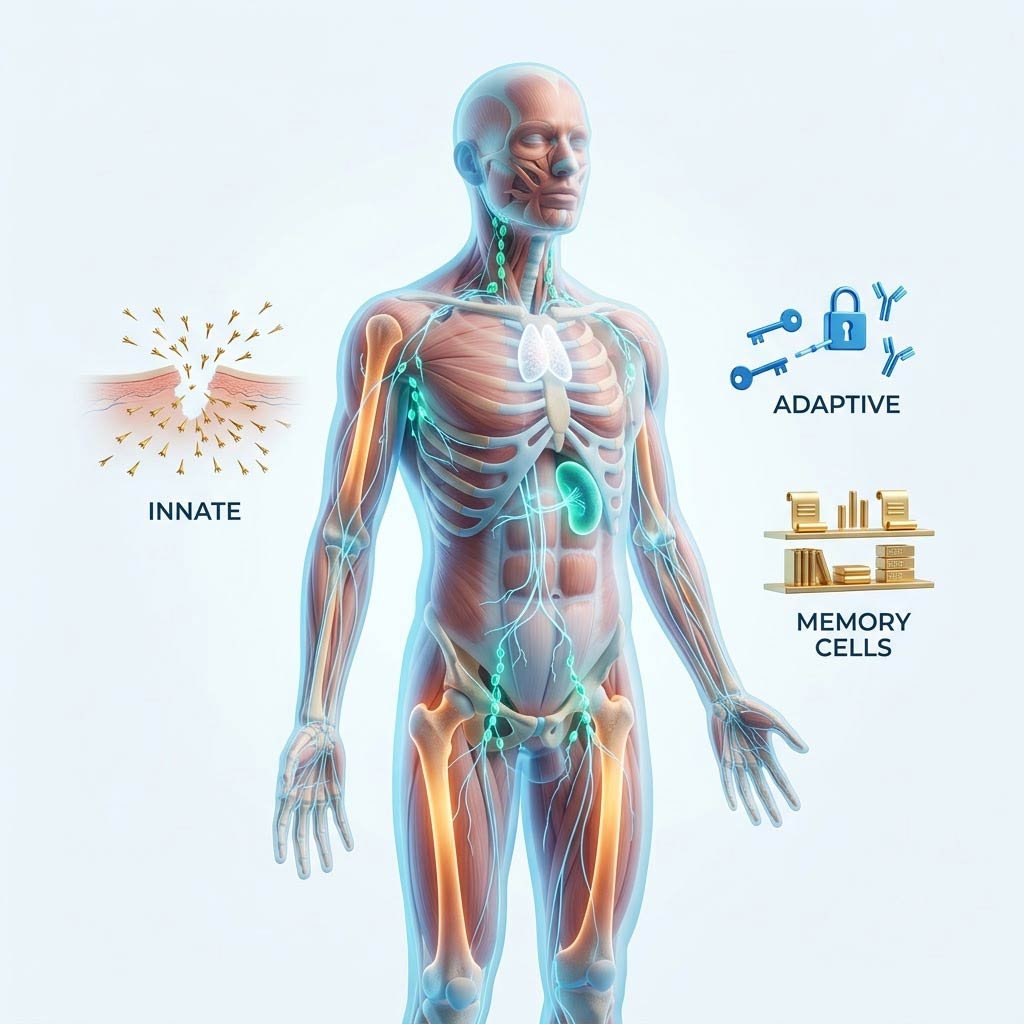
The architecture: the INNATE army (barriers — skin, mucus, acid; complement — the 30-protein chemical cascade; neutrophils — the billions-strong first responders; macrophages — the resident sentinels; NK cells — the infected-cell executioners), the ADAPTIVE army (T cells — killers and helpers, schooled in the thymus; B cells — the antibody factories; the germinal centers — where antibodies evolve in real time), and MEMORY — the surviving clones that stand watch for decades. The whole network is connected by the lymphatic vessels and staffed from the marrow's factory: roughly 1–2 billion white cells born every day.
The Anatomy of the Two Armies
The innate army is the evolutionarily ancient half — the system that a starfish and you both share. Its first layer is the barrier: skin's acid mantle (our skin page's chemistry), mucus and cilia, stomach acid — the wall that most pathogens never pass. Behind it, the fast responders: complement, a thirty-protein cascade that punches holes in invaders the moment antibodies or surfaces flag them; neutrophils, the most abundant white cells — billions of short-lived soldiers with eight-hour lifespans, first to every breach and the primary ingredient of pus; macrophages, the resident big-eaters that both consume invaders and broadcast the alarm; and NK cells, the patrollers that execute virus-infected cells on contact. Their response is generic — the same attack against any intruder — and leaves no memory. What it does leave is inflammation: the recruitment cascade (redness, heat, swelling, pain — the four signs medicine has recognized for two thousand years) that brings the second army.
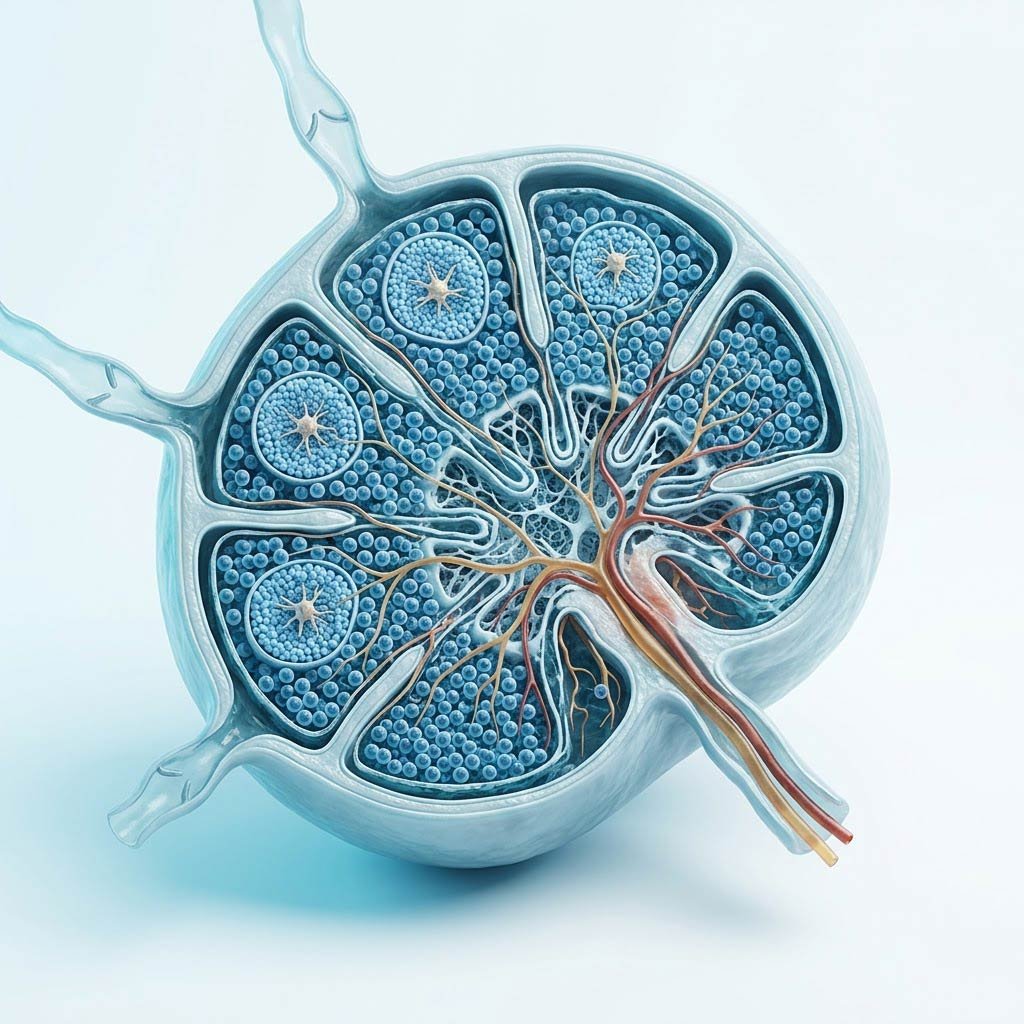
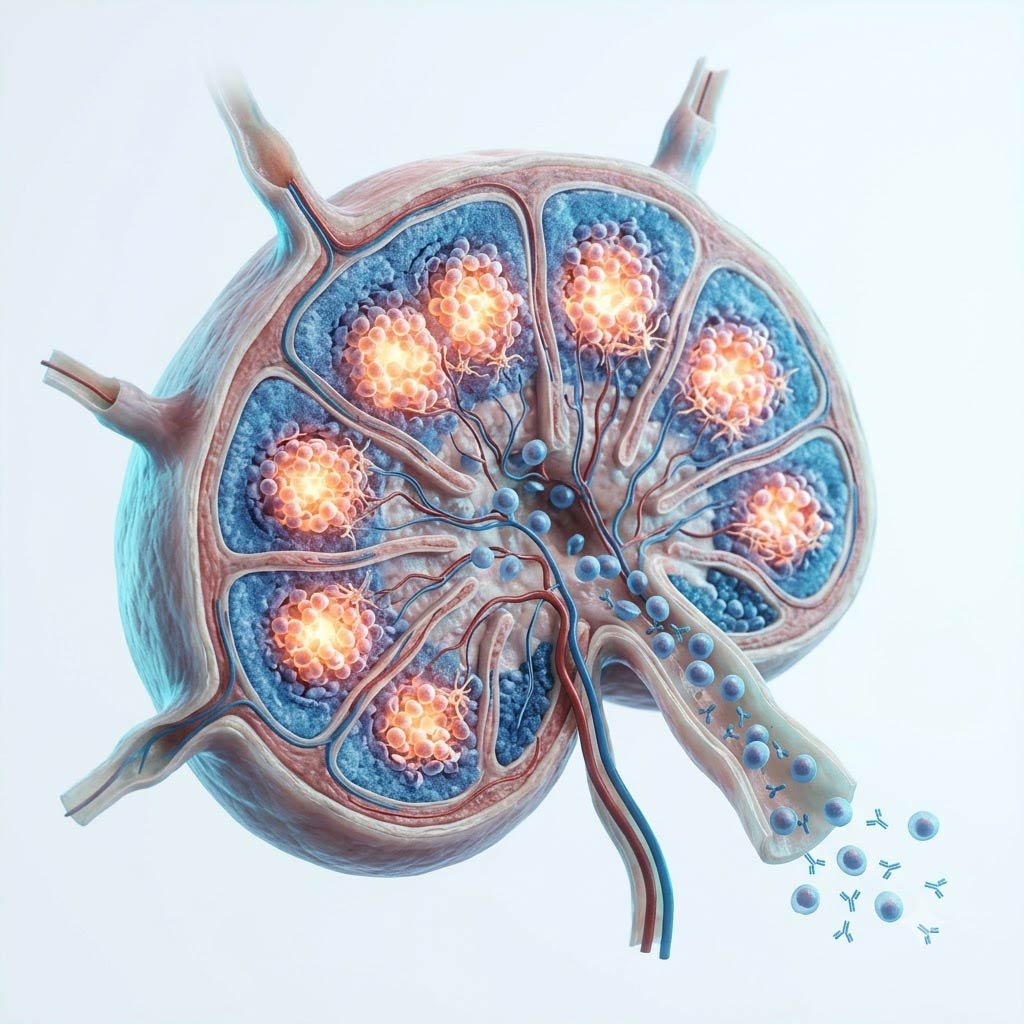
The adaptive army is the vertebrate invention. Dendritic cells — the bridge between the armies — swallow invaders at the infection site, then travel to the lymph node and hold out the evidence: this is the shape of the enemy. T cells that recognize the shape multiply (the CD8 killers execute infected cells; the CD4 helpers command the whole response), and B cells mature into plasma cells that pour out antibodies — protein weapons built to lock onto the invader's exact shape. Inside the lymph node's germinal centers, an evolutionary algorithm runs in real time: B cells mutate their antibody genes and compete for binding, so the antibody you produce in week two is often a hundred times better than week one's. And after the battle, the survivors stand down into memory cells — the decades-long archive that is the entire basis of vaccination.
The system's geography completes the picture. The bone marrow is the factory (our blood page's stem cells, producing the white-cell lineages alongside the red). The thymus — the gland behind the sternum — is the school: T cells are trained there, and roughly 95% are destroyed for reacting to the body's own proteins (negative selection — the tuition of self-tolerance); the gland shrinks from adolescence onward, one mechanism of the immune aging immunology studies. The spleen and lymph nodes are the rendezvous stations where antigen meets adaptive cell — the swollen gland under your jaw is a node's germinal centers at war. And the gut-associated lymphoid tissue (GALT) — the tonsils, Peyer's patches, and the lamina propria's resident army — is the system's largest deployment: ~70% of all immune cells, garrisoned at the border where the outside world's largest interface meets the bloodstream, trained daily by the microbiome's signals (our gut-health topic's full story).
Neutrophils
The first responders — billions strong, eight-hour lives, the majority of pus
T Cells
The schooled killers and helpers — 95% flunked the thymus's self-tolerance exam
B Cells & Antibodies
The weapons factory — antibodies that evolve in real time in the germinal center
Memory Cells
The decades archive — why you never catch measles twice, and why vaccines work
The Network's Rules — and the Word It Retires
Five economies of the defense network organize everything the rest of the page teaches:
- Memory is the invention: antibodies to measles persist for ~75 years after infection; vaccines are the same mechanism, deliberately trained. No supplement on any shelf trains memory — the shelf's honest ceiling is the margin around the response, never the memory at its core. This is the tier distance the aisle blurs and this page keeps visible.
- The gut is the training ground: with 70% of the army garrisoned at the gut border, the microbiome is a daily drill instructor — the 'old friends' exposure that keeps the system calibrated. The farm-effect data (Chapter 5's Amish study) is the field's evidence that the garrison needs exercise, and the fiber-and-fermented pattern (Chapter 3) is the diet's honest version.
- The price of specificity is self-tolerance: an army that recognizes millions of foreign shapes must not recognize your own — the thymus's brutal selection and the regulatory T cells (the standing brake) are the safety architecture, and autoimmunity is their standing cost. Every 'immune-stimulating' product runs against this architecture; anyone with autoimmune disease clears the category with a physician.
- Inflammation is the response, not the enemy: acute inflammation is the army working — the recruitment cascade doing its job for days, then standing down. Chronic inflammation — the garrison that never stands down — is the failure mode, and the anti-inflammatory dietary pattern this library teaches everywhere is aimed at it (the pattern's honest, modest link).
- 'Boost' is the wrong verb — supply, correct, train: an immune system 'boosted' past its own regulation has a name in medicine: allergy when misdirected, autoimmunity when turned inward, cytokine storm when runaway. The honest shelf does not push the accelerator — it supplies the raw materials (protein, zinc, D, C), corrects the deficiencies that impair (the evidence's real signal), and supports the training habits (sleep, movement, the gut pattern). The most-market word on the aisle is the one immunology doesn't use.
Your immune system is two armies and a memory — one answering in minutes with no recollection, one answering in days and remembering for decades. It cannot be 'boosted' past its own regulation without turning on you; it can be supplied, corrected, and trained. The memory is the miracle — and the shelf has never touched it.