Inside the heart.
What does the heart do, and how does it keep every cell alive?
The heart is a muscular pump the size of your clenched fist that moves roughly 7,500 liters of blood every day through about 100,000 beats — approximately 2.5 to 3 billion beats in a lifetime, without a single service interval. It is two pumps in one: the right side sends blood to the lungs for oxygen; the left side drives the oxygenated supply to every cell in the body. And it is self-governing — a cluster of pacemaker cells generates its electrical rhythm independently, which is why a transplanted heart beats in a new chest before any nerve reaches it.
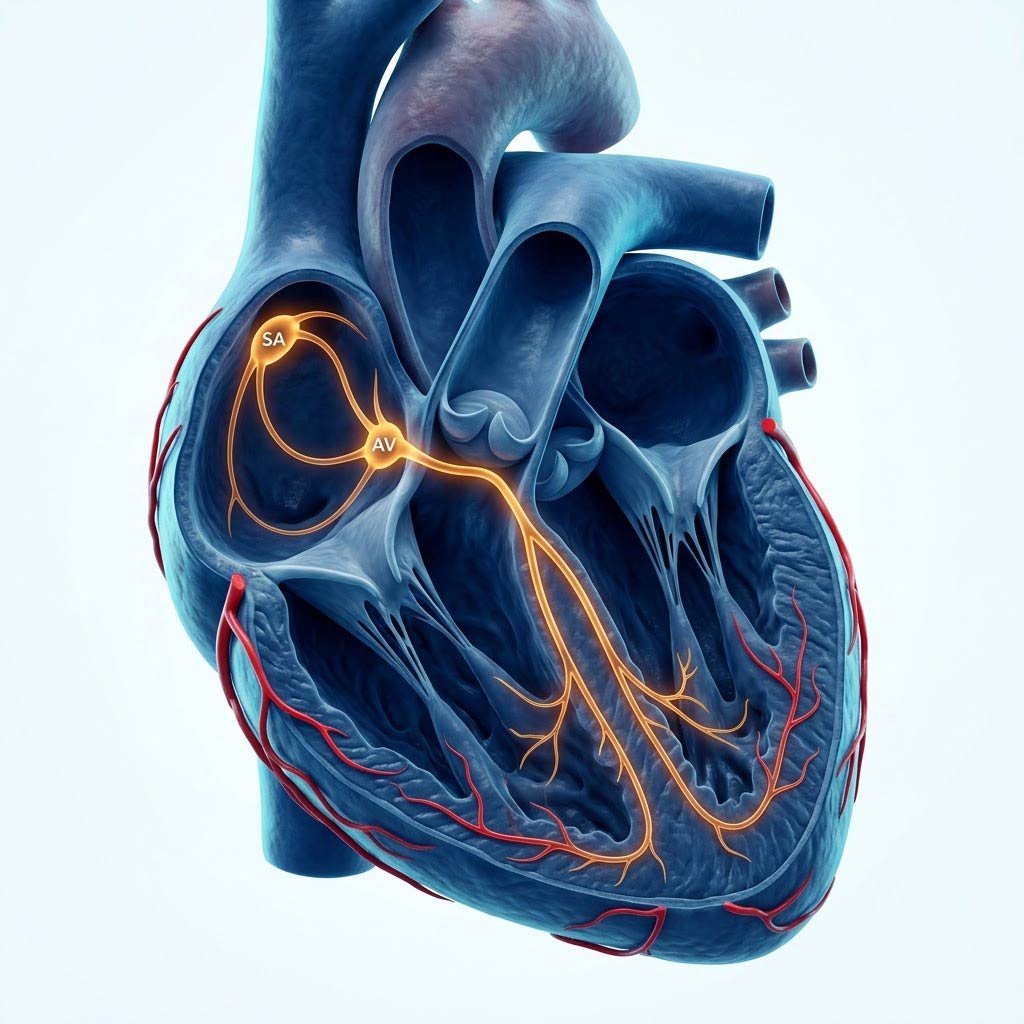
Four chambers (two atria receiving, two ventricles pumping), four one-way valves, a conduction system that fires from the SA node downward, and its own private blood supply — the coronary arteries — feeding the muscle itself. The design is a dual pump in series: right heart to lungs, left heart to body.
The Anatomy of the Dual Pump
Each heartbeat is a two-phase cycle. In diastole, the heart relaxes and fills — and here sits the design's most counterintuitive fact: the heart muscle feeds itself during diastole, when relaxed muscle lets coronary blood flow through. In systole, it contracts: the atria top up the ventricles, then the ventricles fire, valves slam open and shut in sequence, and roughly 70 ml per beat (the stroke volume) launches into the aorta. Cardiac output — heart rate × stroke volume — is the number your life runs on.
The conduction system is the heart's own electrical grid: the SA node (the natural pacemaker, firing 60–100 times a minute on its own), the AV node (the gatekeeper), and the His-Purkinje fibers racing the signal across the ventricles. Every beat of your life traces this path — and every arrhythmia is a detour in it. The coronary arteries (3–4 mm pipes branching off the aortic root) supply the muscle itself — a detail with outsized consequences, because the heart attack that kills heart muscle is the heart's own plumbing failing, not the blood it pumps.
Chambers & Valves
Four chambers, four one-way doors — the pump's architecture
Coronary Arteries
The heart's private blood supply — the heart attack's target
Conduction System
The SA node and its wiring — rhythm without instruction
Endothelium
The one-cell lining every vessel carries — the organ's partner tissue
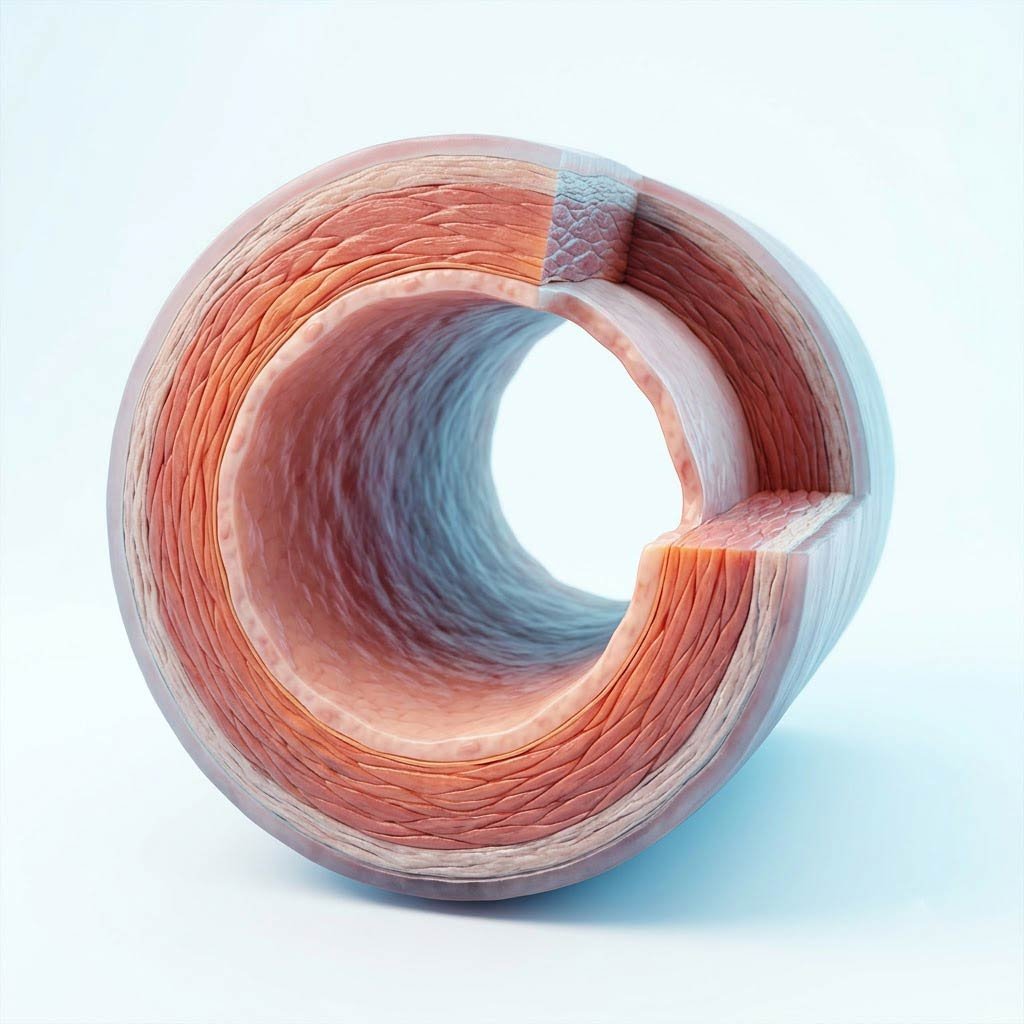
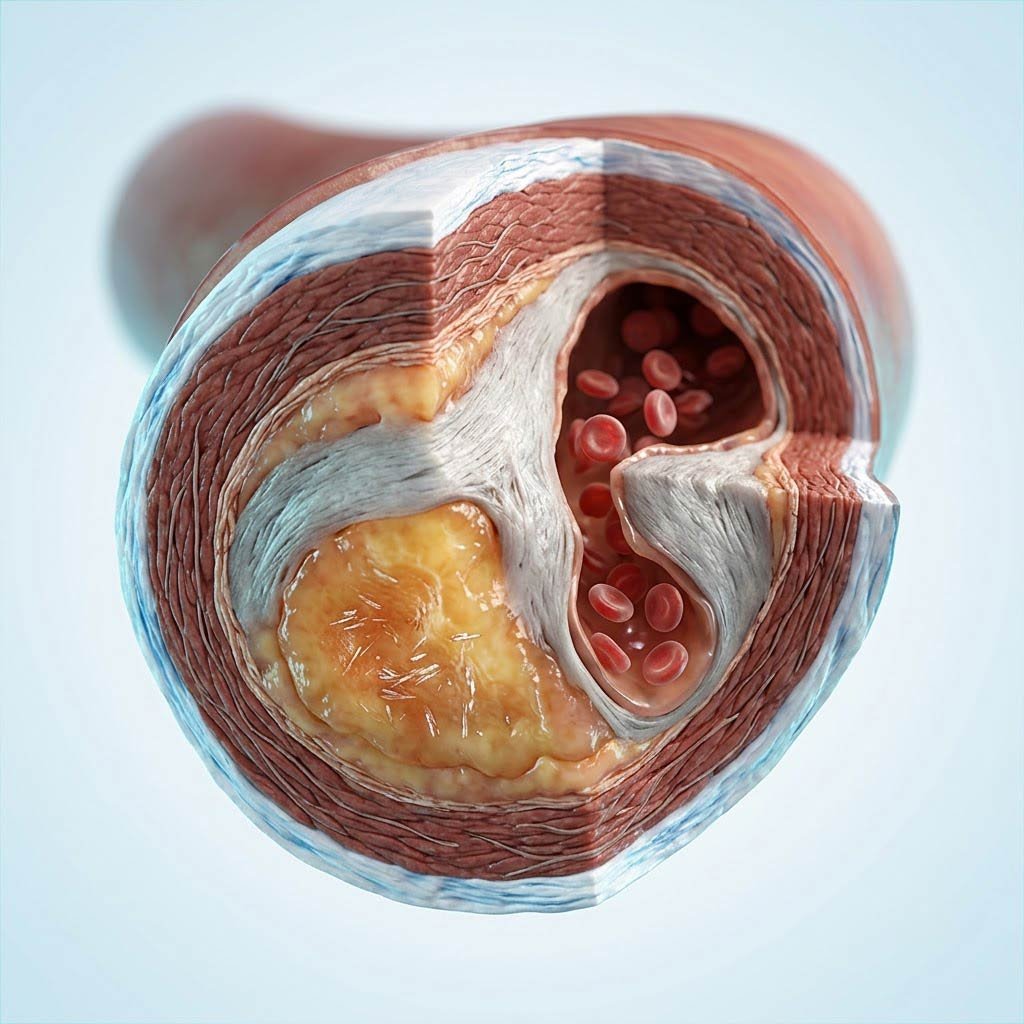
The Heart Feeds Itself in Relaxation
The paradox at the center of cardiology: the hardest-working muscle in the body receives its own blood supply between beats, not during them. Squeezing muscle compresses the coronary arteries embedded in it; only in diastole — the filling phase — does blood flow through them freely. This is why a racing heart is metabolically expensive for the heart itself: faster beats mean shorter, more frequent diastoles, less feeding time per hour.
It is also why the coronary arteries, despite their importance, are only 3–4 mm wide — and why the same atherosclerosis that barely matters elsewhere becomes lethal here. Our erectile-dysfunction page teaches the artery-size principle from its other end: the penile arteries (1–2 mm) narrow first, the coronaries announce themselves years later. The heart's own pipes are the middle chapter of that same disease.
Your heart beats about 100,000 times a day — some 2.5 to 3 billion beats in a lifetime — moving 7,500 liters daily through a fist-sized pump that is never serviced, never replaced, and never takes a night off. It feeds itself between beats. Respect is the minimum it is owed.