What is a Urinary Tract Infection?
A bacterial foothold in a system built to flush — and the adhesion war that decides it.
A urinary tract infection is bacteria establishing themselves where the body's design intends constant flushing — most commonly E. coli from your own gut ascending the urethra into the bladder, gripping the wall with molecular Velcro, and multiplying faster than the stream clears them. UTIs drive roughly 150 million visits and prescriptions worldwide each year; half of women will have at least one, and among those with one infection, a quarter to a third recur within months. The modern framing this page teaches: a UTI is an adhesion story — the bacteria that can't grip get washed out; the ones that grip colonize — and both the prevention shelf (PACs, D-mannose) and the prescription (antibiotics) work on that battlefield. Active infections are treated with antibiotics. Prevention is where the shelf earns its place.
How UTIs Connect
Understanding the Adhesion Story
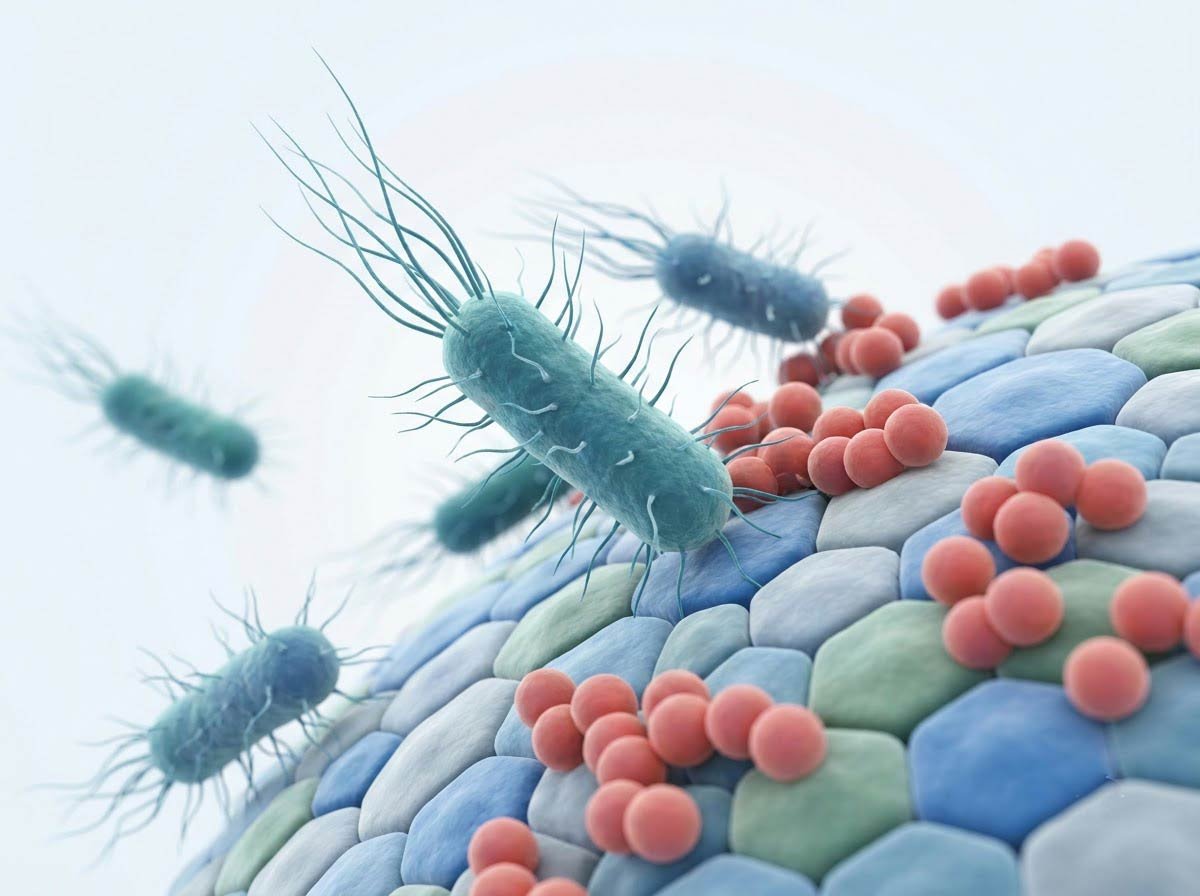
The bladder is not defenseless. Urine flow itself is a flushing mechanism; the bladder lining (urothelium) carries an anti-adhesion surface; the mucosal immune layer secretes defenses. A UTI begins when bacteria defeat all three — and the decisive weapon is adhesion: E. coli's fimbriae, hair-like projections tipped with FimH lectins that lock onto mannose sugars on the bladder's epithelial cells. A bacterium that grips survives the flush; its descendants build biofilm and inflame the wall. Every effective approach in this library works on this sequence: antibiotics kill what's anchored; PACs and D-mannose sabotage the grip; the stream does the rest.
The geography explains the epidemiology. The female urethra is roughly 4 cm (versus ~20 cm in men) — a short road from the perineum, where gut bacteria constantly seed, straight to the bladder. That single anatomical fact drives the female predominance (half of women versus a few percent of men), the post-coital pattern (mechanical inoculation), the diaphragm/spermicide association (altered vaginal flora favoring E. coli), and the postmenopausal surge (estrogen decline thins the tissue and shifts the protective lactobacillus flora). The reservoir is the gut; the gateway is the perineum; the target is the wall. Prevention works every step of the way — which is what Chapter 4 maps.
The clinical categories matter because treatment follows them. Uncomplicated cystitis — bladder infection in a healthy woman with normal anatomy: short-course antibiotics, high cure rates. Complicated UTI — infection with structural, metabolic, or immunological compromise (pregnancy, diabetes, catheters, obstruction, male anatomy): longer treatment, cultures mandatory, complications feared. And pyelonephritis — the ascent to the kidney: fever, flank pain, systemic illness; a serious infection, occasionally a hospitalization, and the emergency boundary this page marks repeatedly.
- Acute uncomplicated cystitis: the classic bladder infection — dysuria, frequency, urgency, in healthy non-pregnant women; short-course antibiotic cure.
- Recurrent UTI: 2 infections in 6 months or 3 in a year — the prevention population this page's shelf serves; warrants a workup conversation and a prevention plan.
- Complicated UTI: infection plus a complicating factor (pregnancy, diabetes, stones, catheter, male anatomy, obstruction) — cultures and longer therapy.
- Pyelonephritis: kidney involvement — fever, flank pain, vomiting; serious, sometimes hospital-treated, never a shelf matter.
- Asymptomatic bacteriuria: bacteria in urine without symptoms — generally NOT treated (except pregnancy and pre-procedure), a stewardship lesson most people are never taught.
The Cranberry Myth and the PAC Discovery
Cranberry's reputation was born from the wrong theory: folklore held that the berries acidify urine, creating an environment bacteria hate. When scientists tested it, the acid story collapsed — urine pH barely moves. Cranberry should have retired as folklore. Instead, the 1990s research found the real mechanism: proanthocyanidins (PACs) — compounds that block the fimbriae's grip, preventing adhesion without killing anything. Anti-stick, not anti-bacterial.
The refinement that matters to every reader of this page: the anti-adhesion effect is dose-dependent at ~36 mg of PACs daily — the amount in properly standardized capsules, and far more than a typical juice serving delivers (with none of the juice's sugar, which is not trivial in a condition where glucose in the urinary tract feeds the invader). Cranberry works — the Cochrane review supports it for recurrent UTI prevention in women — but it works as a standardized extract, at a dose, in the prevention context. Not as juice, not as treatment.
The final lesson is the most modern: cranberry juice cocktail's sugar content isn't just dead calories in a prevention product — in diabetics and those with glucosuria, urinary glucose is an E. coli growth medium. The traditional delivery vehicle mildly undermined the mechanism it carried.
Two conversations define UTI care. First, the testing rule: symptomatic UTIs get treated, but the pattern determines the workup — recurrent UTIs (2 in 6 months / 3 in a year), any UTI with fever or flank pain, all male UTIs, all pregnancy UTIs, and infections failing to respond deserve urine culture; recurrent UTI in a woman occasionally warrants imaging or cystoscopy to rule out anatomical contributors. Second, the trigger-mapping rule: the diary that logs infections against sex, new products, cycle, and hydration finds the pattern — post-coital timing (a single post-sex antibiotic or D-mannose dose is a recognized physician-discussed strategy), spermicide or diaphragm use (strong, modifiable risk), and uncontrolled diabetes (glucose feeds bacteria — our diabetes page's engine, read from the urinary side). And the standing warning: symptoms plus fever or flank pain is the kidney boundary — care today, not the shelf.
The bacteria that cause most UTIs come from your own gut — E. coli that colonized you long ago, living quietly in the intestine, until geography hands them the four-centimeter road to the bladder. The UTI is an inside job; the prevention is border control.
- The female urethra is ~4 cm; the male's ~20 cm — the anatomy that explains the 50% vs few-percent lifetime risk gap.
- A quarter to a third of women with one UTI recur within months — the population prevention serves.
- Asymptomatic bacteriuria is generally NOT treated (except pregnancy) — one of medicine's counterintuitive stewardship rules.
- Postmenopausal recurrent UTIs have a prescription prevention most pages never mention: topical vaginal estrogen — genuinely effective, guideline-supported.