Inside the living skeleton.
Where does osteoporosis actually happen in the body?
Osteoporosis lives in bone's microscopic architecture — and in the cellular renovation crew that maintains it. The skeleton is not a warehouse of stored mineral; it is a chemical plant and a load-sensing instrument, staffed by three cell types in permanent negotiation: demolition crews (osteoclasts), builders (osteoblasts), and buried sensors (osteocytes) that read every step you take. The disease is what happens when the negotiation tips — when demolition outpaces construction — and it fails first in the lattice architecture of the spine, wrist, and hip.
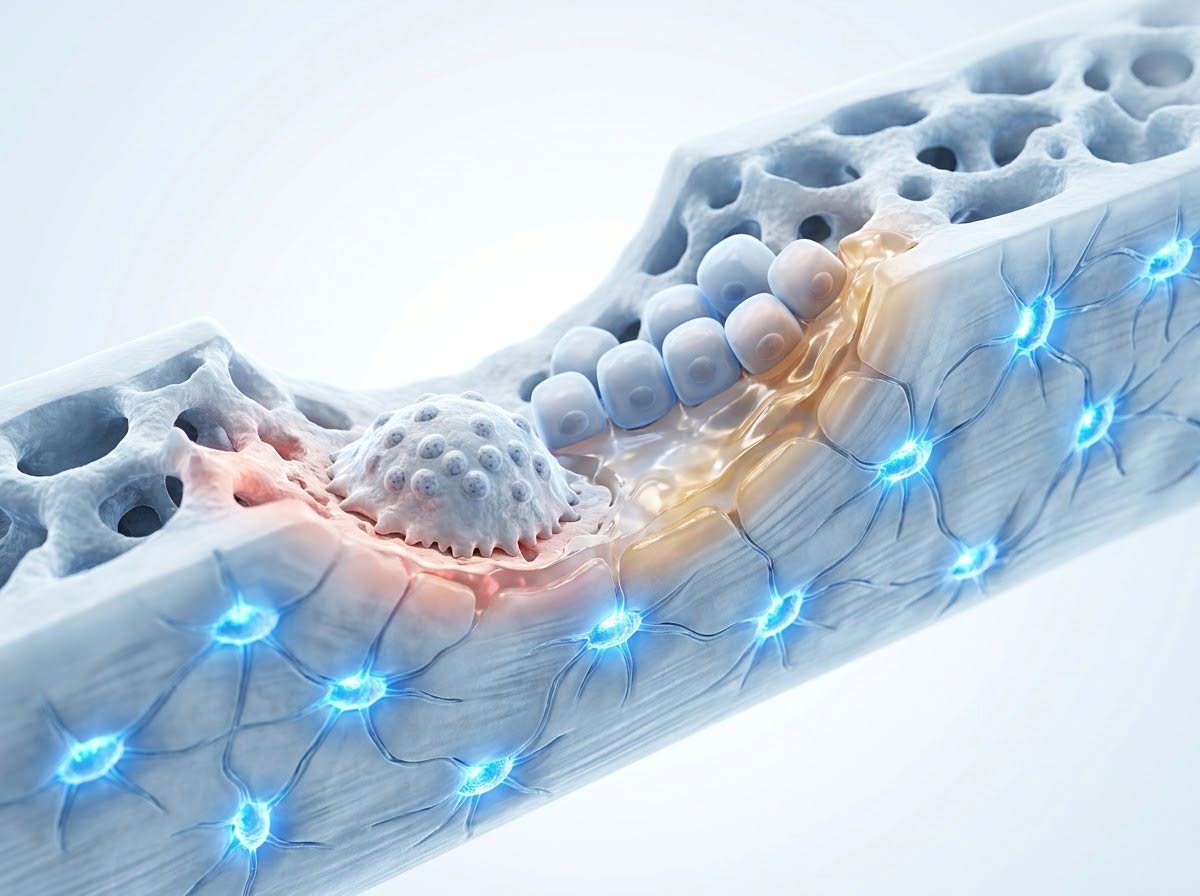
206 bones housing two distinct architectures: dense cortical bone (the outer shell of shafts) and trabecular bone — the honeycomb lattice inside vertebrae and joint ends. Roughly a million microscopic remodeling sites operate at any moment, governed by load signals and calcium demand, replacing ~10% of the skeleton yearly.
The Anatomy of Remodeling
Every patch of bone cycles through the same sequence: an osteoclast arrives, dissolves a pocket of old bone, and departs; osteoblasts follow and lay fresh collagen matrix, which mineralizes into new bone. The process is tightly coupled — resorption and formation matched — and it serves two masters simultaneously: mechanical maintenance (replacing fatigue-damaged bone, adapting to load) and mineral metabolism (the skeleton holds 99% of the body's calcium, and blood calcium is defended without mercy — even at bone's expense).
That second master explains a central fact of bone health: when dietary calcium runs short, the body raids the skeleton. Parathyroid hormone rises, activating osteoclasts to liberate stored calcium and keep blood levels constant — because nerves and heart cannot tolerate low calcium, but bones can tolerate decades of small withdrawals. The skeleton is a bank vault the body will empty to keep the lights on. Vitamin D's role sits upstream: it is what lets the gut absorb dietary calcium in the first place, so the vault never needs raiding.
Osteoclasts
The demolition crew — dissolve old bone, liberate calcium
Osteoblasts
The builders — lay collagen scaffold and mineralize it
Osteocytes
The load sensors — embedded cells reading every step
Trabecular Bone
The honeycomb lattice — where osteoporosis strikes first
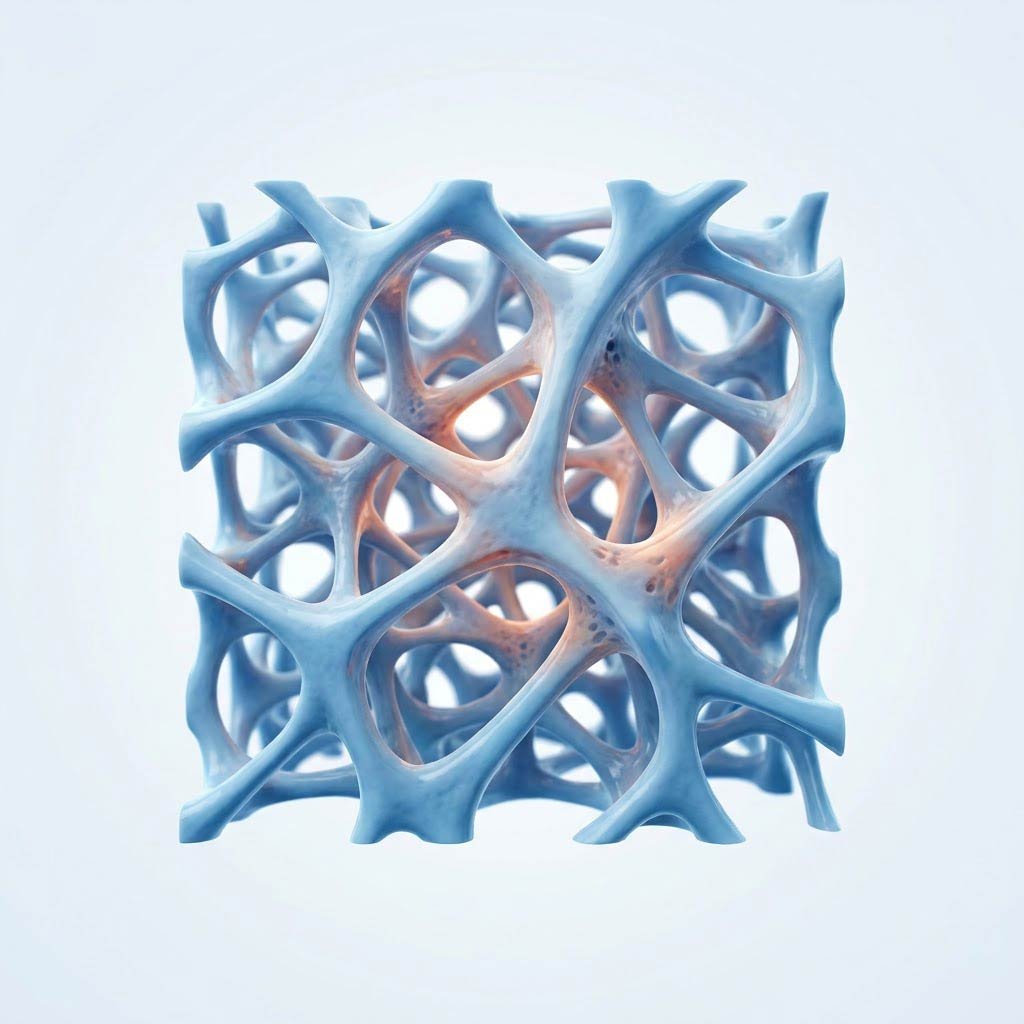
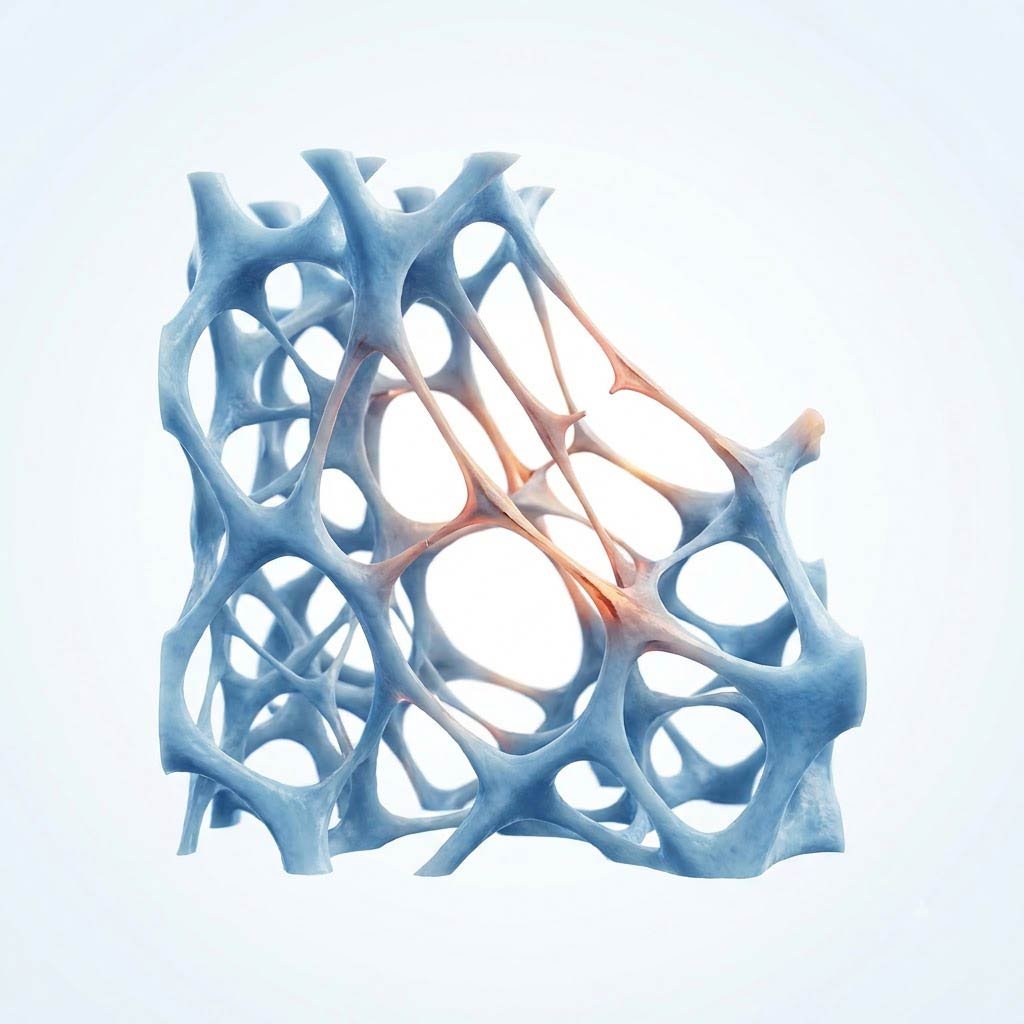
From Balanced Remodeling to Porous Bone
The disease is a shift in the renovation balance — and the shift has several distinct engines:
- Menopause: estrogen normally suppresses RANKL — the signal that summons osteoclasts. Its removal takes the brake off demolition: resorption accelerates while formation lags, fastest in the spine's trabecular-rich vertebrae.
- Aging: osteoblasts decline in number and output for everyone — formation slows while resorption continues, a slow net loss of ~0.5–1% yearly.
- Disuse: without load signals from osteocytes, the system reads 'no work needed here' — bed rest and sedentary life tilt the balance toward resorption (the astronaut lesson).
- Secondary hyperparathyroidism: chronic calcium or vitamin D shortfall keeps parathyroid hormone elevated — a standing order to raid the vault.
- Glucocorticoids: the classic double hit — they suppress osteoblasts AND activate osteoclasts AND reduce gut calcium absorption. Long-term steroid use is osteoporosis by prescription.
Your bones hold 99% of your body's calcium — a bank vault that doubles as your frame. When dietary calcium runs short, the body doesn't hesitate: it raids the vault to keep the lights on. Osteoporosis is what decades of quiet withdrawals look like.