What is Irritable Bowel Syndrome?
A real disorder of the gut-brain axis — where digestion's wiring, not its machinery, is dysregulated.
Irritable Bowel Syndrome is the most common functional digestive disorder on earth — recurring abdominal pain with constipation, diarrhea, or both — affecting 5–10% of people worldwide and driving more gastroenterology visits than any other condition. The modern understanding replaced the old dismissals ('spastic colon,' 'nerves') with biology: IBS is a disorder of gut-brain axis regulation — visceral hypersensitivity (the gut feels normal stretch as pain), disordered motility, microbiome alteration, and low-grade immune activation, with stress and gut infection as documented triggers. The defining message: IBS is real, diagnosable by criteria, manageable — and its diagnosis always includes ruling out the red flags that mimic it.
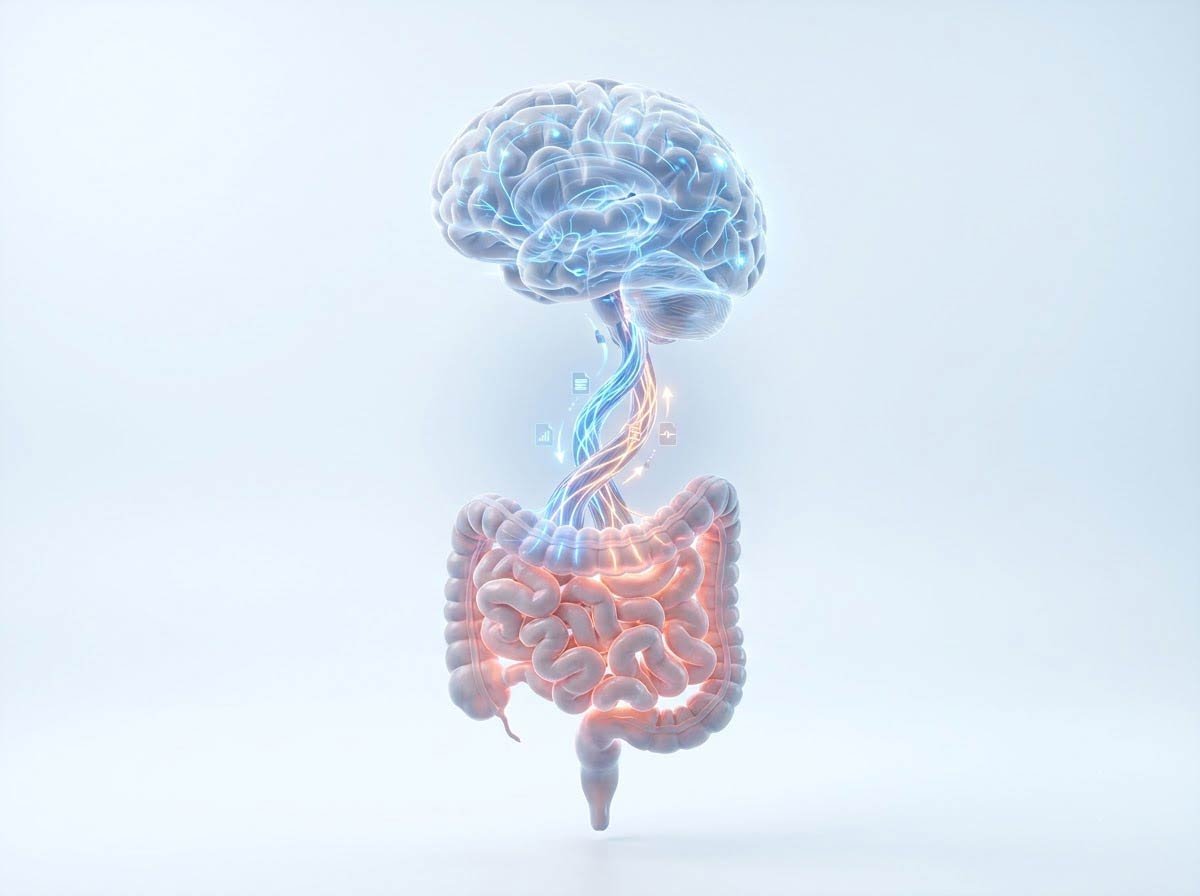
How IBS Connects
Understanding the Disorder of Regulation
IBS is called 'functional' because the machinery is intact — no ulcer, no tumor, no inflammation visible on a scope — but the regulation is broken. Three mechanisms dominate. Visceral hypersensitivity: nerve endings in the gut wall fire pain signals at stretch volumes that a healthy gut registers as nothing — a normal balloon of gas reads as an emergency. Disordered motility: the gut's peristaltic rhythm loses coordination — spasming, stalling, or both in sequence — producing pain, urgency, or constipation. And altered gut-brain signaling: the vagal highway between gut and brain carries traffic in both directions, and in IBS the signals are amplified in transit, which is why stress worsens symptoms and symptoms worsen stress — a genuine physiological loop, not imagination.
The diagnosis is symptom-criteria-based (the Rome IV criteria: recurrent abdominal pain, on average at least one day per week, related to defecation and associated with stool-frequency or stool-form change) — made by a physician after excluding the alarm features that point elsewhere. Two epidemiological facts deserve respect: IBS affects women roughly twice as often as men, and up to 1 in 10 cases begins after an episode of acute gastroenteritis — post-infectious IBS — proving the disorder can follow a physical trigger, not just a psychological one.
- IBS-C (constipation-predominant): hard, infrequent stools, bloating, pain relieved by bowel movements.
- IBS-D (diarrhea-predominant): loose, urgent stools, often post-prandial, with pain easing after defecation.
- IBS-M (mixed): alternating pattern — constipation and diarrhea trading places, sometimes within days.
- Post-infectious IBS: new-onset IBS after gut infection — the microbiome and nerve endings altered by an acute illness that resolved, leaving dysregulation behind.
- The overlap conditions: IBS frequently coexists with functional dyspepsia, chronic fatigue, fibromyalgia, and anxiety — the axis dysregulation expressing itself across systems.
Post-Infectious IBS: The Proof It Isn't 'All in Your Head'
In 2000, an E. coli O157:H7 outbreak contaminated the water supply of Walkerton, Ontario — and gastroenterology gained one of its most clarifying natural experiments. Researchers followed the infected residents for years: a substantial fraction developed new IBS after the infection cleared, with elevated risk persisting nearly a decade.
The mechanism is physiological: the infection triggers low-grade inflammation that alters nerve endings in the gut wall and shifts the microbiome, leaving hypersensitivity and dysmotility after the pathogen itself is gone. The Walkerton cohort joined earlier evidence (after Salmonella and Campylobacter outbreaks) to establish post-infectious IBS as a documented entity — roughly 1 in 10 IBS cases begins this way.
IBS is diagnosed after exclusion of alarm features — the checklist every clinician runs: blood in the stool, unintended weight loss, anemia, symptoms that wake you from sleep, fever, onset of new symptoms after age 50, and family history of colorectal cancer, celiac, or inflammatory bowel disease. Each one changes the workup before any IBS label applies. Standard initial testing before diagnosis often includes celiac serology and inflammatory markers (CRP/fecal calprotectin) — inexpensive tests that separate IBS from its most dangerous mimics. If you carry an IBS diagnosis and develop any red flag, the label is suspended until re-evaluated.
Your gut contains some 500 million neurons — enough to run digestion if the vagus nerve were cut entirely — and constantly sends more signals TO the brain than it receives. In IBS, that upward traffic is amplified. The gut isn't reporting harder; the wiring turned up the volume.
- Up to 1 in 10 IBS cases begins after an episode of acute gastroenteritis.
- IBS affects roughly twice as many women as men; menstrual-cycle hormonal shifts are documented symptom triggers.
- The microbiome differs measurably in IBS — and long-term strict dieting can make that difference worse, which is why elimination diets require reintroduction.
- Gut-directed hypnotherapy has trial evidence comparable to dietary therapy — the brain half of the axis responds to treatment.