What is Hypertension?
A silent condition where the force of blood against artery walls stays chronically elevated.
Hypertension is the quintessential silent killer: it produces no symptoms whatsoever while it quietly reshapes the heart, stiffens arteries, scars kidneys, and raises stroke risk — for years, often decades. It affects an estimated 1.28 billion adults worldwide, roughly half of US adults under the modern 130/80 threshold, and only about 1 in 4 of those has it controlled. The defining message of this page: it is among the most treatable chronic conditions in medicine — every mmHg lowered is measured in strokes and heart attacks that never happen.
How Hypertension Connects
Understanding the Pressure System
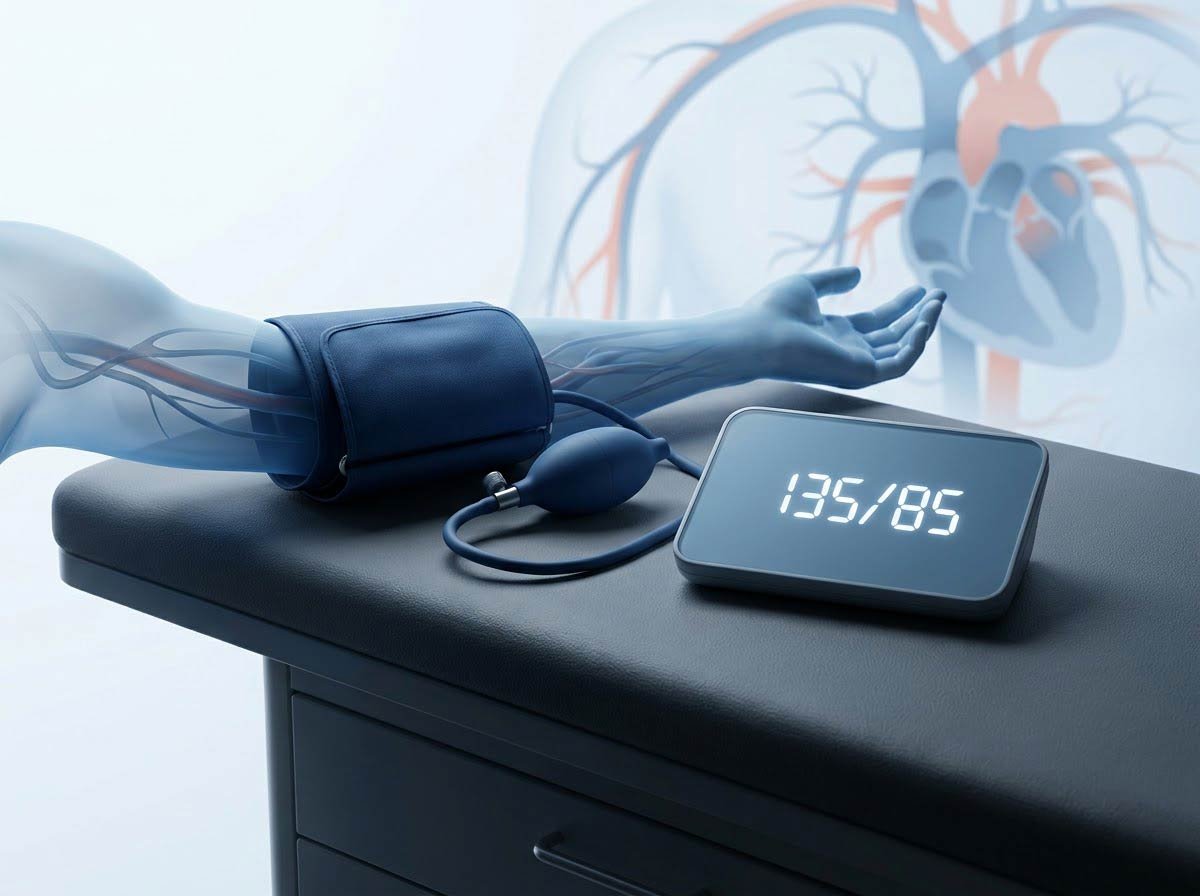
Blood pressure is the product of a simple equation: how much blood the heart pumps (cardiac output) × how tightly the arteries resist it (peripheral resistance). Two numbers capture one beat: systolic (the heart's contraction surge) over diastolic (the resting pressure between beats). Under the 2017 ACC/AHA classification, below 120/80 is optimal, 120–129/<80 is elevated, 130–139/80–89 is Stage 1, and 140/90 or higher is Stage 2 — with 180/120 or above constituting a crisis.
In 90–95% of cases this is primary (essential) hypertension — the accumulated result of genetics, age, sodium intake, weight, alcohol, inactivity, and stress acting on volume and resistance over decades. The remaining 5–10% is secondary — high blood pressure caused by something findable: sleep apnea, primary aldosteronism, kidney artery narrowing, thyroid disease, or medications (NSAIDs, decongestants, even licorice). The distinction matters enormously: secondary causes can sometimes be treated directly, and certain patterns — young onset, resistant to multiple medications, or sudden onset — are the classic triggers to go looking for them.
- Primary hypertension (90–95%): gradual, multifactorial, driven by genes and decades of lifestyle inputs on volume and vascular resistance.
- Secondary hypertension (5–10%): caused by a findable condition — sleep apnea, primary aldosteronism, renal artery stenosis, thyroid disease, or drugs.
- Isolated systolic hypertension: high top number with normal bottom — the signature of stiffened arteries in older adults.
- White-coat hypertension: elevated in the office, normal at home — real stress physiology, worth knowing, treated by monitoring not assumed away.
- Masked hypertension: the reverse — normal in the office, high at home. The reason home readings earn a seat at the diagnostic table.
- Hypertensive crisis (≥180/120): a medical emergency when accompanied by symptoms — covered in Chapter 3.
Framingham: The Town That Invented Risk Factors
In 1948, the US Public Health Service did something medicine had never attempted: enroll an entire town — 5,209 residents of Framingham, Massachusetts — and follow them for decades, measuring everything, waiting. The Framingham Heart Study gave medicine the very concept of the risk factor: it was here that hypertension was proven, prospectively, to predict stroke and heart attack.
Before Framingham, elevated pressure was often dismissed as a harmless compensation — 'essential' in the era's sense of necessary. After Framingham, the numbers on a cuff became a forecast. Every modern risk calculator, and the entire prevention model this page sits inside, descends from that decision to watch one town for a lifetime.
Know your numbers: below 120/80 optimal; 120–129/<80 elevated; 130–139/80–89 Stage 1; 140/90+ Stage 2; 180/120+ is a crisis. Adults with optimal readings should be checked at least every two years — annually after 40 or if elevated. Home monitoring earns its place with correct technique: seated 5 minutes, back supported, feet flat, arm at heart level on a table, validated upper-arm cuff (not wrist), no caffeine or tobacco 30 minutes prior, two readings a minute apart, recorded and shared with your physician.
Only about 1 in 4 US adults with hypertension has it under control — despite it being among the most treatable chronic conditions in medicine. The treatment gap, not the treatment, is the hard part.
- About 75% of dietary sodium hides in processed and restaurant food — the salt shaker is the tip of the iceberg.
- Each kilogram of body weight lost is associated with roughly 1 mmHg lower blood pressure.
- The DASH diet lowered systolic pressure ~11 mmHg in trials — comparable to a single blood pressure medication.
- Untreated sleep apnea is one of the most common hidden causes of medication-resistant hypertension.