What is High Cholesterol?
A silent risk factor where too much LDL cholesterol accumulates in the artery walls.
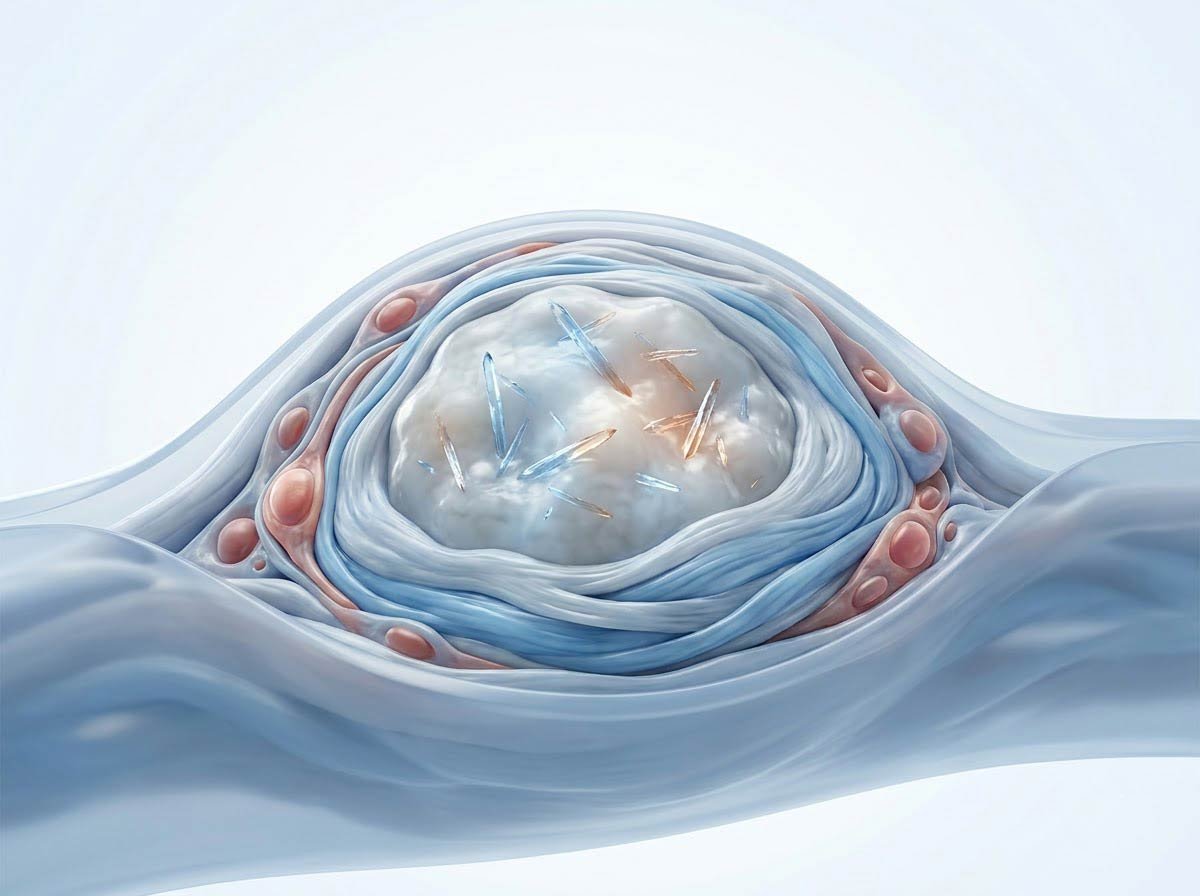
High cholesterol is not a disease you feel — it is a laboratory finding that quietly raises the risk of the diseases that kill most: heart attack and stroke. Roughly 1 in 3 American adults runs a total cholesterol above 200 mg/dL, and the overwhelming majority have no idea, because there are no symptoms — ever. The core fact this page teaches: LDL cholesterol is not merely correlated with atherosclerosis, it is causal — proven by three independent lines of evidence — and lowering it lowers risk, proportionally and predictably.
How High Cholesterol Connects
Reading the Panel — What Each Number Actually Is
A lipid panel is four numbers wearing one name. LDL — low-density lipoprotein — is the causal one: the delivery van that carries cholesterol to tissues, and the one that gets stuck in artery walls. Triglycerides are the fat-transport markers — high levels track with metabolic syndrome, sugar, and alcohol. HDL is the return shuttle; high HDL is generally favorable, though raising it with drugs has famously not panned out — which is why it's no longer a treatment target.
Two newer entries matter. ApoB counts the actual number of atherogenic particles — one per LDL — and is increasingly the single preferred metric, because two people with the same LDL can carry very different particle loads. Lp(a) is an inherited, stickier LDL variant — partly independent of lifestyle — that guidelines now suggest checking once in a lifetime. The causal story belongs to the ApoB-carrying particles: decades of deposition, silent, from your twenties onward.
- LDL: the causal particle. Optimal below 100 mg/dL; treatment thresholds depend on overall risk, not the number alone.
- Triglycerides: the metabolic marker. Below 150 mg/dL is the goal; above 200 deserves attention, usually to sugar, alcohol, and waistline.
- HDL: the return shuttle. Low HDL signals metabolic risk; raising it pharmacologically hasn't reduced events.
- ApoB: the particle count — the 'one number' many lipid specialists now prefer.
- Lp(a): the inherited variant — check once; if high, it sharpens how aggressively the rest is managed.
Familial Hypercholesterolemia: The Natural Experiment That Proved Causality
For decades, critics asked whether LDL was merely a bystander. The answer had been hiding in families: Familial Hypercholesterolemia (FH) — inherited broken LDL-receptor genes affecting roughly 1 in 250 people. With half the usual receptor capacity, their LDL runs 190+ from childhood. Untreated, men with FH face roughly a 50% chance of a heart attack by age 50.
FH is the cleanest natural experiment in cardiology: a single variable — LDL elevated from birth — producing premature, aggressive, predictable disease. Statin trials in the general population then confirmed the other direction: lower the LDL, lower the events, in dose-response, across dozens of trials and hundreds of thousands of patients. Mendelian randomization closed the loop with genetics. LDL is not a bystander. It is the mechanism.
Every adult should know their lipid panel, not just 'cholesterol.' LDL: below 100 optimal, 130–159 borderline-high, 160+ high, and 190+ means FH screening. Triglycerides below 150. Know your 10-year cardiovascular risk score — treatment thresholds follow it, not the raw number. Ask once about ApoB and Lp(a). And if you're over 20 and haven't had a panel in 4–6 years, that's the appointment to make.
Your liver manufactures about one gram of cholesterol a day — roughly five times what a typical diet delivers. 'High cholesterol' was always more a production-and-clearance story than a grocery story.
- High cholesterol produces no symptoms — the first sign is often the cardiovascular event itself.
- Roughly 1 in 250 people carry familial hypercholesterolemia; most don't know it.
- Every cell in your body makes cholesterol; the brain holds about a quarter of your body's total.
- Statin drugs come from a fungus — the original molecule was discovered in a mold culture in 1973.