What is Fatty Liver Disease?
A condition where fat accumulates in the liver of people who drink little or no alcohol.
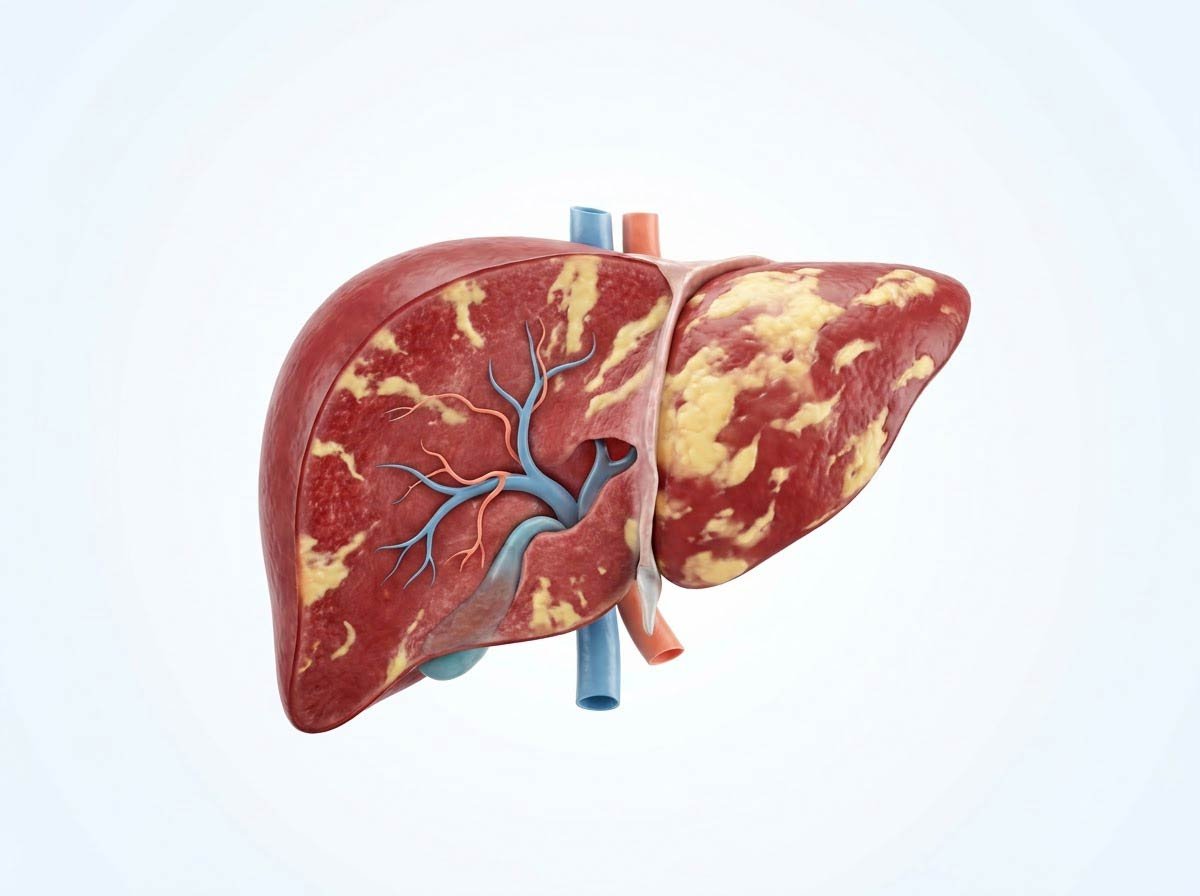
Fatty liver disease — renamed MASLD (Metabolic Dysfunction-Associated Steatotic Liver Disease) in 2023, replacing the older term NAFLD — is the liver manifestation of metabolic dysfunction. Fat infiltrates the liver until it overwhelms the organ's capacity to package and export it. It affects roughly 30% of adults worldwide, about two-thirds of people with type 2 diabetes, and in most people produces no symptoms at all for decades. The defining message of this page: early-stage fatty liver is among the most reversible chronic conditions in medicine — and the treatment is weight loss, not a capsule.
How Fatty Liver Disease Connects
Understanding the Fatty Liver Spectrum
Fatty liver disease exists on a spectrum. Simple steatosis (MASLD) means fat occupies at least 5% of liver cells without significant inflammation — silent, common, and fully reversible. MASH (metabolic dysfunction-associated steatohepatitis, formerly NASH) means the accumulated fat has become toxic to liver cells, drawing inflammation and injury. Sustained injury activates scar-forming cells, producing fibrosis, which in a minority of people progresses over years to cirrhosis — permanent scarring and liver failure risk.
The driver is metabolic: insulin resistance shifts the liver into fat-building mode while visceral fat floods it through the portal vein with raw material. But genetics set the sensitivity — carriers of the PNPLA3 variant accumulate roughly double the liver fat at the same weight, which is why some lean people develop the condition too (lean MASLD, roughly 1 in 5 cases). The single most important number in this field: losing 7–10% of body weight reverses steatosis in most people, and ≥10% measurably improves fibrosis.
- MASLD (simple steatosis): fat in ≥5% of liver cells, no significant inflammation. The reversible stage.
- MASH: fat plus inflammation and liver-cell injury — the progression risk stage.
- Fibrosis (F0–F4): scar tissue accumulating in response to injury. Staging is done by elastography or biopsy; F4 is cirrhosis.
- Cirrhosis: advanced, permanent scarring. Most people with MASLD never reach this stage — but those who do took decades to get there, silently.
- Lean MASLD: the condition in people with normal BMI — driven by genetics and diet composition rather than weight.
The Dallas Heart Study: The Silent Third
In the early 2000s, researchers used MRI spectroscopy — not liver enzymes — to measure liver fat in a diverse Dallas County population. The finding reframed the field: roughly one in three adults had liver fat, making it more common than diabetes. And most of them had completely normal ALT levels.
The study exposed the diagnostic blind spot that still exists today: the routine liver-enzyme test catches only a fraction of fatty liver cases. The disease announces itself through the metabolic picture — weight, waistline, blood sugar, triglycerides — long before it announces itself through the liver's own lab values.
Know your ALT and AST from routine bloodwork, and read them alongside your metabolic numbers: fasting glucose, HbA1c, triglycerides, HDL, and waist circumference. Elevated enzymes with metabolic risk factors deserve a liver evaluation (imaging or elastography). A FIB-4 score — calculated from age, enzymes, and platelets — is the free first-pass tool physicians use to gauge scarring risk. And the therapeutic target to remember: 7–10% body weight loss.
In severe fatty liver, fat can make up over a third of the liver's weight — in an organ whose healthy fat content should be under 5%. The liver absorbs this silently for years, which is exactly why it's so often found by accident.
- Roughly 30% of adults worldwide have fatty liver — most without knowing it.
- About two-thirds of people with type 2 diabetes carry fatty liver.
- Lean people get it too — roughly 1 in 5 cases, driven by genetics (PNPLA3) and sugar intake.
- It was renamed in 2023: NAFLD became MASLD, NASH became MASH — reflecting its metabolic roots.
- 7–10% weight loss is the only intervention proven to reverse early disease and improve fibrosis.