Supplement Forms & Absorption
Walk any supplement aisle and the same nutrient offers itself five ways — magnesium as oxide, citrate, glycinate, malate, threonate; zinc as picolinate, citrate, gluconate — at prices spanning five-fold. The differences are real chemistry: absorption of the same mineral runs from roughly 4% to 40% depending on the form, and the front label's big milligram number is its least honest figure. But the hierarchy the shelf implies is half marketing. This page is the decoder — the label math, the absorption science, the mineral see-saws, and an honest tour of every major form family.

The label, the chemistry, the see-saws
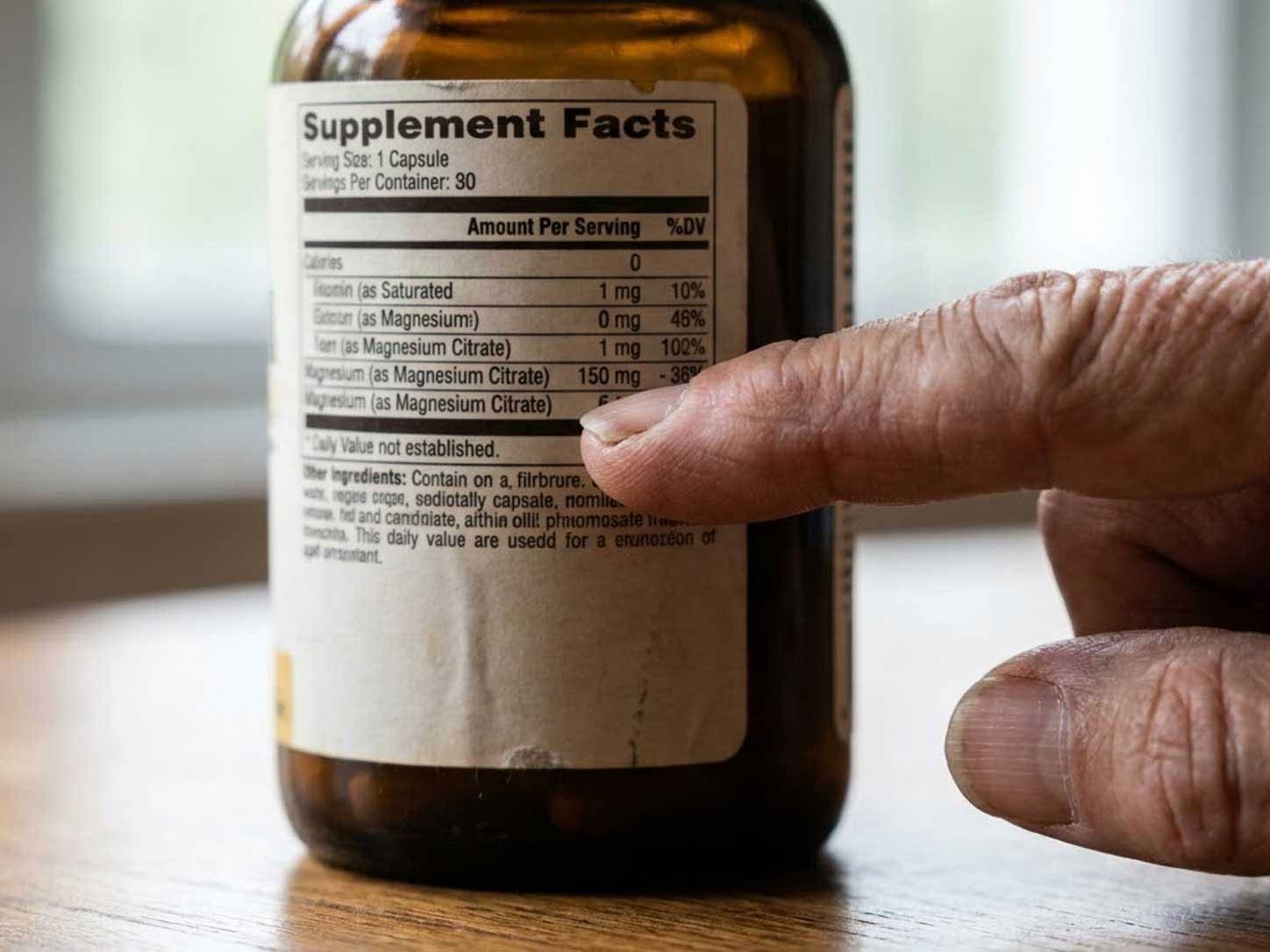
The label math: the number on the front of a mineral bottle is the weight of the whole compound — the mineral bonded to its escort molecule — not the mineral itself. A '500 mg magnesium oxide' pill delivers a fraction of that as elemental magnesium, and then absorbs only a small slice of that; a glycinate or bisglycinate capsule with a smaller front number can deliver more usable mineral. The honest comparison is cost per absorbed milligram — the number no shelf prints, but arithmetic any shopper can run off the back panel. The rule generalizes: the bigger the front number, the more skeptical the reading.
Bioavailability, and why chelation means gentleness: bioavailability is the share of an ingested dose that reaches the bloodstream — and it is where form chemistry earns its keep. Magnesium oxide absorbs at roughly 4%: it mostly stays in the gut, where its presence draws water in — which is why oxide is, functionally, a laxative that happens to carry a mineral claim. Chelation — bonding the mineral to an amino acid like glycine — changes both halves at once: the bonded molecule absorbs several-fold better and doesn't float free in the intestine drawing water, which is the entire reason glycinate and bisglycinate forms are called gentle. Two honest caveats the marketing skips: absorption percentages are approximations from small pharmacokinetic studies, not precise constants — and blood-level bioavailability is not the same thing as clinical benefit when your status is already adequate.
The see-saws and the gate: minerals share doors, and the sharing has consequences. Zinc and copper compete for the same intestinal transport — chronic high-dose zinc reliably induces copper deficiency, with anemia and neurologic symptoms that can persist; the 40 mg daily ceiling exists precisely to protect the mineral you're not taking. Calcium and iron block each other at their shared channel — a reason to schedule calcium-heavy supplements and iron apart, and a quiet partial self-cancellation inside some multivitamin mineral blends. And the most elegant regulation of all: hepcidin, the hormone that closes iron's absorption door after every dose and keeps it shut for roughly a day — the discovery behind the flipped dosing advice that alternate-day iron can absorb more total mineral than daily dosing, with fewer gastrointestinal side effects. The body regulates at the door; smart dosing works with the door, not against it.
The form tours, honestly graded: magnesium — oxide the cheap laxative-tier standard; citrate well-absorbed and gently osmotic (the regularity form); glycinate chelated, gentle, the calm-and-sleep favorite with the glycine bonus; malate and threonate carrying specialized claims whose unique evidence remains thin. Iron — sulfate the most-studied standard; fumarate denser in elemental iron; gluconate gentler with less; bisglycinate the chelated gentlest — with the pairing chemistry (vitamin C unlocks, tea and coffee brake) living on the Iron & Nutrition page. Zinc — picolinate and bisglycinate wear chelated premium labels whose head-to-head evidence outpaces modestly; citrate and gluconate are common and adequate; and the one place form genuinely changes the intervention is the lozenge — acetate and gluconate dissolving slowly across throat tissue deliver zinc where a swallowed capsule never goes. B12 — cyanocobalamin, the cheap stable synthetic, converts to active forms as a routine step and raises blood levels effectively (the trace-cyanide fear is chemistry turned into marketing); methyl- and adenosylcobalamin are the active coenzymes with narrow genuine niches; and injections exist because the gut cascade breaks — not because the cheap form fails. Vitamin D — D3 sustains blood levels meaningfully better per unit than D2, and lichen-sourced D3 now covers the plant-based gap D2 used to own.
The gut dependency, the red flags, and the frame: everything above happens downstream of the stomach — acid releases minerals from food and B12 from its protein bound form, which is why long-term acid suppressors quietly cut absorption of iron, B12, and calcium while the fridge stays full (the Gut page's cascade story, priced in supplement form). Berberine's famous ~5% absorption is the same story reframed: poorly absorbed, yes — and increasingly understood as gut-first mechanism, the microbiome mediating the effect. The red flags when you read a form label: proprietary blends that hide amounts, 'clinically superior form' claims resting on blood-level studies rather than outcomes, and IV-dose comparisons selling oral bottles. And the frame that closes: food first, need established by testing — and only then the form, which is the last mile of a supplement decision, never the first. A consistent, adequate, well-absorbed form taken regularly beats the theoretically optimal molecule taken occasionally. The tour is worth knowing; the routine is what works.
- The front label's milligrams are compound weight — the back panel's elemental line is the real dose.
- Absorption runs ~4% (magnesium oxide) to ~40% (glycinate): real chemistry, honest approximations.
- Chelation = gentleness: bonded minerals absorb better and don't draw water into the gut.
- Zinc and copper share transport — the 40 mg ceiling protects the mineral you're not taking.
- Hepcidin closes iron's door for ~24 hours: alternate-day dosing can out-absorb daily.
- B12's cyano form converts routinely — the fear story is marketing; the injection exists for broken cascades.
- No form beats consistency: the molecule is the last mile of the decision, not the first.
“The milligram count is the least honest number on the bottle. The form is the most useful — and neither is the first question.”
— The decoder principleThe factor families
The label math
Compound versus elemental weight, cost per absorbed milligram — the arithmetic that deflates the front label.
The see-saws
Zinc-copper, calcium-iron — minerals competing for shared doors, and the scheduling that keeps the peace.
Explore Zinc →The absorption gate
Hepcidin's day-long iron door and the acid that releases everything — regulation happening at the entrance.
Explore Gut Health & Digestion →The gentle chemistry
Chelation: bonding minerals to amino acids so they absorb better and bother the gut less.
Explore Magnesium →The story, frame by frame


The form families — and the route into each
Every card links to a full BodyFinds journey, where each mineral's form story lives in full: foods, testing, dosing science, and honest products.
The form-spread showcase — oxide to glycinate, the label math, the gentle-chemistry standard.
supplementThe salt tour and the hepcidin gate — alternate-day dosing science and the test-first rule.
supplementThe see-saw mineral — copper competition, the 40 mg ceiling, and the lozenge exception.
supplementThe conversion chemistry — cyano's routine activation and the injection's real reason.
supplementThe two-molecule race — D3's per-unit advantage and the lichen source.
supplementThe upstream dependency — acid release, the B12 cascade, and what suppression quietly costs.
research-topicThe 5% reframed — poor absorption as gut-first mechanism, the microbiome as mediator.
supplementWhy are there different forms of magnesium?
The complete form-question journey — the shelf tour, the label math, the purpose matching, and the honest grading of every bottle.
Where this information comes from
- NIH ODS — Magnesium Government
- NIH ODS — Iron Government
- NIH ODS — Zinc Government
- NIH ODS — Vitamin B12 Government
- NIH ODS — Vitamin D Government
- PubMed — Iron Absorption and Dosing Schedule (Stoffel et al.) Database
- FDA — Dietary Supplements Government