Inside the butterfly governor.
What does the thyroid do — and why does a 25-gram butterfly run every cell you own?
The thyroid is a 25-gram, butterfly-shaped gland at the base of your neck that sets the metabolic speed of every cell in your body — heart rate, body temperature, digestion speed, thinking speed, how fast you burn fuel at rest. It does this with a design no other organ shares: its cells are the only cells in the body that capture iodine, they weld that iodine onto a protein scaffold and store months of finished hormone in a warehouse (unique among endocrine glands), and its output is mostly a prohormone — T4 — that other tissues convert to the active form using selenium-dependent enzymes. Understanding the trap, the warehouse, and the cascade explains everything from why thyroid disease is gradual to why Chernobyl caused thyroid cancers — and why a iodine pill can prevent them.
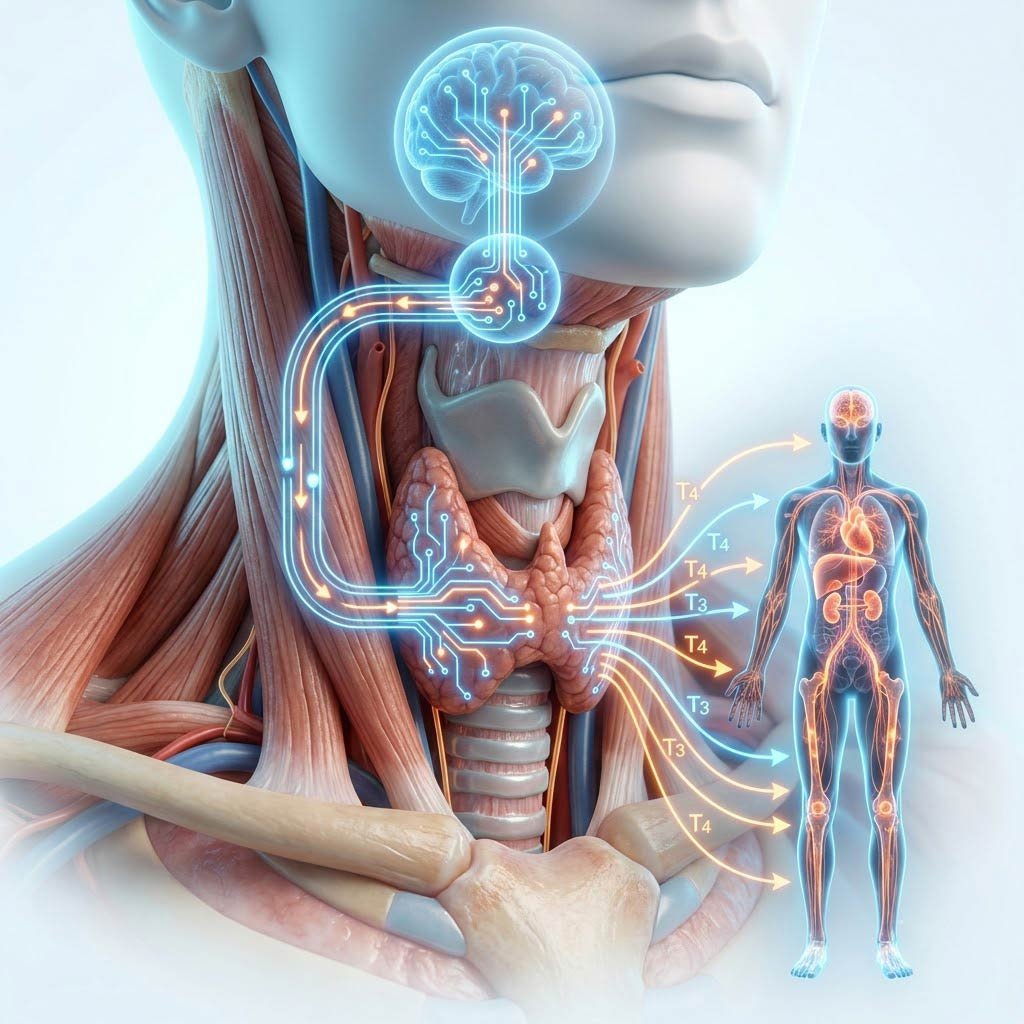
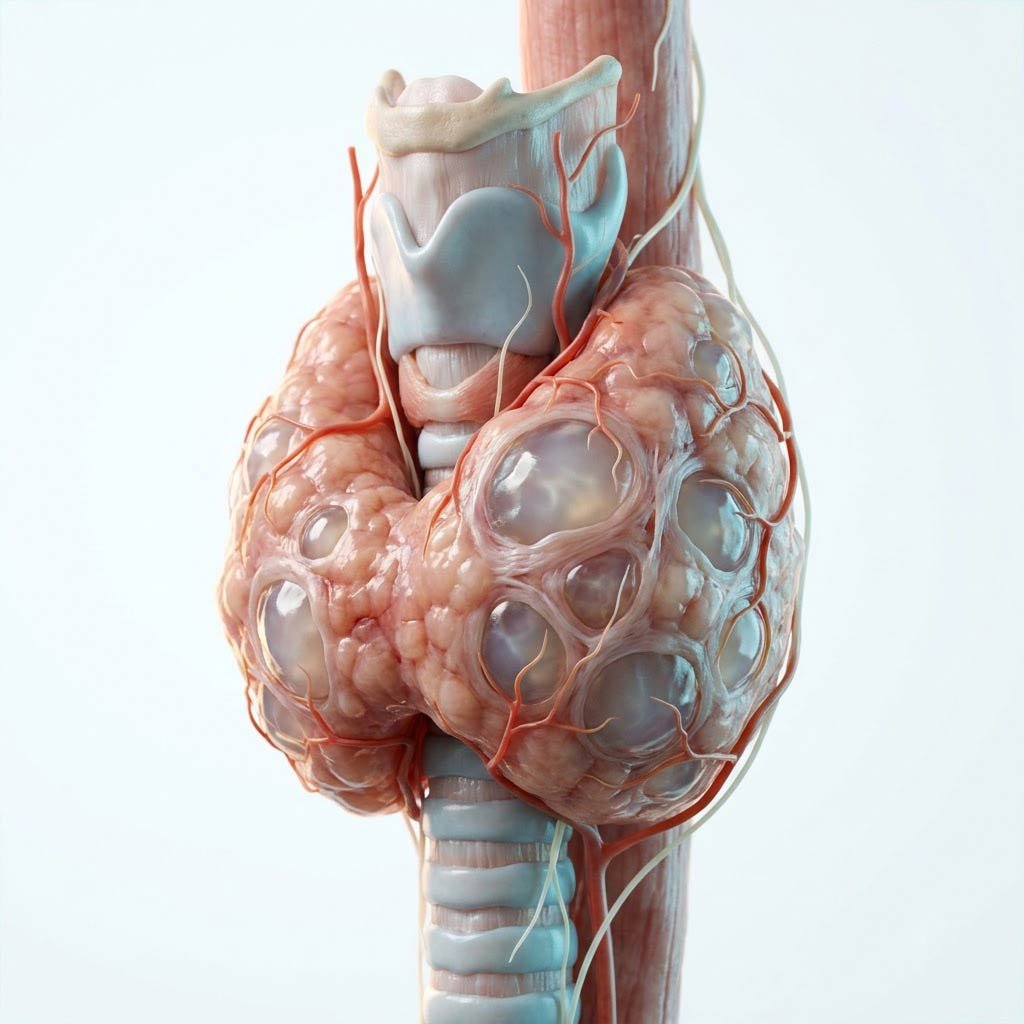
A butterfly of tissue wrapped around the trachea, built from a million microscopic follicles — each a ring of iodine-capturing factory cells around a lake of stored hormone (colloid). Commanded by TSH from the pituitary, feeding back through the same line, and delivering its hormone to receptors on literally every cell in the body.
The Anatomy of the Iodine Trap
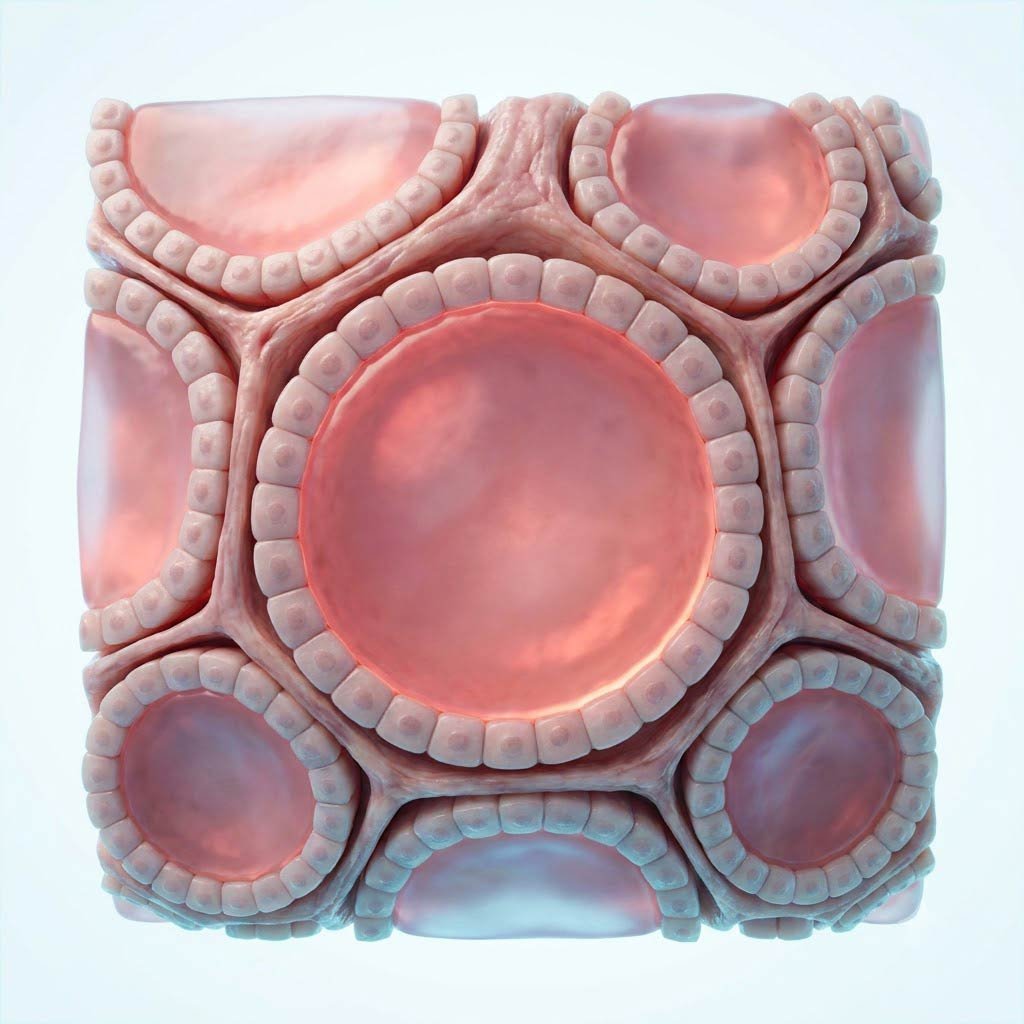
The thyroid's signature anatomy is the follicle: a ring of epithelial cells surrounding a lake of protein-rich colloid. The factory cells carry the NIS symporter — a molecular pump that grabs iodide from the bloodstream and concentrates it inside the cell at 30–40 times blood levels. No other cell in the body does this. The captured iodine is welded onto thyroglobulin, a giant protein scaffold stored in the colloid lake — and when TSH's order arrives, the cells slice finished T4 (and a little T3) off the scaffold and release it into the richest blood flow, gram for gram, of any organ in the body.
The warehouse design has a clinical consequence: the thyroid stores 2–3 months of finished hormone — the only endocrine gland that stockpiles its product. This is why thyroid disease is gradual: the autoimmune burn of Hashimoto's drains the warehouse over years before hormone levels ever fall, and why thyroid medication changes take six weeks to judge — the body's hormone pool turns over slowly. The gland's most distinctive feature (the iodine trap) and its most distinctive design choice (the warehouse) together explain the disease patterns our thyroid-disorders page maps.
Follicular Cells
The only iodine-capturing cells in the body
Colloid Stores
Months of hormone warehoused — why disease is slow
C-Cells
The calcitonin cells — the gland's calcium player
NIS Symporter
The iodine trap — the gland's signature and its vulnerability
The Conversion Cascade — The Organ's Systemic Reach
The thyroid's most underappreciated design: it ships a draft, and the body finishes it:
- T4 is the prohormone: ~93% of the gland's output — long-lived, circulating storage that does little until converted.
- T3 is the active hormone: ~7% made in the gland, ~80% converted from T4 in the liver, muscle, and brain — by deiodinase enzymes built around SELENIUM. The organ's chemistry extends into every tissue; the selenium story (Chapter 5) is this chemistry.
- Reverse T3 is the inactive mirror: the same T4 can be converted into a molecule that looks like T3 but does nothing — a metabolic brake pedal whose role in illness and stress remains an active research question, honestly graded.
- Every cell carries the receptor: there is no tissue in the body without thyroid-hormone receptors — which is why the symptoms of thyroid disease span heart rate, temperature, digestion, mood, hair, skin, and cognition simultaneously. The governor governs everything or the symptoms wouldn't.
- Calcitonin — the fourth hormone: from the C-cells scattered between follicles, a minor player in calcium regulation that matters clinically mainly as a marker for the rare medullary thyroid cancer.
Your thyroid is a 25-gram butterfly that runs on an element no other cell will touch, stores months of hormone in a warehouse no other gland keeps, and sets the metabolic speed of every cell you own. When the dial drifts, nothing in the body stays untouched.