Inside the living barrier.
What is skin — and why is the body's largest organ also its immune frontier, vitamin D factory, and the most honest mirror of your inside?
Your skin is ~2 square meters of living wall — the largest organ you own — a three-layer system rebuilt from scratch every month: an epidermis that marches its cells upward into a brick-and-mortar barrier, a dermis of woven collagen (the loom that gives skin its strength), and a fatty insulation beneath. But the wall metaphor undersells it. Skin is an immune organ (sentries live inside the barrier itself), an endocrine organ (it manufactures vitamin D3 from sunlight — the first step of the pathway our vitamin-d3 page teaches), a sensory surface (millions of receptors — the nervous system's largest antenna), and a thermostat (2–4 million sweat glands running evaporative cooling). It is also the only organ you and everyone else can see — which makes it medicine's most honest mirror: diabetes, thyroid disease, liver disease, and nutritional deficiency all write on the surface. The modern message this page teaches: skin is a barrier system first, and most of what the beauty aisle sells it is cosmetics chemistry, not organ medicine.
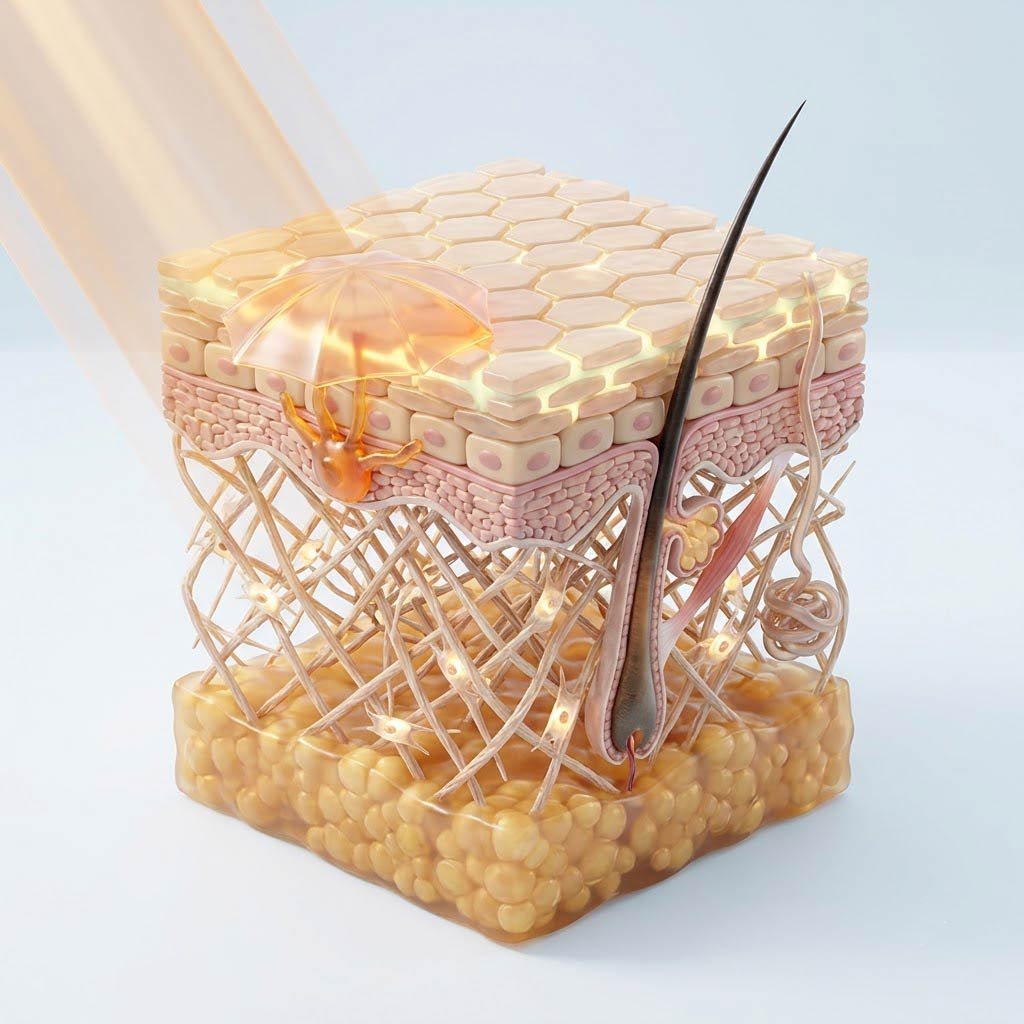
The architecture: the epidermis (the barrier — keratinocytes born at the base, dying into a brick-and-mortar surface as they migrate upward, melanocytes donating UV-shield pigment from below), the dermis (the strength — fibroblasts weaving collagen and elastin around the vascular and nerve networks, plus every follicle and gland), and the hypodermis (insulation, energy reserve, the shock absorber). The surface is replaced roughly every 28 days — a new wall, monthly, for a lifetime.
The Anatomy of Barrier and Renewal
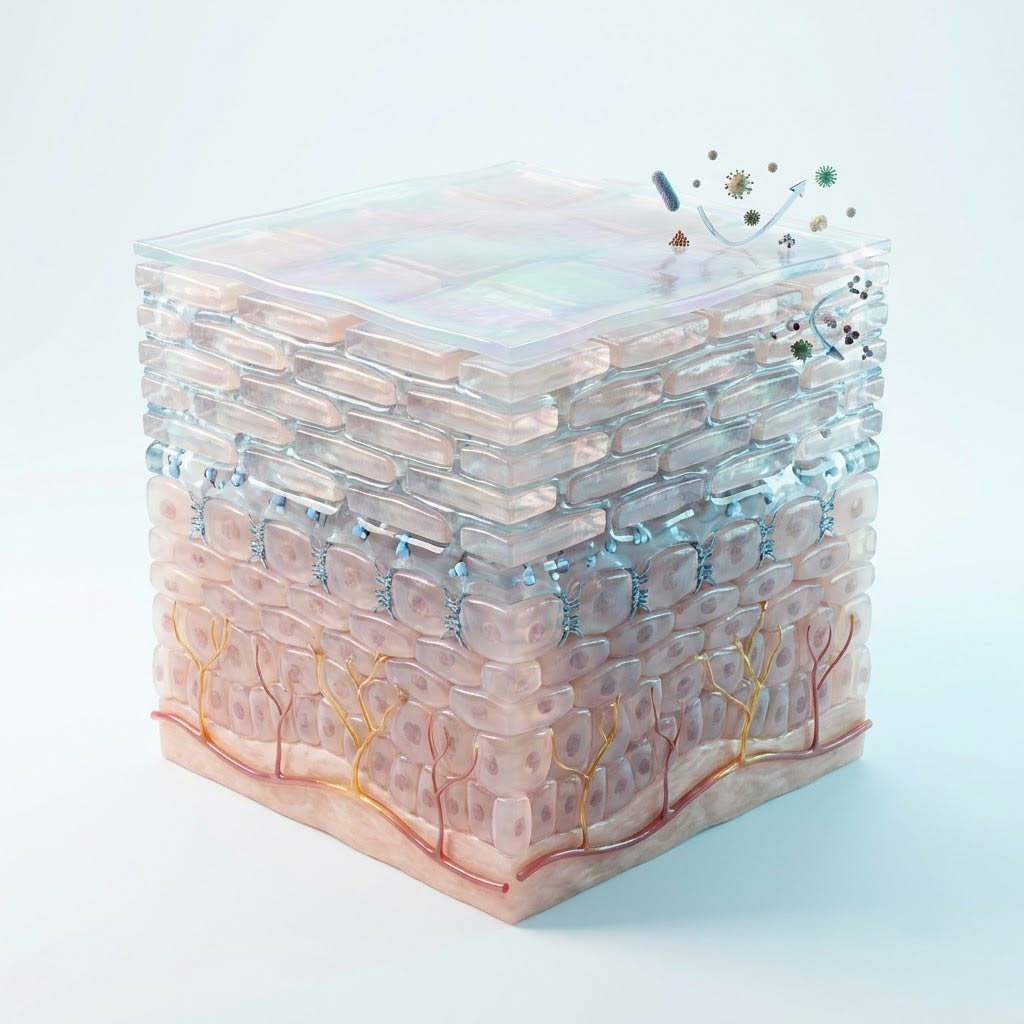
The epidermis is a one-way march. Keratinocytes — more than 90% of epidermal cells — are born by division in the basal layer, then spend their lives migrating upward, flattening, filling with keratin, and dying into the stratum corneum: the outer wall of flattened, dead cells (the bricks) sealed in stacked lipids (the mortar). The whole journey takes about 28 days — a complete new surface every month. Interspersed at the base are the melanocytes, one for every ~30 keratinocytes, packaging melanin and donating it upward — the built-in UV shield (the tan is damage control, not health), and the source of the Fitzpatrick skin-type gradient that defines each person's sun-risk arithmetic. And living inside the barrier itself: Langerhans cells — immune sentinels standing watch in the wall, sampling everything that touches it. The skin's barrier is not a fence around the immune system; it is a staffed border.
Beneath, the dermis is the organ's strength and its engine room: fibroblasts weaving the collagen I lattice (the loom that makes skin the body's protein-richest visible tissue — and the target of every 'collagen' claim this page grades), elastin fibers for recoil, the vascular network that blushes, flushes, and radiates heat, and the nerve endings that make skin the body's largest sensory surface. The appendages descend from here: hair follicles (each a mini-organ with its own stem-cell reservoir — our hair-health topic's entire territory, resident in this organ), sweat glands (the 2–4 million evaporative-cooling units), and sebaceous glands (sebum — the skin's own moisturizer, the acid mantle's lipid half, and the fuel of acne). The hypodermis beneath cushions, insulates, and stores — the organ's foundation and energy bank.
Keratinocytes
The bricks — 90%+ of epidermal cells, the 28-day upward march
Stratum Corneum
The wall — dead cells in lipid mortar, the barrier proper
Fibroblasts
The collagen loom — the dermis's architects and repair crew
Melanocytes
The UV shield — the tan is damage control, not health
Beyond the Wall: The Organ's Four Other Jobs
The barrier is the headline, but the organ runs five systems at once — each one a destination elsewhere in this library:
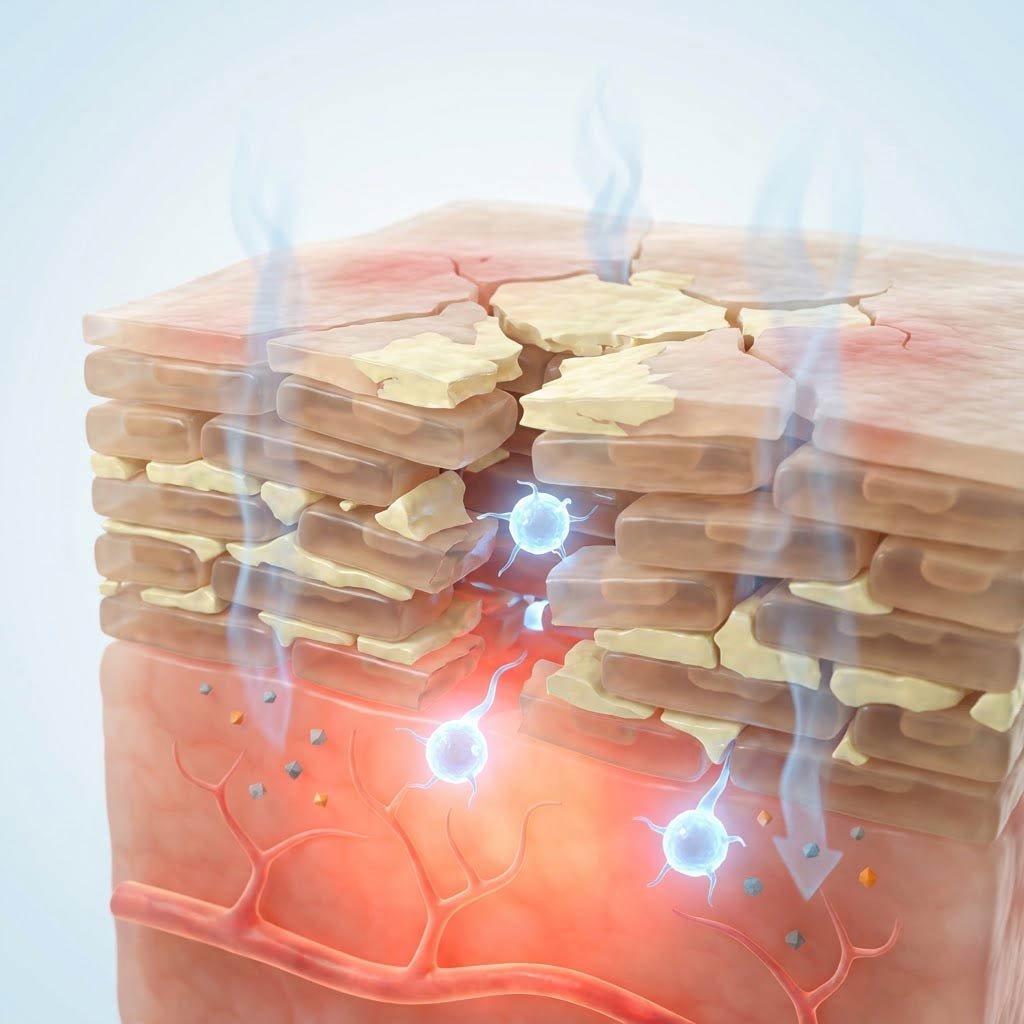
- The immune frontier: the physical wall plus antimicrobial peptides, the acid mantle (pH ~4.5–5.5, hostile to most pathogens), and Langerhans sentinels — the border where the outside world meets the immune system (our immune-health topic's outermost layer).
- The endocrine factory: UVB converts 7-dehydrocholesterol in the epidermis into previtamin D3 — the first step of the pathway our vitamin-d3 page teaches, with the kidney finishing the activation (our kidneys page's enzyme). Sunscreen rightly blocks the reaction; the answer is the supplement, never the burn.
- The thermostat: sweat evaporation plus dermal blood-flow shunting — the organ that holds core temperature at 37°C through deserts and saunas alike.
- The sensory interface: millions of touch, temperature, pain, and vibration receptors — the nervous system's largest antenna (our nervous-system pages' territory, told from the surface).
- The aging clock: dermal collagen declines ~1% per year after maturity — and UV exposure accelerates the loss (photoaging: the extrinsic clock stacked on the intrinsic one). The reason sun protection outranks every bottle is arithmetic: the extrinsic clock is the one you control.
Your skin is two square meters of living wall — rebuilt from scratch every 28 days, staffing an immune border, manufacturing a hormone in the sunlight, and wearing your inside health on its outside. Guard the barrier; the barrier guards you.