Inside the gland at the gate.
What is the prostate — and why does a gland the size of a walnut run the entire male urinary story simply by where it sits?
The prostate is a walnut-sized donut wrapped around the urethra at the bladder's exit — and its position, more than any other fact, writes its disease story. It is a secretory gland (producing 20–30% of semen's volume, plus PSA — a liquefaction enzyme that became the world's most contested blood test), it holds the highest zinc concentration of any tissue in the body (roughly ten times plasma), and it is testosterone-dependent for life — with a second growth spurt beginning in the 40s that swells the inner ring of the donut around the pipe. That growth is nearly universal: by their 60s, half of men carry histologic enlargement; by 85, nearly nine in ten. The page's central anatomy: the gland has two zones that age in opposite directions — the inner transition zone that swells (BPH's home) and the outer peripheral zone where cancers arise (the digital exam's target) — one gland, two diseases, two completely different conversations. This page teaches the plumbing and both conversations; our bladder page taught the downstream organ.
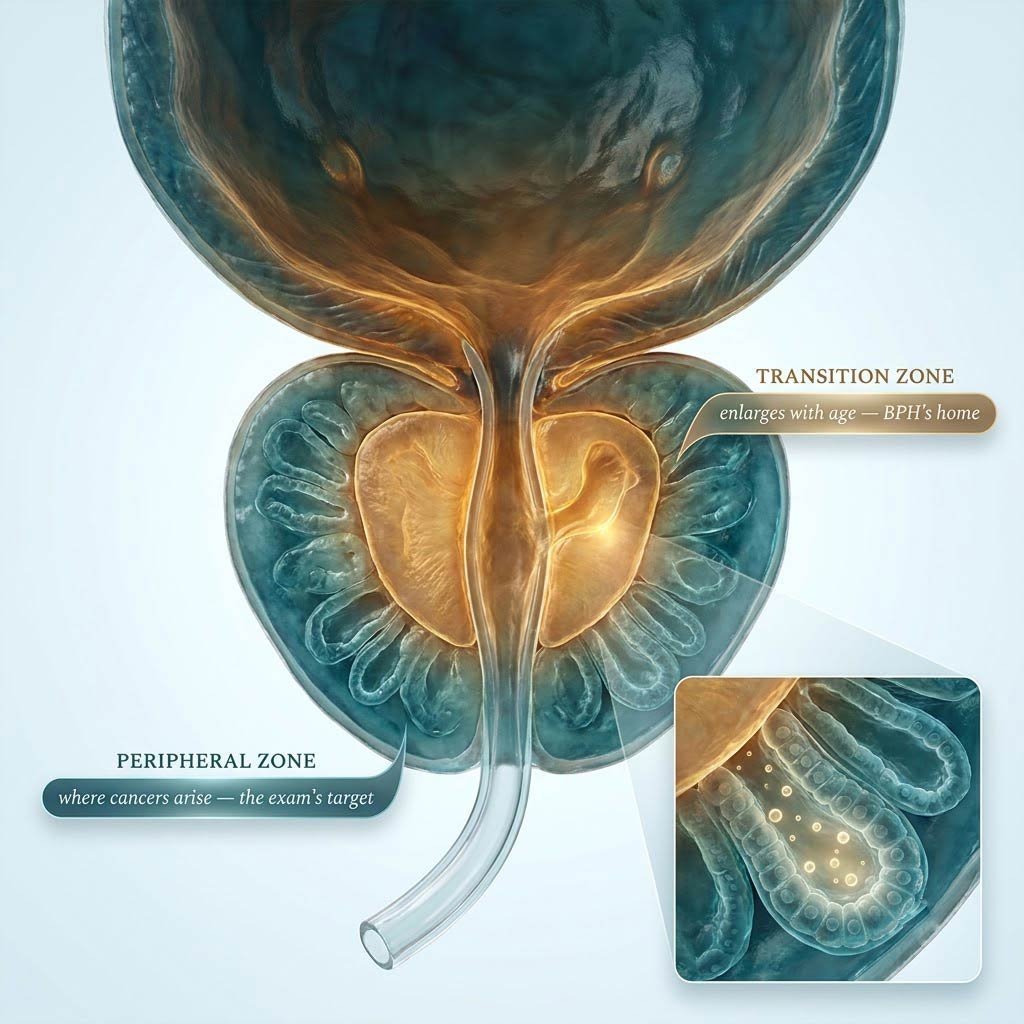
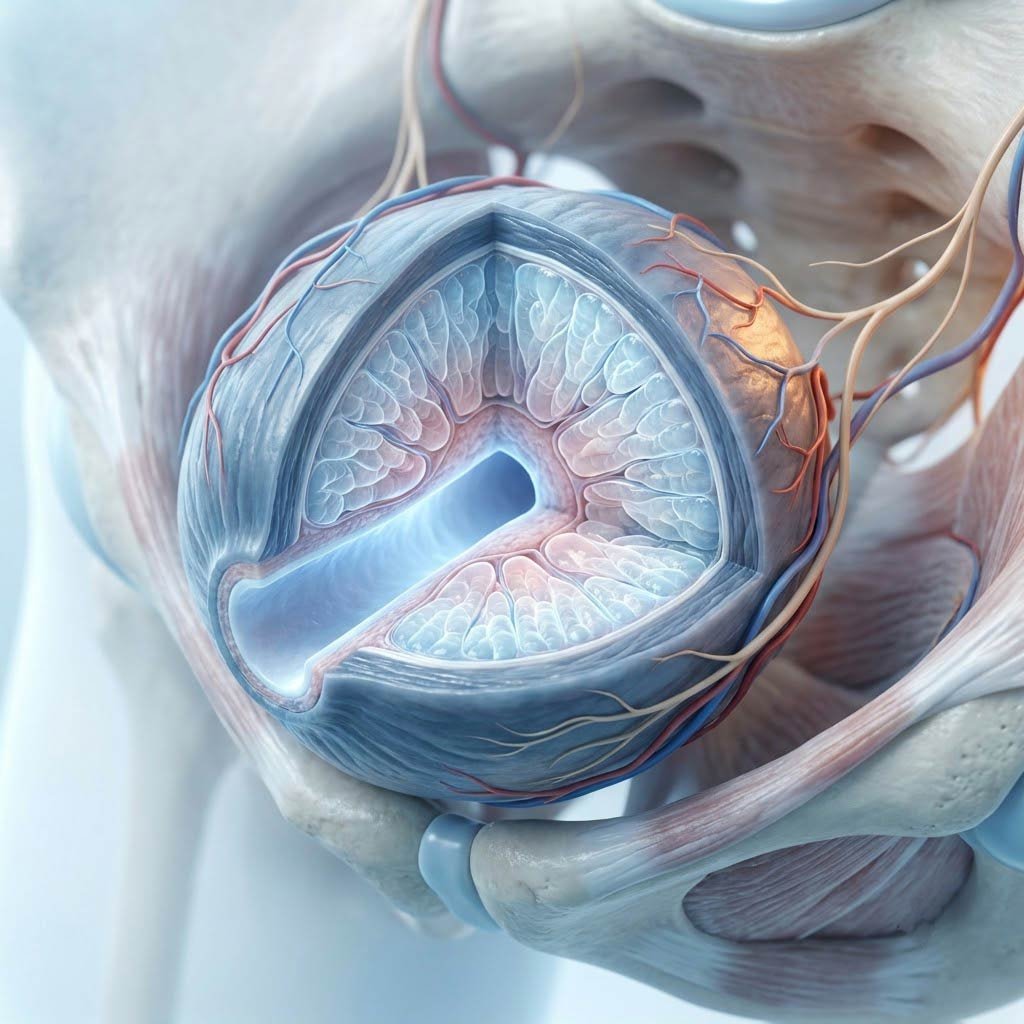
The architecture: a fibromuscular gland (~20 g in a young man, growing for life) sitting directly below the bladder, encircling the urethra's first stretch. Inside, three zones with different destinies: the TRANSITION ZONE (the inner ring — enlarges with age; BPH's origin), the PERIPHERAL ZONE (the outer belt — ~70% of cancers arise here; the digital exam's target), and the CENTRAL ZONE (the cone around the ejaculatory ducts). The gland's secretions — citrate, zinc-rich antibacterial fluid, PSA (the semen-liquefying enzyme), and the clot-and-liquefy chemistry of ejaculation — make up a fifth to a third of semen volume. The capsule's smooth muscle carries alpha-1 receptors: the dynamic half of obstruction.
The Anatomy of Position, Zones, and the Second Growth
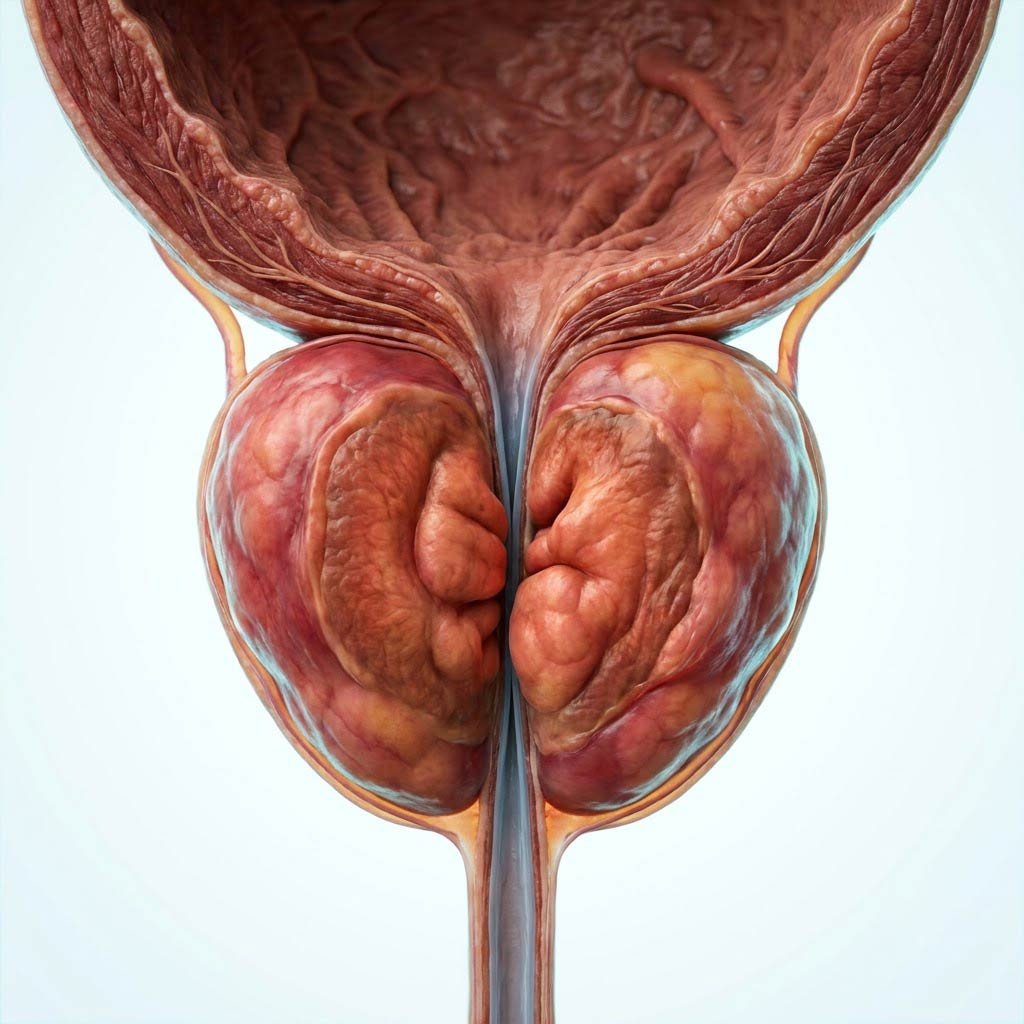
The position is destiny. The prostate wraps the urethra immediately below the bladder, at the very gate the bladder must open to empty — which means an enlarging gland compresses the pipe from the inside, like a fist closing around a straw. This is why a gland with no role in urination whatsoever can dominate the urinary story: BPH is not a bladder disease or a kidney disease — it is a plumbing disease caused by geography. And the obstruction has two components urology teaches as a pair: static (the enlarged tissue physically narrowing the channel) and dynamic (the capsule's smooth-muscle tone, under alpha-1 adrenergic control, tightening the gate on demand). The two components explain the Rx tier's two drug classes exactly: alpha-blockers relax the dynamic squeeze (working in days), while 5-alpha-reductase inhibitors shrink the static mass (working over months by starving the gland of DHT — the hormone story below). One disease, two levers, two prescriptions.
The zones are the second great anatomy lesson: the same gland ages in two opposite directions at once. The inner transition zone — a tiny fraction of the young gland — begins growing in the 40s under the influence of DHT (dihydrotestosterone, testosterone's locally-converted, more potent cousin), and grows for life: this is BPH, the compression story, the stream's slow narrowing. The outer peripheral zone — the majority of the gland's tissue — is where ~70% of cancers arise, growing outward where there is room to hide for years: this is the digital rectal exam's logic (the peripheral zone is the part a finger can actually reach) and the biopsy's map. The two diseases barely overlap: enlargement does not cause cancer, cancer does not cause enlargement — one gland, two independent clocks. The man with a 'big prostate' on imaging has a BPH conversation; the man with a nodule in the peripheral zone has a cancer conversation; and confusing the two is the internet's favorite prostate error.
The secretory chemistry completes the picture. Prostatic fluid is a concentrate: citrate (an energy substrate at concentrations found nowhere else), zinc at roughly ten times plasma levels (an antibacterial defense — one reason young prostates rarely infect), vitamin C and anti-clotting factors — and PSA, a liquefaction enzyme whose day job is un-clotting semen after ejaculation. PSA's fame came later: a lab marker for prostate activity that became a monitoring test (1986), then a screening test (1994), then the most argued-about blood test in medicine (Chapter 5's story) — a liquefaction enzyme carrying the weight of a screening debate. The gland's chemistry is real; the test's meaning is a conversation; and the honest page keeps the two separate.
Transition Zone
The inner ring that swells — BPH's home, the stream's squeeze
Peripheral Zone
The outer belt where ~70% of cancers arise — the digital exam's target
The Capsule's Muscle
Alpha-1 tone — the dynamic obstruction, the blocker's lever
The Zinc Bank
10× plasma — the antibacterial secretions that mislead the megadose marketing
The Gland's Rules — and the Conversations They Set Up
Four economies of the gate gland organize the rest of the page:
- Enlargement is universal; obstruction is individual: histologic BPH reaches nearly 90% of men by 85, but symptoms vary enormously — some 60 g glands obstruct little, some 30 g glands obstruct badly. The size predicts poorly; the symptom score (IPSS — this chapter's drawer) is the instrument that actually grades the journey. Nobody treats a size; everybody treats a score and an exam.
- BPH does not cause prostate cancer — the zones barely speak: the enlargement conversation and the cancer conversation are different appointments with different tools (symptom score and flow versus PSA, exam, MRI, and biopsy). The internet's conflation — 'enlargement means cancer risk' — is false, and the honest page retires it early so both real conversations can happen cleanly.
- Finasteride halves PSA — and that's a reading rule, not a problem: the 5-ARIs that shrink the gland also drop PSA by roughly 50%, which means a man on finasteride needs his PSA interpreted on a different baseline (doubling his number, roughly, to compare). The standing teaching of every urology clinic, and a perfect example of why medications belong in the lab conversation (the estate's medication-review rule, PSA edition).
- The night is the symptom canary: the stream drifts so slowly over years that daytime symptoms are normalized away — but nocturia is counted: one trip is common, two is a score, three is a conversation. And the page's elder-safety note, rarely taught: the 3 AM bathroom trip is where hips break — nocturia's real danger in older men is the fall on the way, which makes the treatment conversation a fracture-prevention conversation too.
Your prostate is a walnut wrapped around your exit pipe — an inner ring that swells in nine of ten men who reach 85, an outer belt where cancers quietly grow, a gland whose position writes its entire disease story. The stream tells it early, the score puts a number on it, and every tier that treats it is real. Endurance is the only wrong answer.