Inside the countdown organ.
What are the ovaries — and why is this the only organ in the body born with its entire lifetime supply?
The ovaries are two almond-sized organs running two clocks at once: a monthly cycle (the HPO axis's hormonal loop — hypothalamus, pituitary, ovary — the same thermostat architecture our thyroid page teaches) and a lifelong countdown that no other organ runs. Every other organ regenerates — skin monthly (our skin page), blood continuously (our blood page's 2.4 million cells per second), even brain and muscle slowly. The ovary cannot: a female is born with roughly 1–2 million follicles, loses them continuously from before birth, and by menopause the supply is spent — of the original million, only ~400 ever ovulate. This fixed endowment is the page's organizing fact: it makes the ovary the only organ that ages by design, makes menopause a species-level feature rather than a malfunction, and makes the follicle — not the cell — the unit of ovarian medicine. The organs run a dual business: the endocrine ovary (estrogen, progesterone, and testosterone — hormones that reach bone (our bones page's density story), heart, brain, and skin) and the reproductive ovary (one selected follicle per cycle, one egg released, one corpus luteum's month of progesterone).
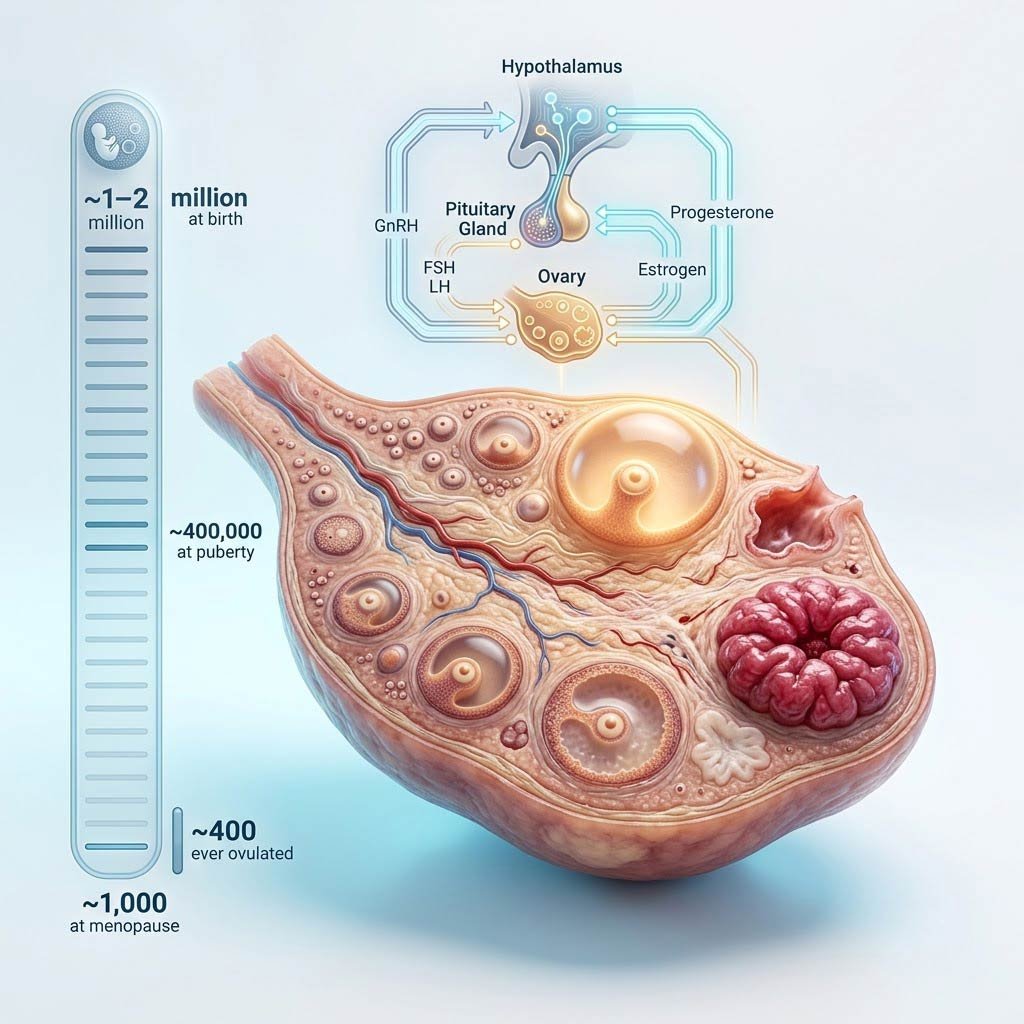
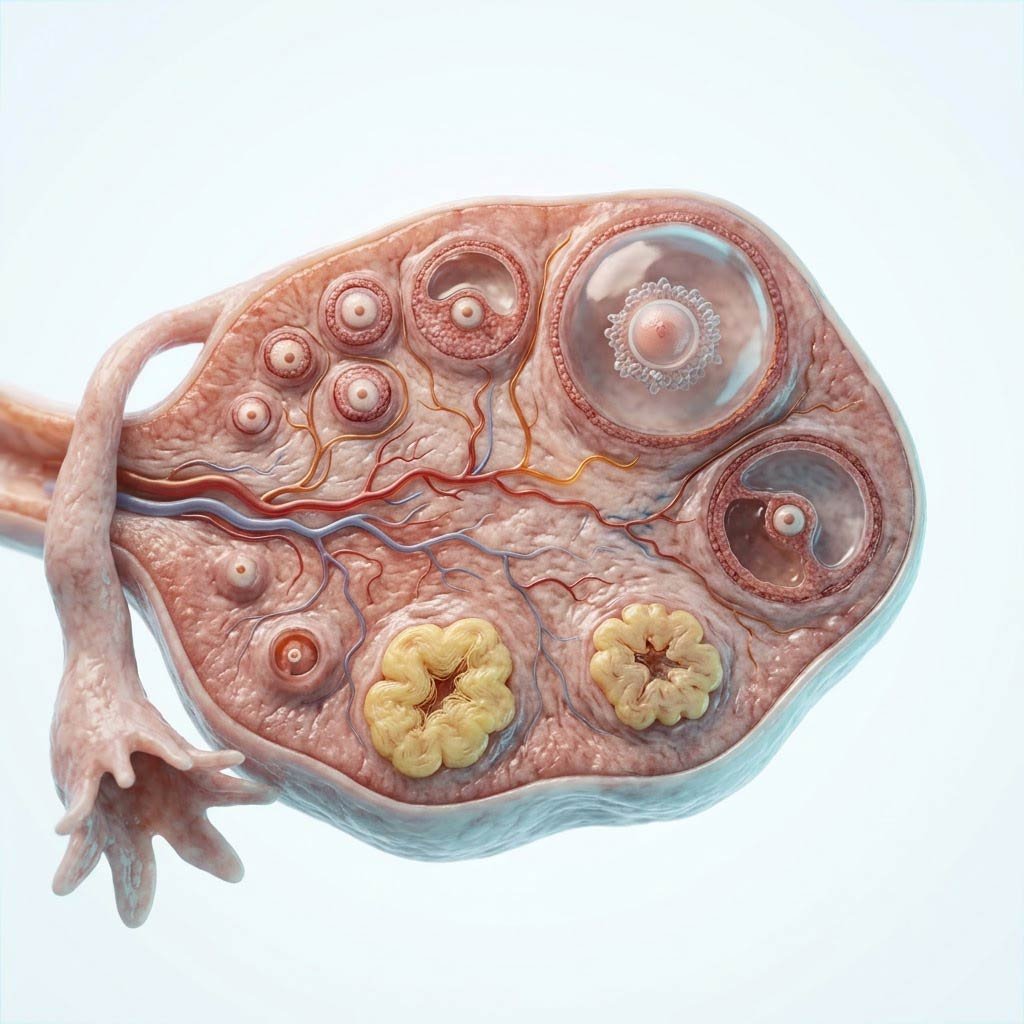
The architecture: the cortex (the follicle bank — primordial follicles in their thousands, sleeping since before birth), the monthly recruitment (FSH wakes a cohort; one becomes dominant; the rest are lost), ovulation (the LH surge releasing the egg at mid-cycle), the corpus luteum (the dominant follicle's afterlife — a progesterone factory for two weeks, the cycle's second half), and the two-cell system (theca cells producing androgens, granulosa cells converting them to estrogen — the cooperation PCOS breaks). Above it all, the HPO axis: GnRH pulses from the hypothalamus, FSH and LH from the pituitary, ovarian steroids feeding back — the monthly thermostat.
The Anatomy of Two Clocks and One Countdown
The monthly clock is the cycle, conducted by the HPO axis. The hypothalamus pulses GnRH; the pituitary answers with FSH (follicle-stimulating hormone) and LH (luteinizing hormone); the ovary responds — and its hormones feed back to slow the signals down. The month in three acts: the follicular phase (FSH recruits a cohort; one follicle wins dominance and pours out estrogen), ovulation (the mid-cycle LH surge, triggered by peak estrogen's switch from negative to positive feedback — one of biology's rare flip-signals — releases the egg), and the luteal phase (the emptied follicle becomes the corpus luteum, a temporary gland producing progesterone to hold the uterine lining ready). No pregnancy, and the luteum regresses after ~14 days; the progesterone withdrawal is what menstruation is — not the body 'flushing', but the lining responding to the hormone's departure. The whole system is a thermostat loop with a monthly pulse: elegant, tunable, and the reason ACOG calls the menstrual cycle a vital sign — a window on the endocrine system as informative as blood pressure.
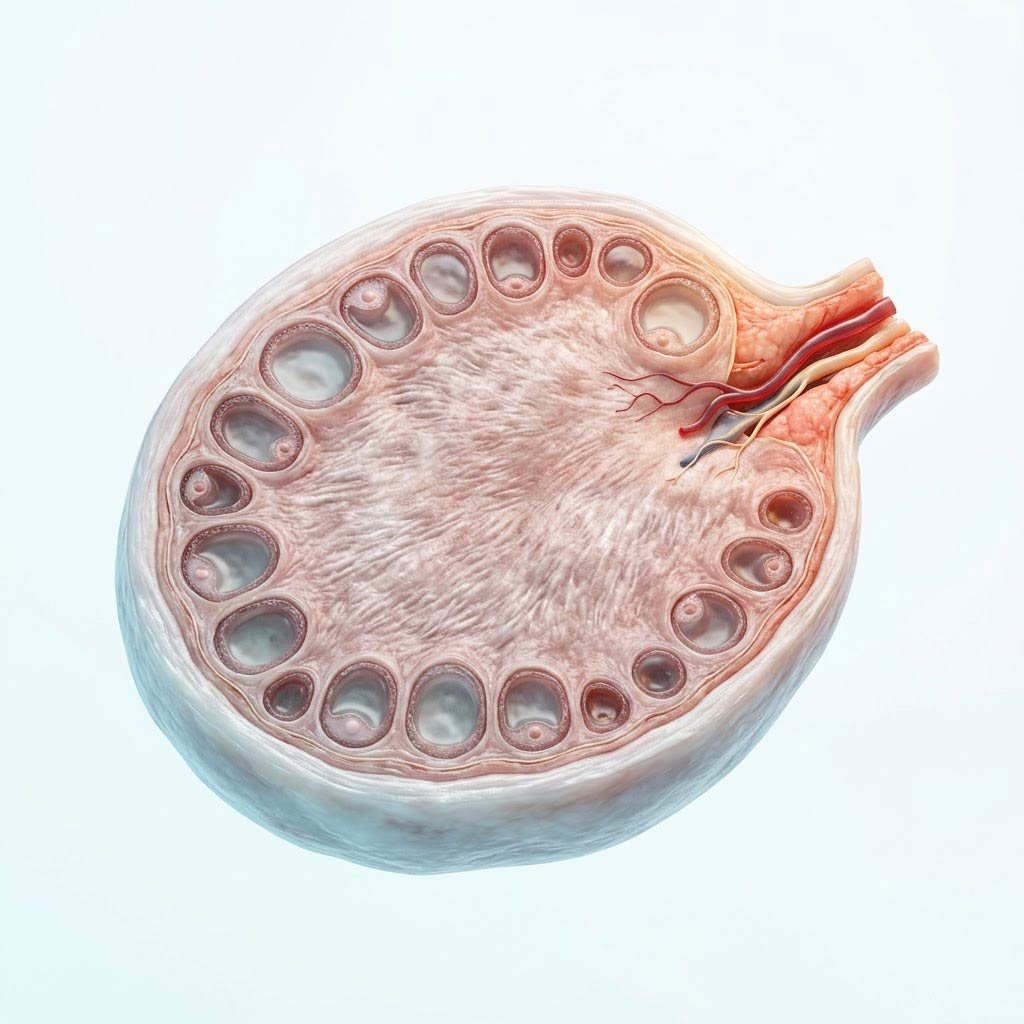
The two-cell system is the estrogen engine, and the place PCOS breaks it. Theca cells (the follicle's outer layer) respond to LH by producing androgens — testosterone and its precursors; granulosa cells (the inner layer, FSH-responsive) contain the enzyme aromatase, which converts those androgens into estradiol. The cooperation is the design: theca makes the raw material, granulosa refines it. In PCOS, the loop distorts — high insulin drives the theca cells to over-produce androgens while suppressing the liver's SHBG (raising free testosterone), and FSH's aromatase effort can't keep the refinery pace: androgens accumulate, follicles stall before dominance (the 'string of pearls' of Chapter 1's comparison image), and the cycle lengthens or stops. The syndrome's full name — polycystic ovary syndrome — names the organ, but the engine is metabolic: insulin resistance is present in the majority of women with PCOS, including the lean (our diabetes page's machinery, read from the ovary).
The countdown clock is the page's great difference. The follicle supply peaks at ~6–7 million at mid-gestation — before birth — and declines from that moment without replenishment: ~1–2 million at birth, hundreds of thousands at puberty, ~1,000 at menopause. The mechanism is apoptosis at scale — the vast majority of follicles are lost to atresia, never ovulated, from infancy onward; the pace accelerates through the late 30s and 40s as the remaining pool's quality and quantity fall together. This is why the ovary is the only organ with a hard age curve medicine cannot presently reverse — why fertility declines through the 30s, falls steeply after 37, and the natural endowment ends at menopause (average ~51) — and why the modern toolkit (egg freezing, IVF, donor eggs) is built around the countdown rather than against it. No supplement on any shelf replenishes a follicle. The honest shelf works the margins — the insulin signal, the metabolic pattern, the deficiency correction — while the countdown is biology's to keep.
The Follicle
The unit of ovarian life — one egg plus its support cells, spent once
Theca Cells
The androgen producers — the raw material side of the two-cell system
Granulosa Cells
The aromatase refinery — converting androgens to estrogen under FSH
The Corpus Luteum
The follicle's afterlife — a two-week progesterone factory
Estrogen's Whole-Body Job — and the Menopause That Ends It
The ovarian hormones are systemic signals, and the estate's other pages are the ledger of their work:
- Bone: estrogen is the skeleton's maintenance chief — it restrains the osteoclasts (the resorption crews); its loss at menopause is why postmenopausal bone loss is the fast chapter of our osteoporosis page's story. The bone-estrogen link is one of the estate's central organ partnerships.
- Heart and lipids: the premenopausal lipid pattern (higher HDL, protected-endothelium effects) shifts after menopause toward the male pattern — one thread of the cardiovascular risk change that our heart and hypertension pages manage in the later decades. The WHI story (Chapter 5) is this territory's most consequential and most misread trial.
- Brain: estrogen is neuroactive — thermoregulation (the hot flash is a hypothalamic event), the perimenopausal brain-fog reports, and the mood windows; our brain and sleep pages carry the honest versions, including what the evidence does and does not support for cognition.
- Skin and connective tissue: collagen and hydration decline post-menopause — our skin page's aging clocks, the intrinsic one; the 'estrogen creams' that promise reversal belong to the prescription tier or the myth tier, never the shelf.
- The gut link: the estrobolome — the gut bacterial set that metabolizes and recycles estrogens — is the fiber-pattern connection our gut pages carry, honestly graded as emerging (fiber's broader benefits are the practical takeaway).
- Menopause is a design, not a disease: the endowment ends; the symptoms are real (vasomotor, sleep, mood, genitourinary) and treatable — the modern position (The Menopause Society 2022) is that hormone therapy, for symptomatic women under 60 or within 10 years of menopause, has a favorable benefit-risk profile. The panic era followed a misread trial (Chapter 5's WHI story); the honest page keeps both the caution and the correction.
Your ovaries are the only organ on a countdown — a million follicles at birth, four hundred chances to ovulate, the supply spent by design. They run a monthly thermostat and a lifelong clock at once, and their hormones build bone, shape lipids, and warm the brain. Menopause is not a malfunction; it is the arithmetic of the endowment.