Inside the engine.
What are muscles — and why is the organ that moves you also the organ that predicts how long you'll live independently?
Skeletal muscle is ~40% of your body weight — over 600 muscles, the largest organ system you own — built from a microscopic engine of interlocking protein filaments that convert chemical energy into force in milliseconds. It is also a neural organ (every fiber answers to a nerve; strength is wiring as much as tissue), a regenerative organ (muscle stem cells — satellite cells — repair damage throughout life), and an endocrine organ (contracting muscle releases myokines that signal to fat, bone, liver, and brain). And it is the organ with the harshest aging clock: muscle mass declines 3–8% per decade after 30, accelerating after 60 — the arithmetic behind the field's most important framing: muscle is the organ of longevity, because the strength reserve at 80 determines the independence at 80.
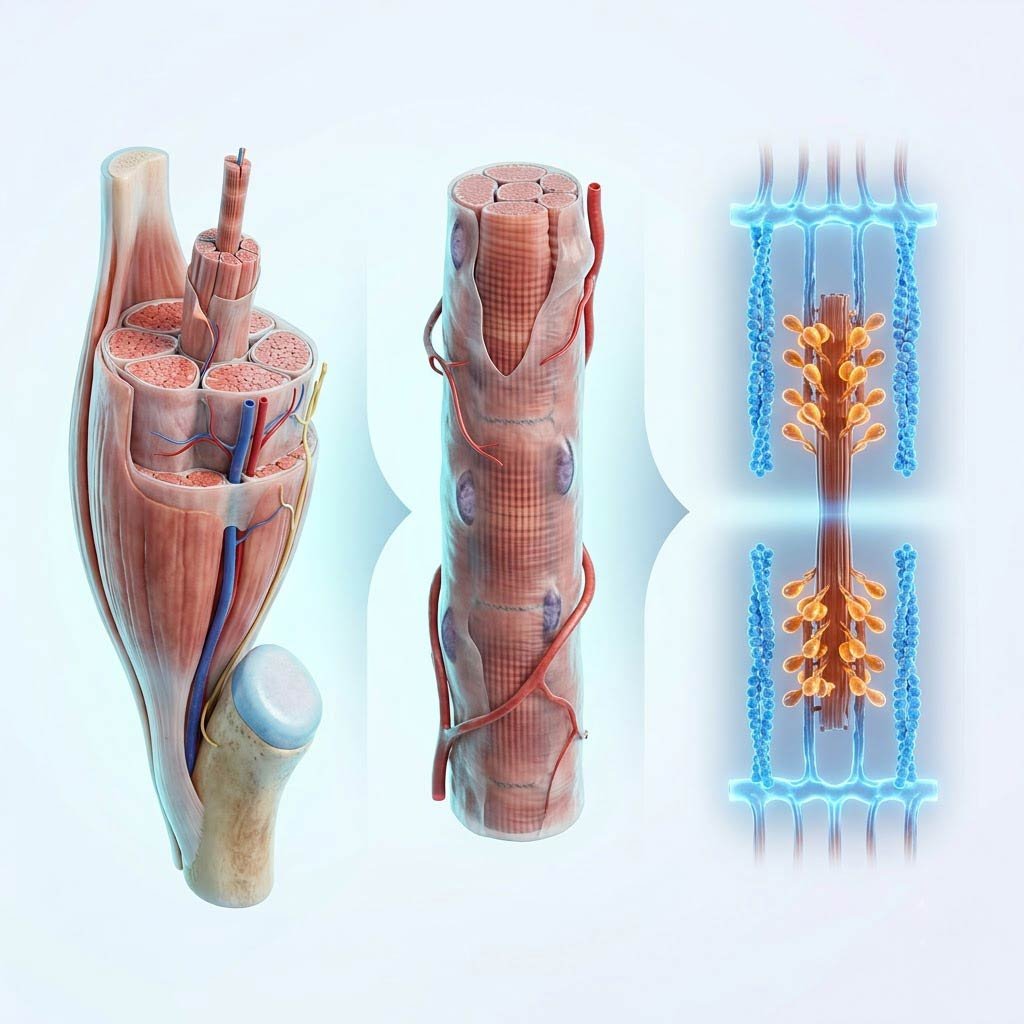
The hierarchy: whole muscle (bundled fascicles, sheathed, tendon-attached) → muscle fibers (the multinucleated cells, some running the muscle's length) → myofibrils → the sarcomere — the basic contractile unit, where thick myosin and thin actin filaments interdigitate and slide. Each sarcomere shortens a few percent; billions in series and parallel produce the movement of a limb.
The Anatomy of Contraction — and the Wiring
The engine is the sarcomere: a repeating unit of thick myosin filaments surrounded by thin actin, anchored at the Z-lines. Contraction is the sliding filament mechanism — the 1954 discovery (Chapter 3's story): myosin heads, energized by ATP, reach out, grab actin, pull, release, and repeat — billions of microscopic rowing strokes shortening the fiber. The calcium signal (released from the sarcoplasmic reticulum on the nerve's command, re-sequestered by magnesium-dependent pumps) is the on-off switch; the ATP supply (buffered by phosphocreatine — our creatine page's molecule) is the fuel gauge. Every cramp, every twitch, every contraction you have ever felt is this mechanism, scaled.
The wiring is the motor unit: one motor neuron and the hundreds of fibers it commands. The nervous system grades force two ways — recruiting more motor units, and firing them faster — and the recruitment order is fixed (small, fatigue-resistant units first; the large, powerful, fast-fatiguing units only when demand is high). Two consequences: strength training is neural training (the first weeks of gains are wiring, not tissue — the reason a novice doubles strength before adding visible muscle), and the aging nervous system's loss of motor neurons is a driver of sarcopenia that no nutrition alone reverses. The neuromuscular junction — where nerve meets fiber — is the system's most vulnerable point, and the reason progressive muscle weakness (difficulty rising, climbing stairs) is a medical symptom, not a fitness observation.
Actin & Myosin
The sliding-filament engine — force from interlocking protein
Motor Unit
One neuron, hundreds of fibers — the grading of force
Satellite Cells
The muscle stem cells — repair and growth throughout life
Proprioceptors
The muscle spindles — the body's position sense, the wiring beneath balance
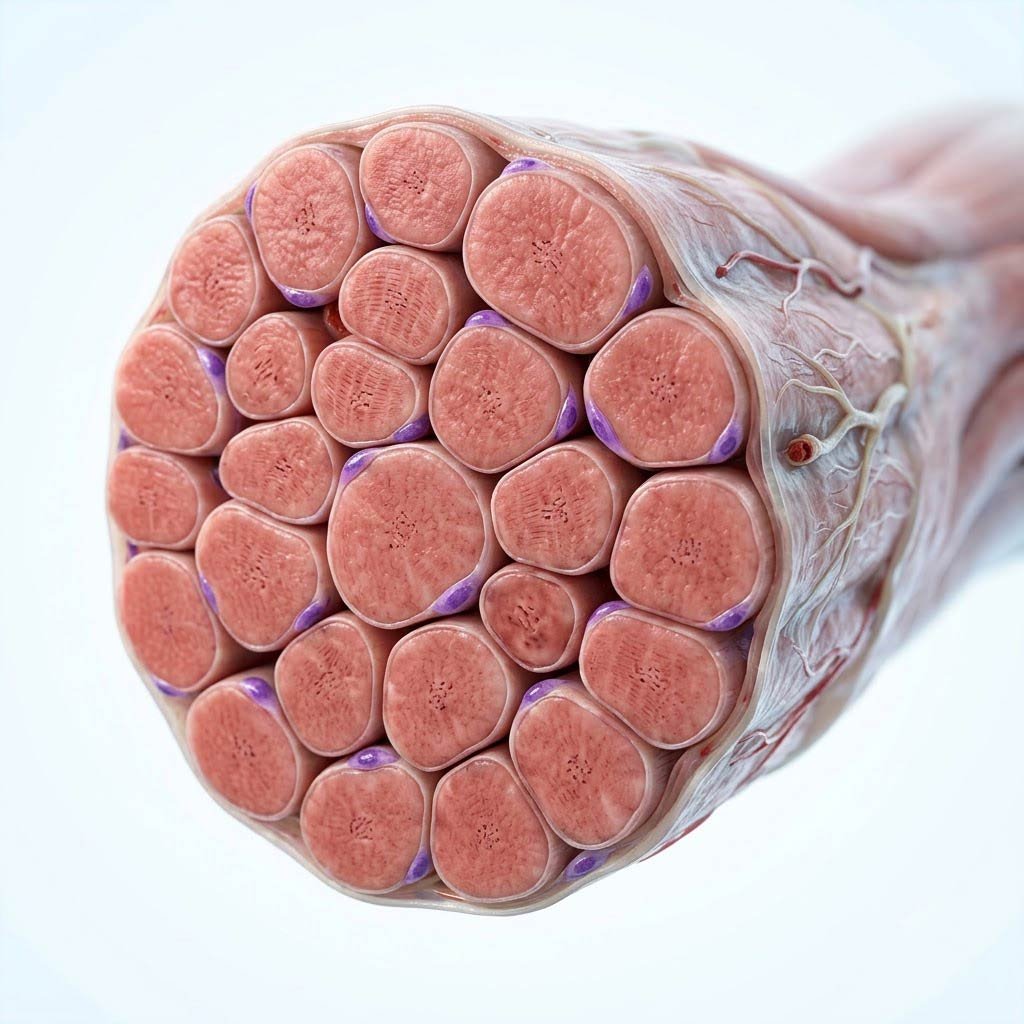
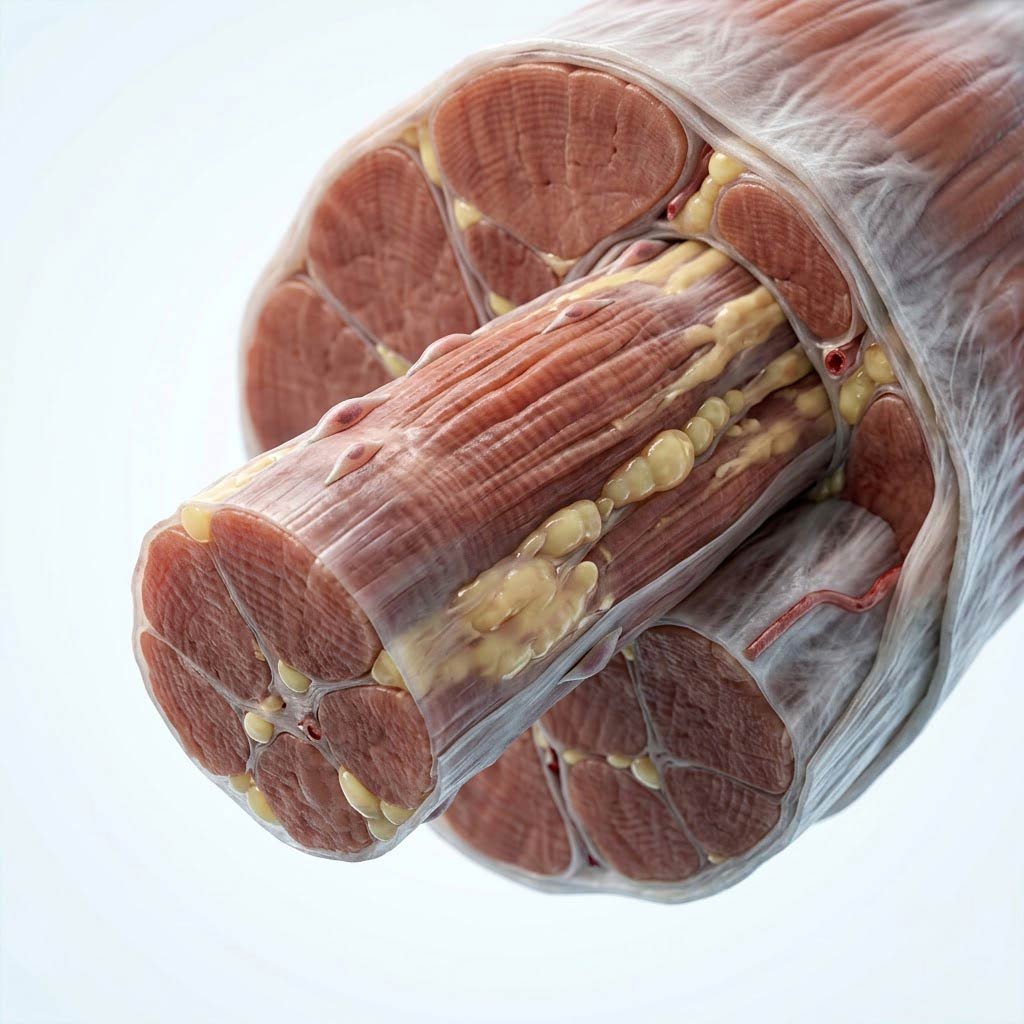
Fiber Types, Myokines, and the Aging Clock
The muscle system's three least-taught features explain its health story:
- Fiber types: Type I (slow-twitch, fatigue-resistant, mitochondrial-rich — the endurance workers) and Type II (fast-twitch, powerful, fast-fatiguing — the strength workers). Type II fibers are preferentially lost in aging — the reason the elderly lose explosive power (rising from a chair) before they lose endurance, and the reason power training belongs in the geriatric prescription.
- Myokines — muscle as endocrine organ: contracting muscle releases signaling molecules (myostatin's opposite, irisin, IL-6 in its exercise context, BDNF-stimulating factors) that talk to fat, bone, liver, and brain. Muscle is not merely moved by the body — it regulates the body. The discovery reframed sedentary muscle as an endocrine organ gone quiet.
- The satellite-cell reserve: muscle's regenerative capacity — the stem cells that repair microdamage and donate nuclei to growing fibers — declines with age and disuse but never vanishes. It is stimulated by the same signal that maintains the tissue: loading. The repair system rides on the use.
- Anabolic resistance: aging muscle's blunted response to protein's synthesis signal — the per-meal threshold roughly doubles with age (the PROT-AGE story our protein and osteoporosis pages teach). The aging muscle needs MORE of the stimulus, exactly when appetite delivers less — the squeeze that sarcopenia management exists to relieve.
- The per-decade clock: 3–8% mass loss per decade after 30, accelerating after 60 — with strength declining faster than mass (the quality loss: fiber, nerve, and signaling all declining together). The clock is not destiny: resistance training reverses the trend at every age studied, including the over-90s.
Muscle is ~40% of your body — an engine, a neural organ, a regenerative tissue, and a hormone factory — losing 3–8% of itself per decade after 30, in silence, unless you load it and feed it. The strength reserve you build at 50 is the independence you keep at 80. Muscle is the organ of longevity.