Inside the 180-liter filter.
What do the kidneys do — and why do they filter everything you own, every day?
Your kidneys filter 180 liters of blood plasma every day — your entire blood volume roughly 40 times — and then take back 99% of it. That is the design: filter everything, reabsorb what you need, excrete the remainder as 1–2 liters of urine. It is the most wasteful-brilliant engineering in the body, and it buys something priceless: precise, second-by-second control of your internal chemistry — water, sodium, potassium, acid, and the levels of countless molecules. Two fist-sized organs, ~2 million nephrons (the filter-reabsorption units), running five functions simultaneously: filtration, blood pressure control, red-blood-cell manufacture (EPO), vitamin D activation, and chemistry balance.
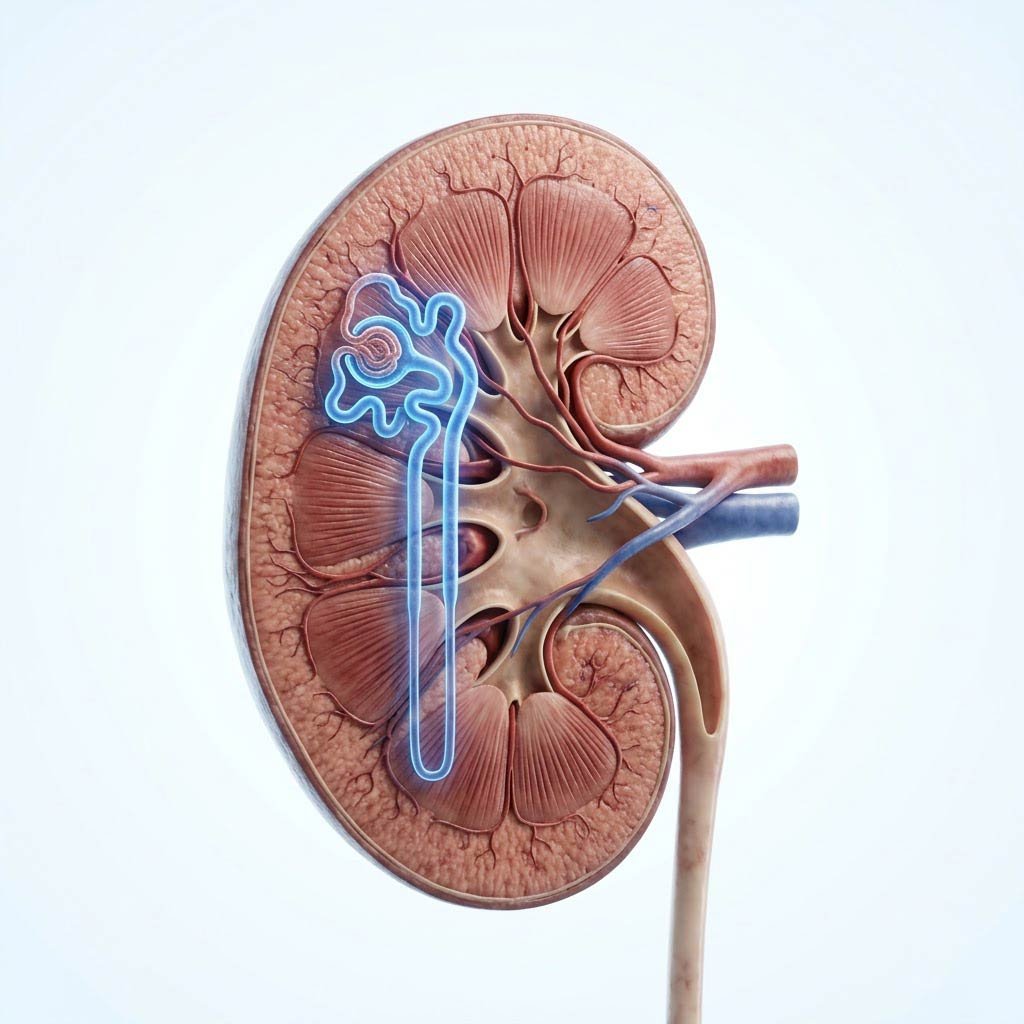
Each kidney holds about a million nephrons — the functional units. Each nephron is a two-part machine: the glomerulus (a tuft of capillaries that pressure-filters plasma) feeding a long tubule that takes back water, glucose, and electrolytes the body wants to keep. No new nephrons are made after birth — the lifetime supply is the supply.
The Anatomy of Filter-and-Choose
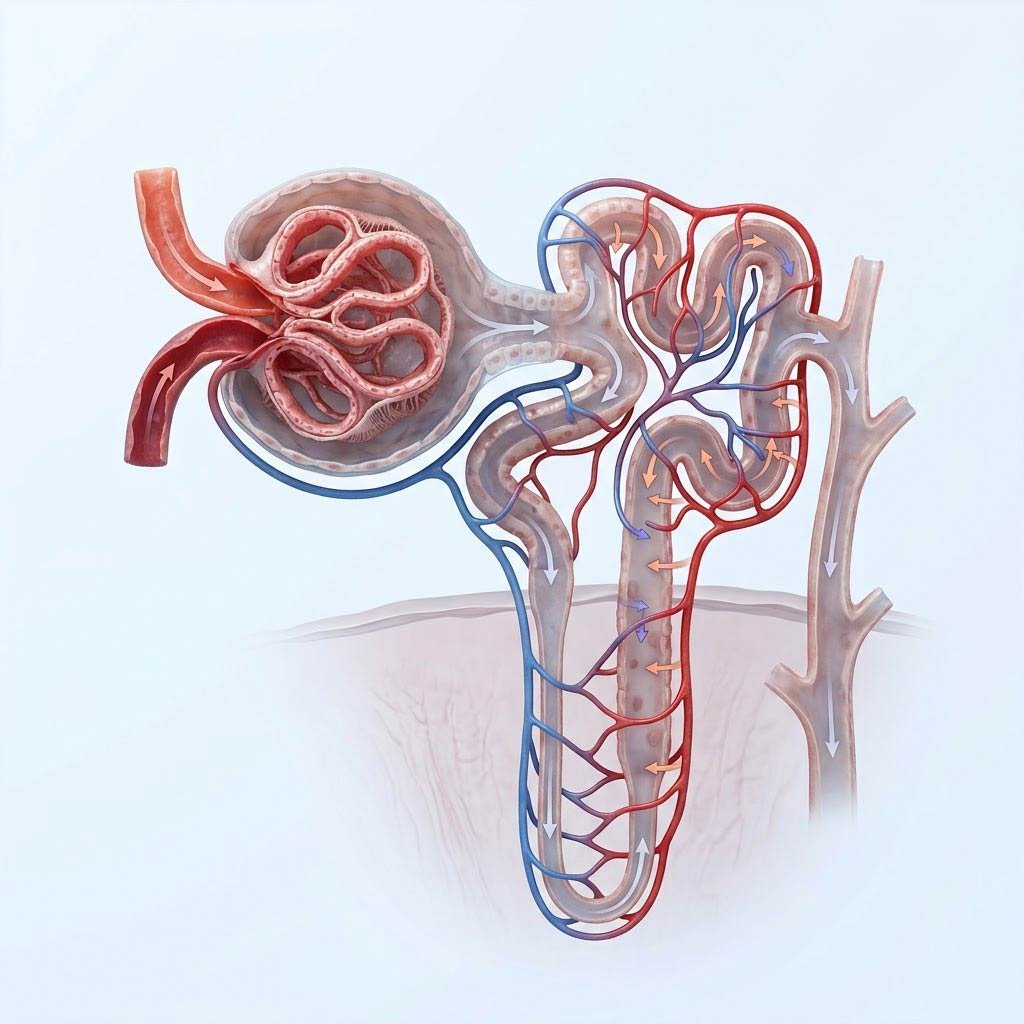
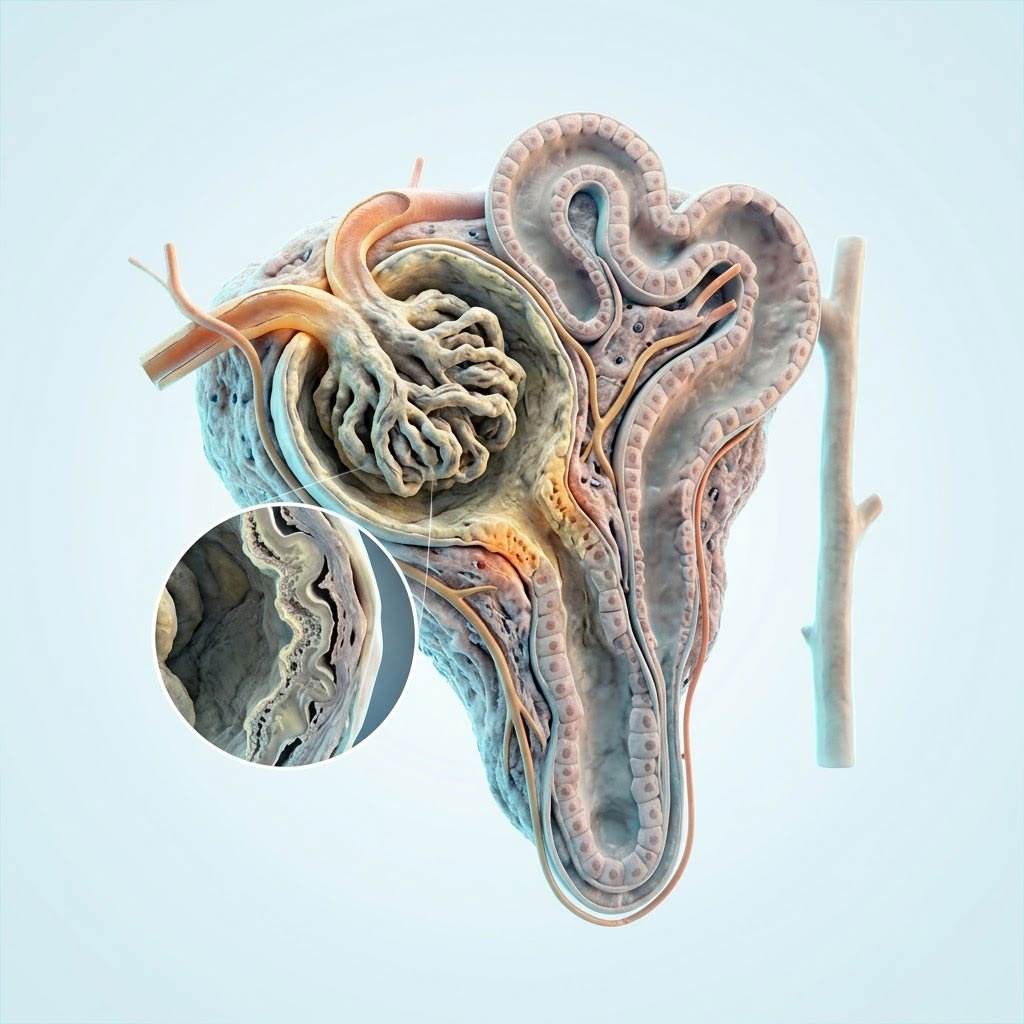
The nephron's first half is the glomerulus: a ball of leaky capillaries under pressure, wrapped in Bowman's capsule. Blood pressure forces plasma through the capillary walls — water, salts, glucose, small molecules pass; blood cells and proteins (mostly) stay behind. The filtrate, at 180 liters a day, would dehydrate the body in hours if it left as-is. The second half — the tubule — is the reclamation line: a selectively-absorbing duct that takes back glucose entirely, water as needed, sodium under hormonal control, and fine-tunes potassium, calcium, and pH. What remains is urine.
The elegance is that the tubule chooses: each segment handles a different recovery task, under different hormonal controls (ADH for water, aldosterone for sodium, PTH for calcium). This is why the kidney is an endocrine organ as much as a filter — it both responds to hormones and makes them. And the vulnerability is built into the arithmetic: the nephrons you are born with are all you get. Kidneys can hypertrophy surviving units to compensate, but each nephron lost to diabetes, pressure, or inflammation is lost for life — which is why kidney disease is measured in percent-of-function (eGFR) and why prevention is the entire game.
Glomerulus
The pressure filter — where plasma becomes filtrate
Tubule
The reclamation line — 99% recovered, chosen by design
Juxtaglomerular Cells
The pressure sensors — RAAS commanders
Peritubular Cells
The EPO factory — the oxygen-sensing blood-maker
Five Functions, Five Library Pages — The Most Connected Organ
The kidney's five jobs map onto five destinations in this library — no organ's functions fan out wider:
- Filtration & clearance: the kidneys remove drugs, toxins, and metabolic waste — the reason every medication dose is adjusted in kidney disease, and why the kidney is where supplements accumulate. The clearance function is this page's caution flag.
- Volume & blood pressure: the kidneys control the body's fluid volume and run the RAAS system — the body's pressure dial. Our hypertension page teaches the loop from that end.
- Red blood cell manufacture: the kidneys sense tissue oxygen and release erythropoietin (EPO) — the hormone that tells marrow to build red cells. Failing kidneys under-produce EPO: anemia of kidney disease, our anemia page's EPO story.
- Vitamin D activation: the second hydroxylation step — turning 25-OH into active calcitriol — happens in the kidney. Our vitamin-d3 page teaches the pathway; this page teaches what failing activation means.
- Chemistry & concentration: potassium, sodium, acid-base, and water balance — and the urine-concentration chemistry whose failure mode is kidney stones, our kidney-stones page's entire subject.
Your kidneys filter 180 liters a day — your entire blood volume forty times — and take back 99% of it. The extravagance is the engineering: by filtering everything and choosing what to keep, they control your internal chemistry second by second. The nephrons you're born with are all you get. Guard them.