Inside the living scaffold.
What are bones — and why is the hardest tissue in your body also one of the most dynamic?
Bone is not the dead framework the skeleton-model suggests — it is a continuously renovated living tissue: roughly 10% of your skeleton is demolished and rebuilt every year, the entire body renewed about once a decade, for a lifetime. The renovation runs through a microscopic relay of three cell types — osteoclasts (the demolition crew), osteoblasts (the construction team), and osteocytes (the embedded load sensors) — coordinated by hormones, fed by calcium and protein, and shaped by every step you take. Understanding the renovation explains why bone health is a lifelong project (the crew works from childhood to old age), why bone disease is silent (the crew fails gradually, without pain), and why the skeleton is also an endocrine organ — bone cells make hormones that regulate your blood sugar and your fertility, a 2000s discovery that reframed what bones are.
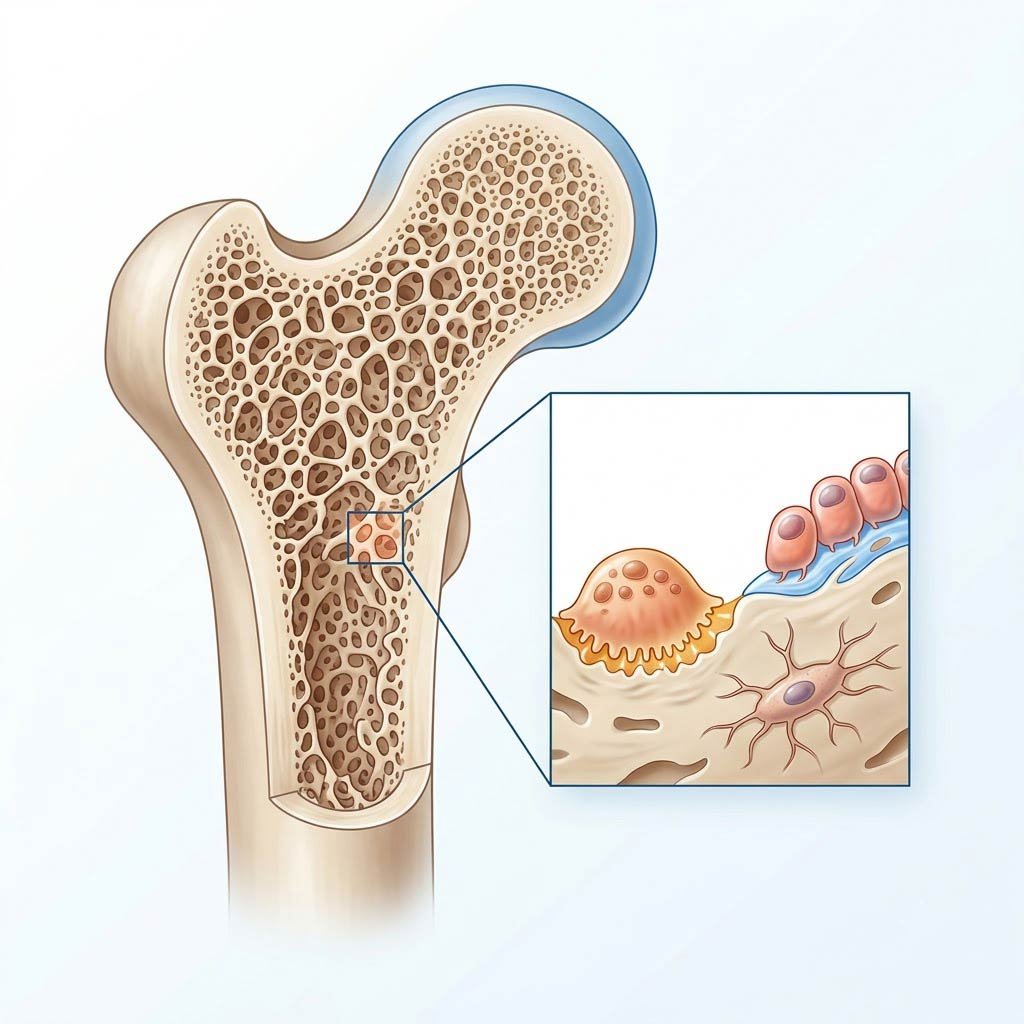
206 bones in two architectures: dense cortical bone (the outer shell, 80% of skeletal mass) and trabecular bone (the internal honeycomb, 20% of mass but far higher surface area — where metabolic activity concentrates). The skeleton stores 99% of body calcium, manufactures blood cells in its marrow, and shelters the brain, heart, and lungs — the structural, mineral, hematological, and protective organ in one.
The Anatomy of the Renovation Crew
The remodeling cycle runs in Basic Multicellular Units — microscopic construction sites that sweep through the skeleton continuously. Phase one: activation. A signal (hormone, microdamage, or mechanical load detected by osteocytes) summons an osteoclast to the site. Phase two: resorption. The osteoclast — a large, multinucleated cell that secretes acid and dissolving enzymes — carves out a pocket of old bone in about two weeks. Phase three: formation. Osteoblasts arrive and fill the pocket with new collagen matrix (osteoid), which mineralizes over months. The cycle takes 3–6 months per site; roughly a million sites are active at any moment; the whole skeleton turns over about once a decade.
The coupling between resorption and formation is the system's elegance — and its vulnerability. In healthy adult bone, the two phases are balanced: what the demolition crew removes, the construction team replaces. Estrogen maintains the balance (it suppresses RANKL, the signal that summons osteoclasts — the menopause story). Aging slows the osteoblasts more than the osteoclasts. Chronic disease and medications accelerate the osteoclasts. Every osteoporosis therapy — bisphosphonates (slow the demolition), teriparatide (accelerate the construction), denosumab (blocks the demolition summons) — works by adjusting one side of this balance. The crew is the drug target.
And the crew works for a signal that is not hormonal but mechanical: the osteocyte network. Osteocytes — former osteoblasts buried alive in their own matrix, ~42 billion of them, connected by tiny canaliculi — sense the strain of every load. Bone that is loaded is maintained; bone that is unloaded is removed. This is Wolff's law (formulated 1892): bone adapts to the forces placed upon it — reinforcing where stress arrives, dismantling where it falls silent. The astronaut's bone loss, the tennis player's denser dominant arm, the bed-rest patient's hip fragility: all the same law, reading load as instruction.
Osteoclasts
The demolition crew — dissolve old bone, liberate calcium
Osteoblasts
The construction team — lay collagen, mineralize it
Osteocytes
The load sensors — 42 billion embedded cells reading every step
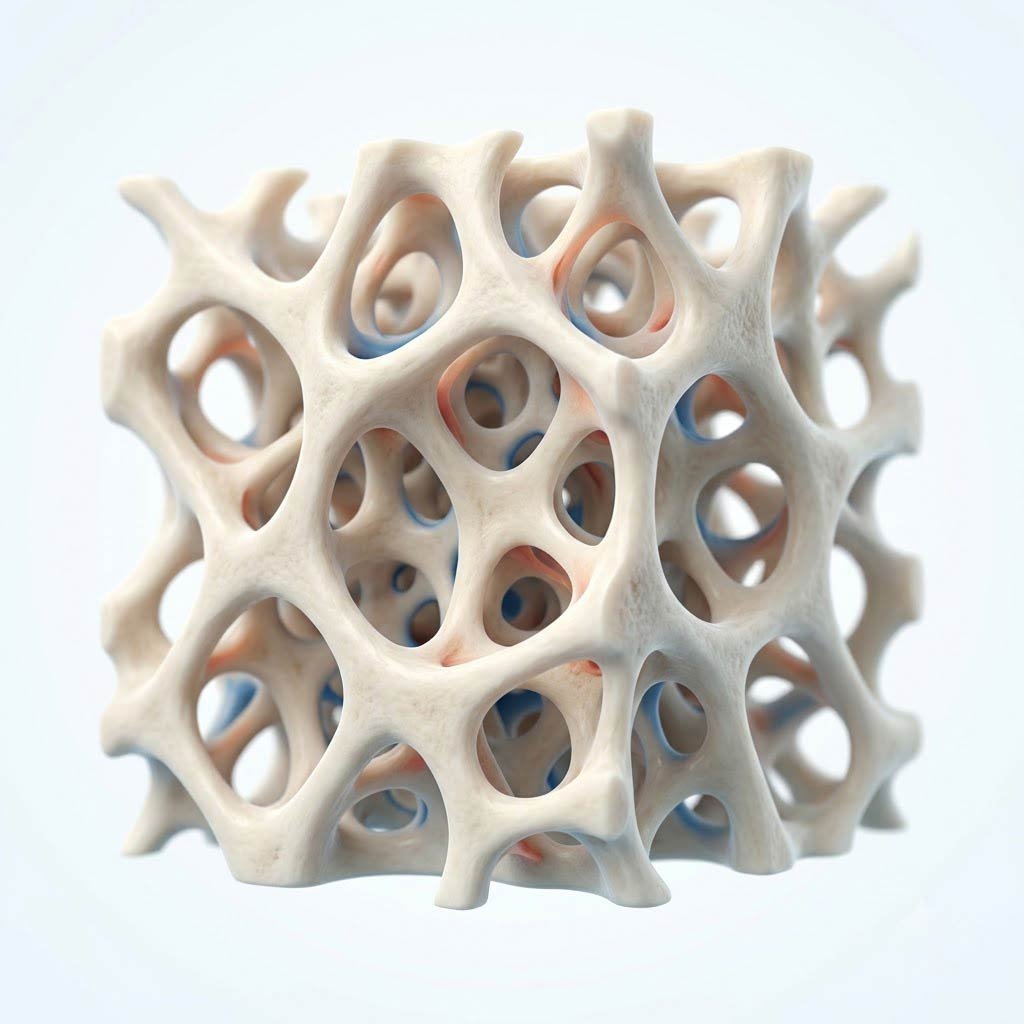
Trabecular Bone
The metabolic honeycomb — where remodeling concentrates
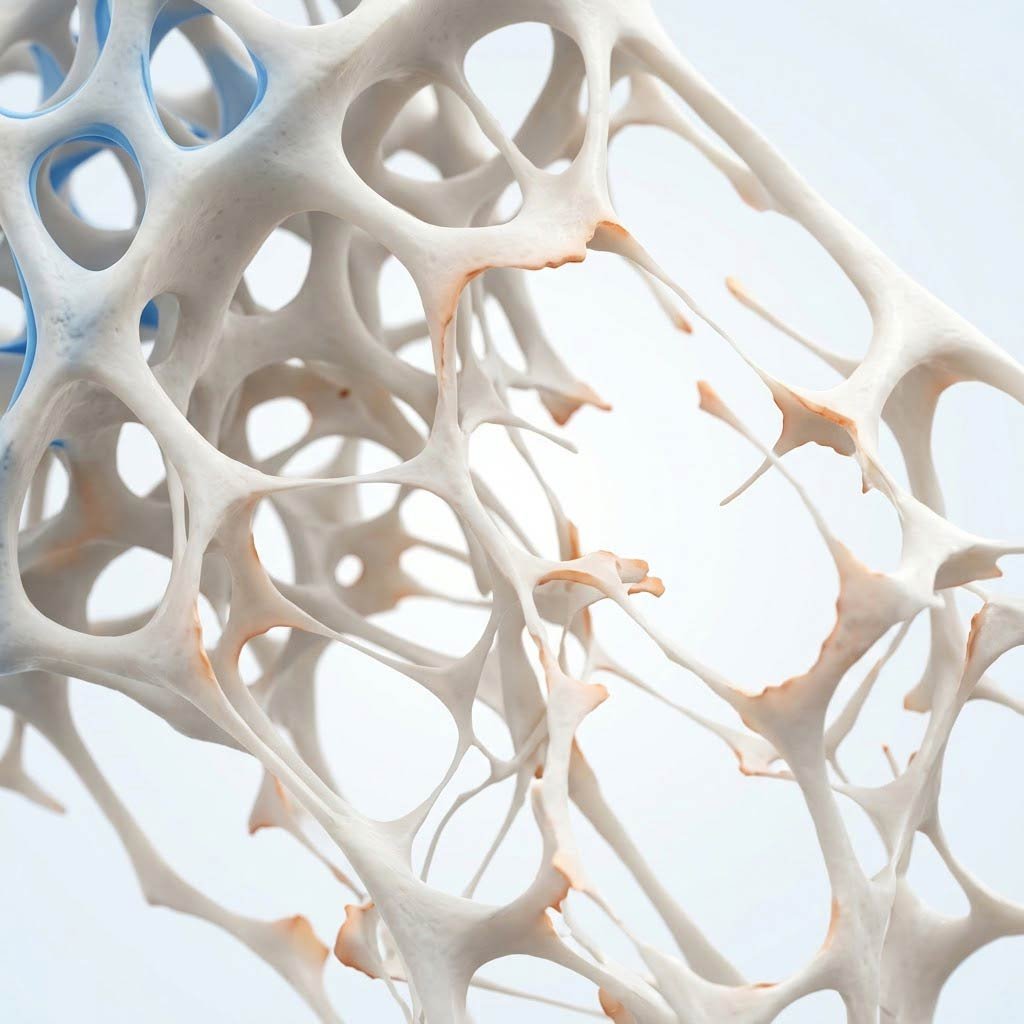
The Bone You Cannot See — And the Calcium Bank
The skeleton's two architectures fail at different rates, and the difference explains osteoporosis's fracture pattern:
- Trabecular bone (the honeycomb): higher surface area, faster turnover — the first to lose in estrogen withdrawal and aging. The spine, the wrist, the hip's femoral neck: the trabecular-rich sites where osteoporotic fractures concentrate.
- Cortical bone (the dense shell): slower turnover, more resilient — but porous cortical bone (the accumulating Swiss-cheese holes) drives the hip fracture of advanced age.
- The calcium bank: 99% of body calcium lives in bone — the mineral is both structural AND a reservoir the body raids when blood calcium runs low (parathyroid hormone activates osteoclasts to liberate it, because nerves and heart cannot tolerate low blood calcium). The diet defends the bank; the bank defends the blood; chronic underfunding drains the vault.
- The endocrine organ: osteoblasts and osteocytes produce hormones — osteocalcin (regulating glucose metabolism and testosterone production — the discovery that reframed bone as a metabolic player) and FGF23 (regulating phosphate via the kidneys). Bone talks to the body; the body answers.
Your skeleton is completely rebuilt about every ten years — a million microscopic construction sites demolishing and reconstructing continuously, from your first breath to your last. The bone you have today is not the bone you were born with, and not the bone you will have in a decade. The renovation crew works for life — the question is whether you supply it.