Inside the living river.
What is blood — and why is the body's only liquid organ also its largest factory and its most recyclable tissue?
Blood is five liters of living tissue that flows — technically a connective tissue, functionally an organ: 25 trillion red cells (each a hemoglobin-filled oxygen courier, each replaced every 120 days), a defense fleet of white cells, a repair crew of platelets, all suspended in plasma — the straw-colored transport ocean that is itself 55% of the volume. The production numbers are the body's most industrial: the bone marrow births 2.4 million red cells every second, on standing orders from a kidney-made hormone (EPO — our kidneys page's story, told from the receiving end). And the recycling is the body's most complete: 90% of the iron in your blood today has been in previous generations of cells — reclaimed from the dead by macrophages and shipped back to the marrow. This page teaches the organ; our anemia page teaches its most common failure; and the supplement trio is the narrow, honest shelf that feeds red-cell production when the raw materials run short.
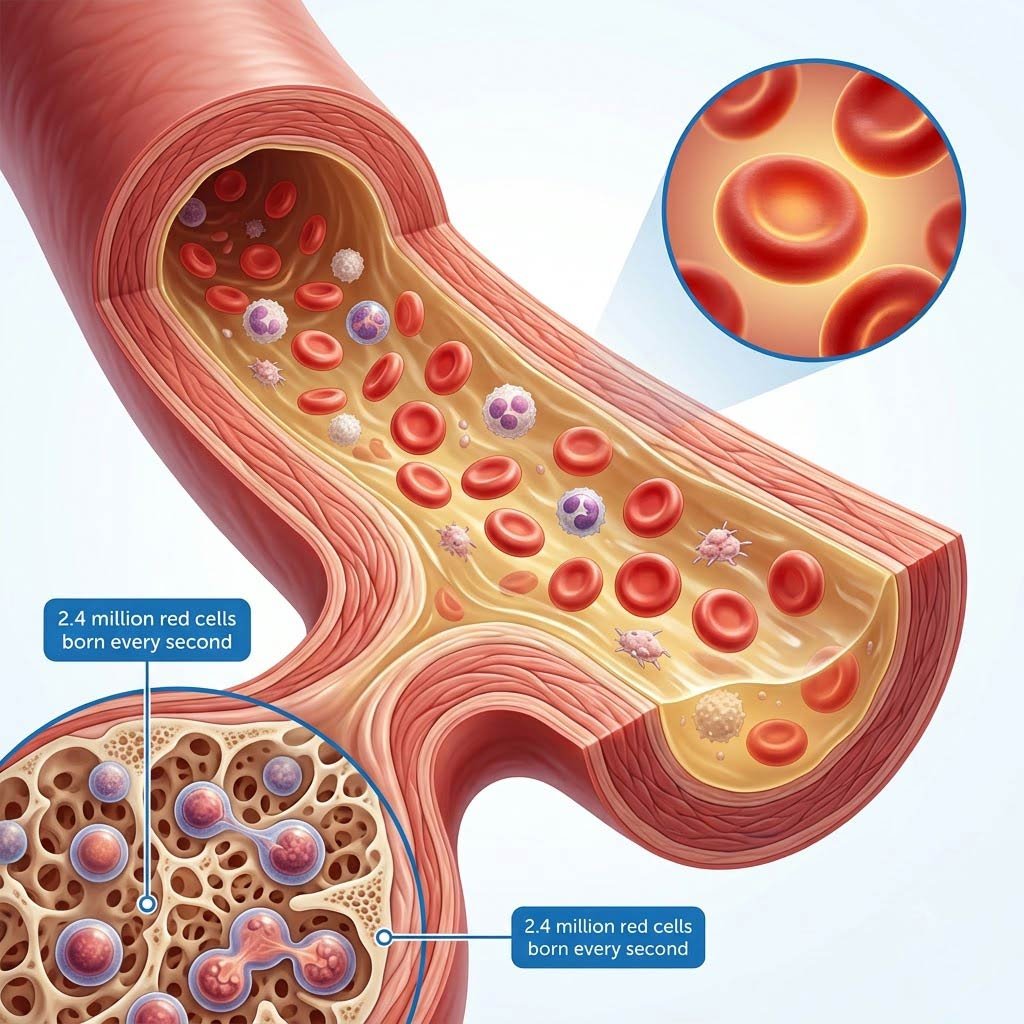
The composition: plasma (55% — water, proteins, nutrients, hormones; the transport medium and chemical buffer), red blood cells (the oxygen fleet — biconcave discs, no nucleus, packed with ~270 million hemoglobin molecules each), white blood cells (the defense fleet — five lineages from neutrophils to lymphocytes), and platelets (the repair crew — cell fragments that seal breaches in minutes). All born in the bone marrow from hematopoietic stem cells — the body's most productive factory — under the hormonal command of erythropoietin (EPO), made by the kidneys.
The Anatomy of the River and Its Factory
The red cell is a masterpiece of specialization-by-subtraction. It begins as a marrow stem cell, ejects its nucleus (and its DNA — the reason red cells cannot repair themselves and live only 120 days), and finishes as a hemoglobin-filled courier shaped like a biconcave disc — the dimpled geometry that lets each cell squeeze through capillaries narrower than itself and carry maximum cargo with minimum viscosity. Each cell holds ~270 million hemoglobin molecules; each hemoglobin carries four heme groups; each heme holds one iron atom at its exact center — the reason a single mineral's shortage shrinks the entire fleet's cargo capacity, and the arithmetic behind iron-deficiency anemia (our anemia page's engine). Oxygen loads in the lungs, unloads in the tissues, and the cycle repeats ~100,000 times across each cell's 120-day life before the spleen's macrophages retire the cell — digesting it and shipping its iron back to the marrow with ~90% efficiency. Your body runs on recycled iron the way a city runs on reclaimed water: what you eat each day is a top-up, not the supply.
The production line answers to a kidney-made hormone. Erythropoietin (EPO) — released by the kidneys' oxygen-sensing cells when tissue oxygen runs low — commands the marrow to commit more stem cells to the red-cell line and release them early (the reticulocytes, the young cells a lab counts to read production speed). It is one of the body's cleanest feedback loops: low oxygen → EPO rises → more red cells → oxygen corrected → EPO falls. This is the loop our kidneys page teaches from the hormone's source — and the loop that fails in kidney disease (the anemia of CKD), that medicine cloned in 1989 (recombinant EPO, transforming dialysis patients' lives), and that sport abused to death in the 1990s (Chapter 3's story: the same hormone that rescues, overdoses to lethal viscosity).
The rest of the river has its own economies. White cells — five lineages, from the fast-dying neutrophil first responders (bacteria's worst 8-hour enemy) to the decade-living lymphocytes of adaptive memory — circulate as a patrol, ready to exit into any tissue on chemical signal (our immune-health topic's mobile army). Platelets — anucleate cell fragments, 150–400 thousand per microliter — plug breaches in seconds and orchestrate the clotting cascade when the breach is large: a system powerful enough to seal a severed vessel in minutes and precise enough (in health) to leave flowing blood untouched. Plasma — the 55% — carries albumin (the osmotic anchor that keeps fluid in vessels), antibodies, clotting factors, lipids, hormones, and everything the blood is asked to deliver anywhere. The river is not just transport; it is the body's logistics network, defense perimeter, and repair crew in one tissue — and it is the only organ you can donate a piece of weekly and lose entirely in minutes.
Red Cells
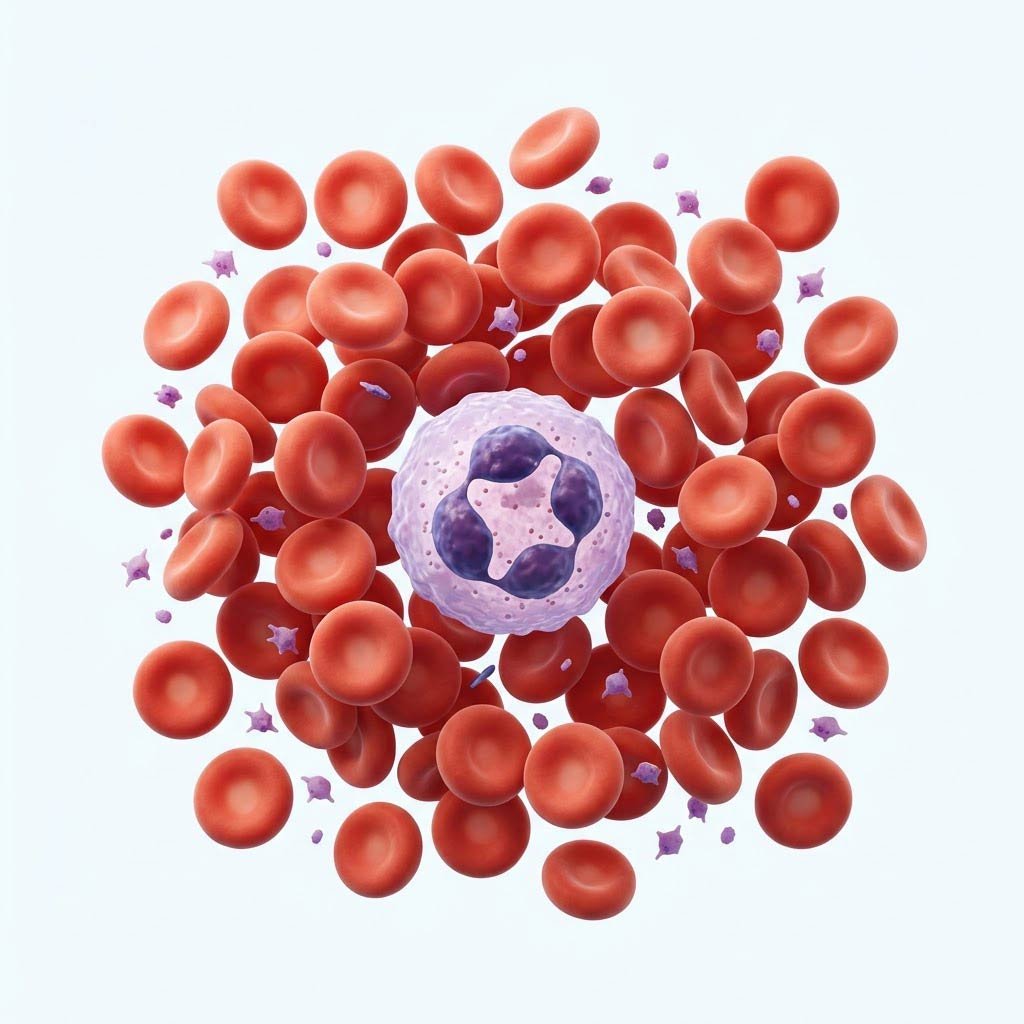
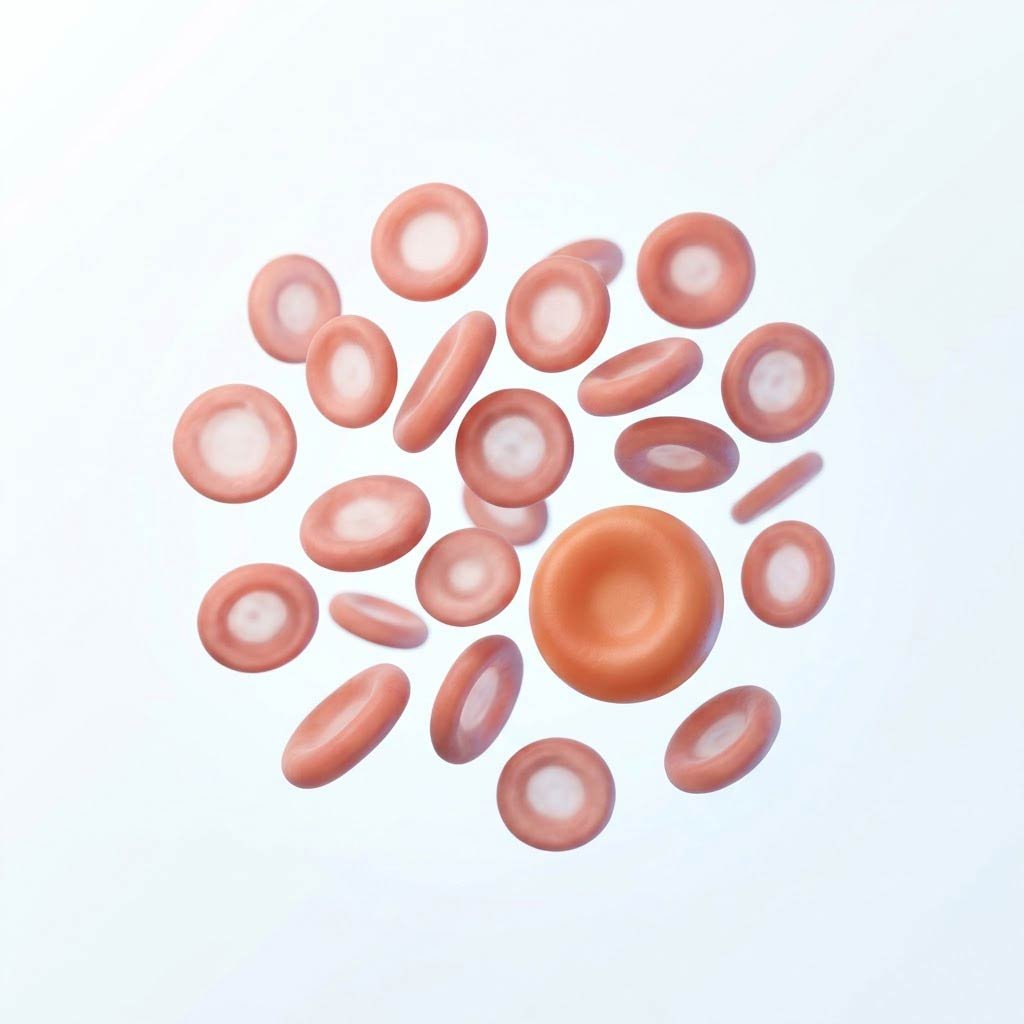
The oxygen fleet — 25 trillion couriers, no nucleus, 270M hemoglobins each
White Cells
The defense fleet — five lineages, from hours-lived responders to decade-lived memory
Platelets
The repair crew — sealing breaches in seconds, running the clotting cascade
Plasma
The transport ocean — 55% of volume, the body's logistics medium
The Rules the Rest of the Page Runs On
Four economies of the river organize everything from diagnosis to prevention:
- The marrow is the body's busiest factory: 2.4 million red cells, ~2 billion platelets, and a full complement of white cells born every second — which is why the marrow shows nutritional deficiency FIRST. Iron, B12, or folate shortage slows DNA synthesis and hemoglobin fill in the fastest-dividing tissue before almost anywhere else: the blood smear is the body's early-warning screen (the megaloblastic and microcytic pictures our anemia page teaches).
- Iron is guarded, not free: the body has no excretion route for iron — excretion is only through loss (blood, sloughed cells). The mineral is managed by hepcidin, a liver hormone that gates both gut absorption and macrophage release: a system built for a world of scarcity, which becomes a liability of silent excess when intake is high and genes load it further (hemochromatosis, Chapter 2). This is why iron is the one mineral this library gates hardest behind a lab value.
- Blood is where medicine reads the whole body: the complete blood count is the most-ordered test in medicine for a reason — infection, inflammation, allergy, leukemia, hydration, and three nutritional deficiencies all write on the river. The CBC is the body's dashboard; this page teaches its logic.
- It is the only organ you can donate — and lose in minutes: a unit of donated blood is ~200–250 mg of iron (a third of the average woman's stores), given safely because the marrow replaces the volume in days — and the iron over weeks-to-months (the donor's arithmetic, Chapter 3). And acute blood loss beyond ~30–40% of volume is life-threatening in minutes — the reason trauma care begins with the river. Both facts belong in every reader's model: the generosity the system is built for, and the fragility it defends.
Your blood is a 25-trillion-cell river — two and a half million red cells born every second, every cell replaced four times a year, ninety percent of its iron reclaimed from its own dead. It is the only organ you can donate — and the only one you can lose in minutes.