Inside the stress command system.
What are the adrenal glands — and why does the body run two different clocks for danger, one in seconds and one in months?
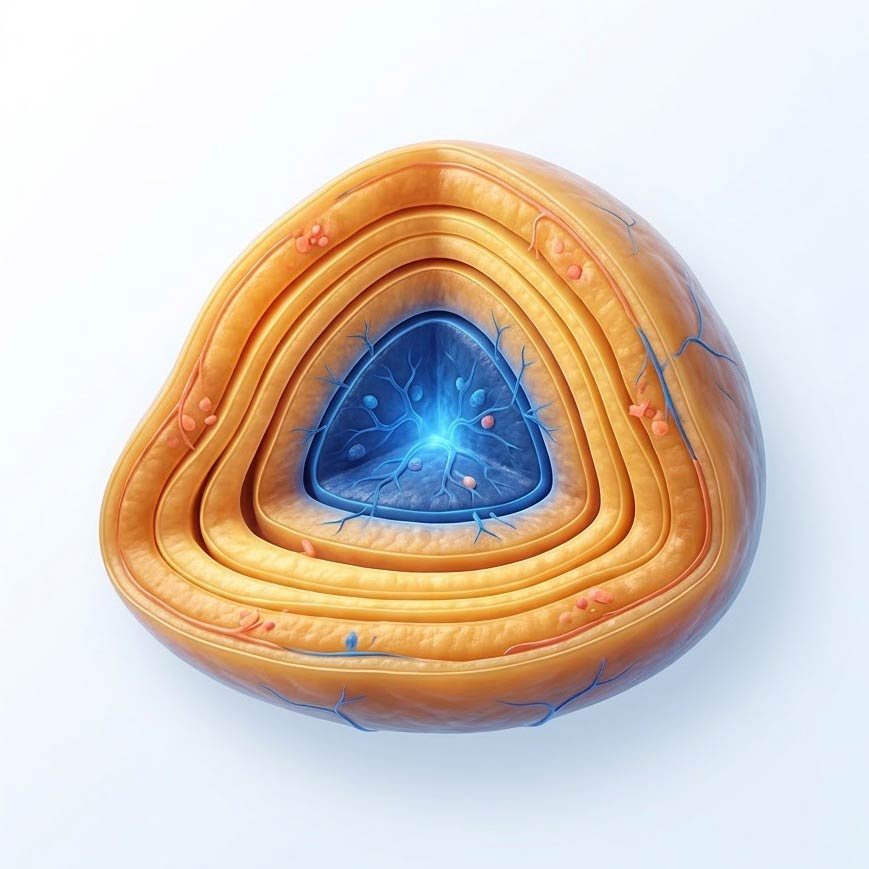
Your adrenal glands are two triangular caps atop the kidneys, each one gland stacked inside another: a cortex (the outer steroid factory — cortisol, aldosterone, and the androgen precursors) wrapped around a medulla (the inner core — adrenaline and noradrenaline, the fight-or-flight hormones). The stacking is the design: the medulla answers in seconds (a direct sympathetic wire from the brainstem — the sprint alarm), the cortex answers in minutes and stays for months (the HPA axis's hormonal cascade — the siege engine). Together they run the body's entire time-structured response to everything threatening, demanding, and exhausting — and their regulation story is the most misunderstood in popular health: the adrenals are not a battery that burns out ('adrenal fatigue' — the myth this page retires); they are a command system that can be suppressed, overdriven, and diseased — but never 'worn out' by modern life. This page teaches the real physiology and the real failures.
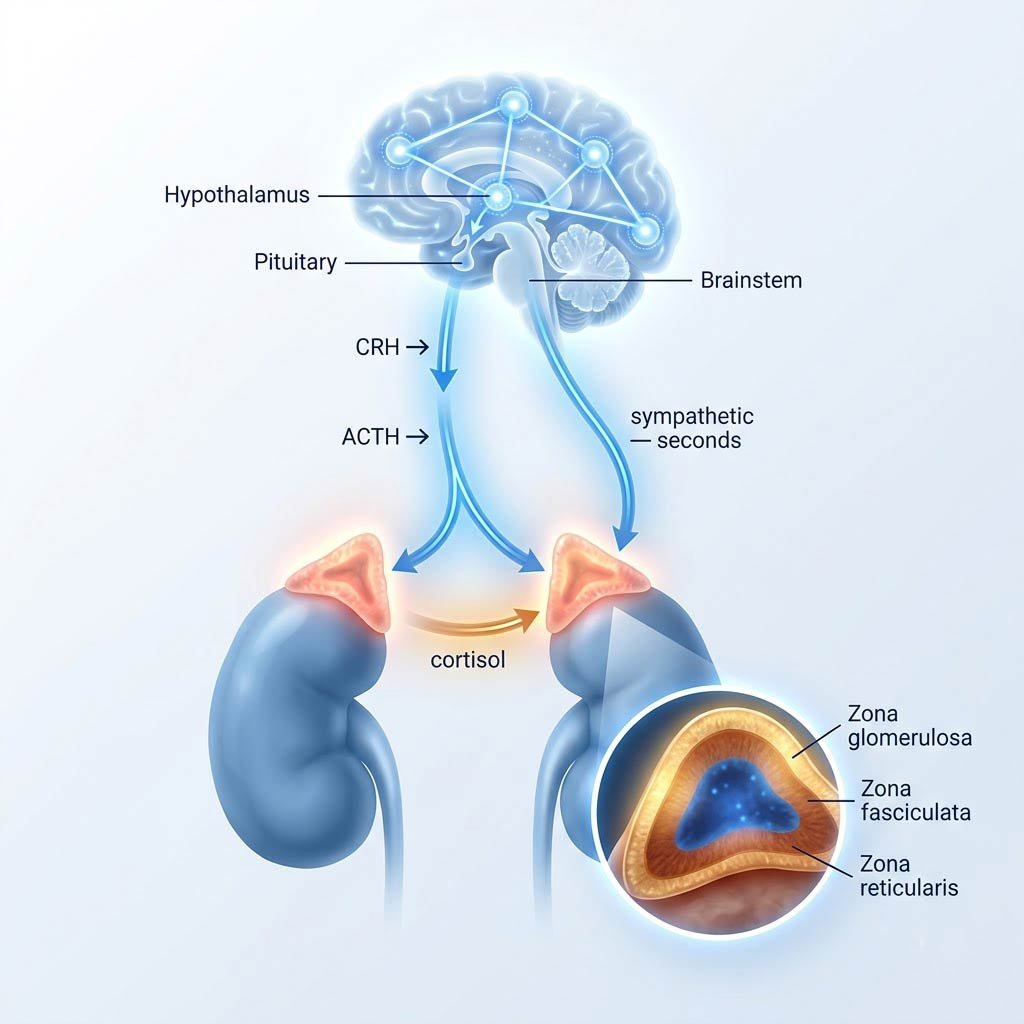
Each adrenal is two organs in one. The CORTEX (outer, steroid-producing, ACTH-dependent): zona glomerulosa (aldosterone — salt, water, blood pressure), zona fasciculata (cortisol — the stress hormone, daily-rhythmed and demand-driven), zona reticularis (DHEA and androgen precursors). The MEDULLA (inner, a sympathetic ganglion in disguise): adrenaline and noradrenaline, released on direct neural command within seconds of threat. The whole gland weighs ~4–5 g each side, drains directly into the vena cava, and answers to two masters — the HPA axis (slow, hormonal) and the sympathetic nervous system (fast, neural).
The Anatomy of Two Clocks
The fast clock is the medulla — and it is not really an endocrine gland at all, but a sympathetic ganglion that lost its nerve: embryologically neural tissue, wired directly into the sympathetic nervous system, releasing its hormones into blood instead of across a synapse. The brainstem's threat appraisal fires; within one to three seconds, adrenaline is in the circulation — heart rate, blood pressure, airways, pupils, glucose mobilization: the body sprinting before the thinking brain even knows there is a race. This is the system that surges in a near-miss traffic moment, a panic attack's first wave (our anxiety page's engine), and the caffeine jolt — and it is nearly instantaneous because it is wired, not hormonal.
The slow clock is the cortex, and its master is the HPA axis: the hypothalamus releases CRH → the pituitary releases ACTH → the adrenal cortex makes cortisol. Minutes to rise, hours to clear, and — critically — a circadian rhythm underneath everything: cortisol peaks within an hour of waking (the cortisol awakening response — the morning mobilization), declines across the day, and bottoms near midnight. The rhythm is not a stress artifact; it is the metabolic day-night schedule that choreographs glucose availability, immune tone, and alertness. Stress adds demand on top of rhythm; rhythm never disappears — which is why cortisol blood tests are timed, and why a 'flat' or inverted curve (high at midnight) is a finding, not a mood.
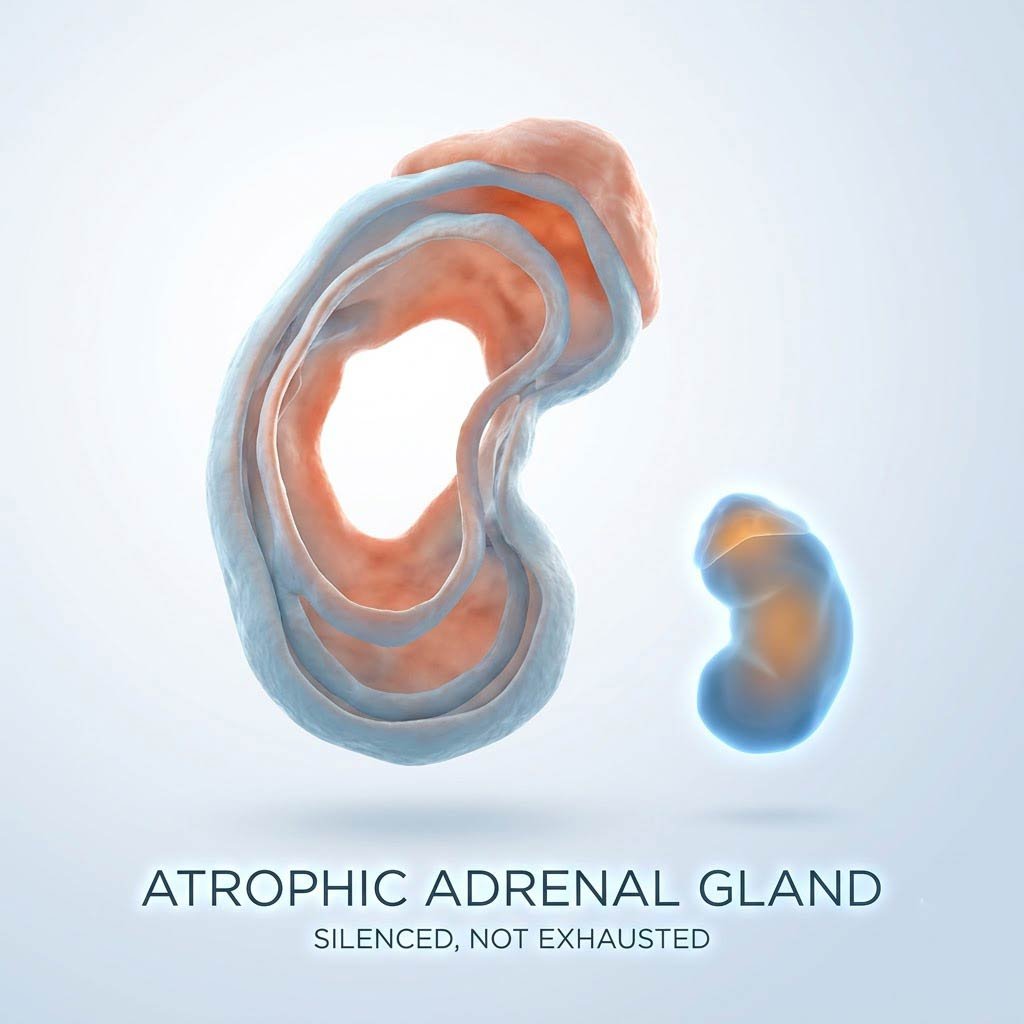
And the third layer is the one popular health forgets: the cortex's feedback discipline. Cortisol feeds back on the hypothalamus and pituitary, suppressing its own production — a thermostat, exactly like the thyroid's loop (our thyroid-disorders page's teaching, adrenal edition). The thermostat is why long-term steroid pills (prednisone) shrink the axis: the pill's cortisol satisfies the thermostat, the brain stops sending ACTH, and the cortex — jobless — atrophies. And it is why abruptly stopping those pills is dangerous: the atrophied gland cannot answer the next stressor, and adrenal crisis follows. The gland does not 'burn out'; it gets silenced — and unsilencing takes weeks of prescribed tapering. The distinction is this page's YMYL core.
Zona Fasciculata
The cortisol layer — the siege engine of the stress response
Zona Glomerulosa
The aldosterone layer — salt, volume, and blood pressure
Medulla
The adrenaline core — a sympathetic ganglion releasing into blood
The Cortisol Rhythm
The circadian wave — morning peak, midnight trough, the metabolic schedule
The Physiology That Retires the Folk Myth
Four facts about the real adrenals that 'adrenal fatigue' mythology gets wrong:
- The adrenals do not deplete a finite reserve: cortisol is synthesized from cholesterol on demand — there is no stored cortisol to run out of. The gland is a factory with a supply chain, not a battery with a charge. Real adrenal failure (Addison's — autoimmune destruction, Chapter 2) is rare, diagnosable, and catastrophic; the folk syndrome shares none of its biochemistry.
- 'Tired but wired' is rhythm distortion, not gland exhaustion: chronic stress can flatten or shift the cortisol curve, and insomnia plus daytime fatigue is real — but the mechanism is signal distortion (the brain's regulation), not organ depletion. The treatment tier for the real pattern is behavioral: light, sleep timing, and the stress-load levers our sleep and stress pages teach.
- The diagnosis that exists looks nothing like the myth: adrenal insufficiency (Addison's) means fatigue with weight loss, low blood pressure, salt craving, and skin darkening — a serious disease treated with lifelong steroid replacement. Self-treating undiagnosed fatigue with 'adrenal support' glandulars risks two failures at once: missing the real diagnosis (thyroid, anemia, depression, sleep apnea — our pages on each) and suppressing the real axis with the bottle (Chapter 6's harm card).
- The glandular shelf is the folk myth's product line: desiccated adrenal extracts — the 'adrenal support' category — are unregulated tissue concentrates with three documented problems: variable content, the theoretical risk of containing active hormones (suppressing your own axis — the steroid-pill logic in a bottle), and no trial evidence for any 'fatigue' claim. The category our supplement chapter retires, with the real physiology as the reason.
Your adrenal glands run two clocks for danger — a wired alarm that answers in seconds and a hormonal siege engine that answers in minutes and stays for months. They are command systems, not batteries: overdriven, suppressed, diseased — never 'worn out' by your life.