What is PCOS?
A hormonal-metabolic condition where insulin resistance drives the ovaries into an androgen-heavy loop.
Polycystic ovary syndrome is the most common endocrine condition of reproductive-age women — affecting roughly 8–13% worldwide, with up to 70% undiagnosed. The name is the least accurate part of it: the 'cysts' are not cysts but stalled follicles, and the syndrome is less an ovary disease than a whole-body metabolic condition with ovarian consequences. The engine: insulin resistance drives the ovaries' theca cells to overproduce androgens, androgens disrupt follicle development and cycle regularity, and the disrupted hormones feed back into worse insulin resistance — a loop that runs for decades. The modern message: PCOS is manageable — the same metabolic levers that treat type 2 diabetes treat its engine — and its diagnosis (2 of 3 Rotterdam criteria) is the start of that management, not a label of infertility.
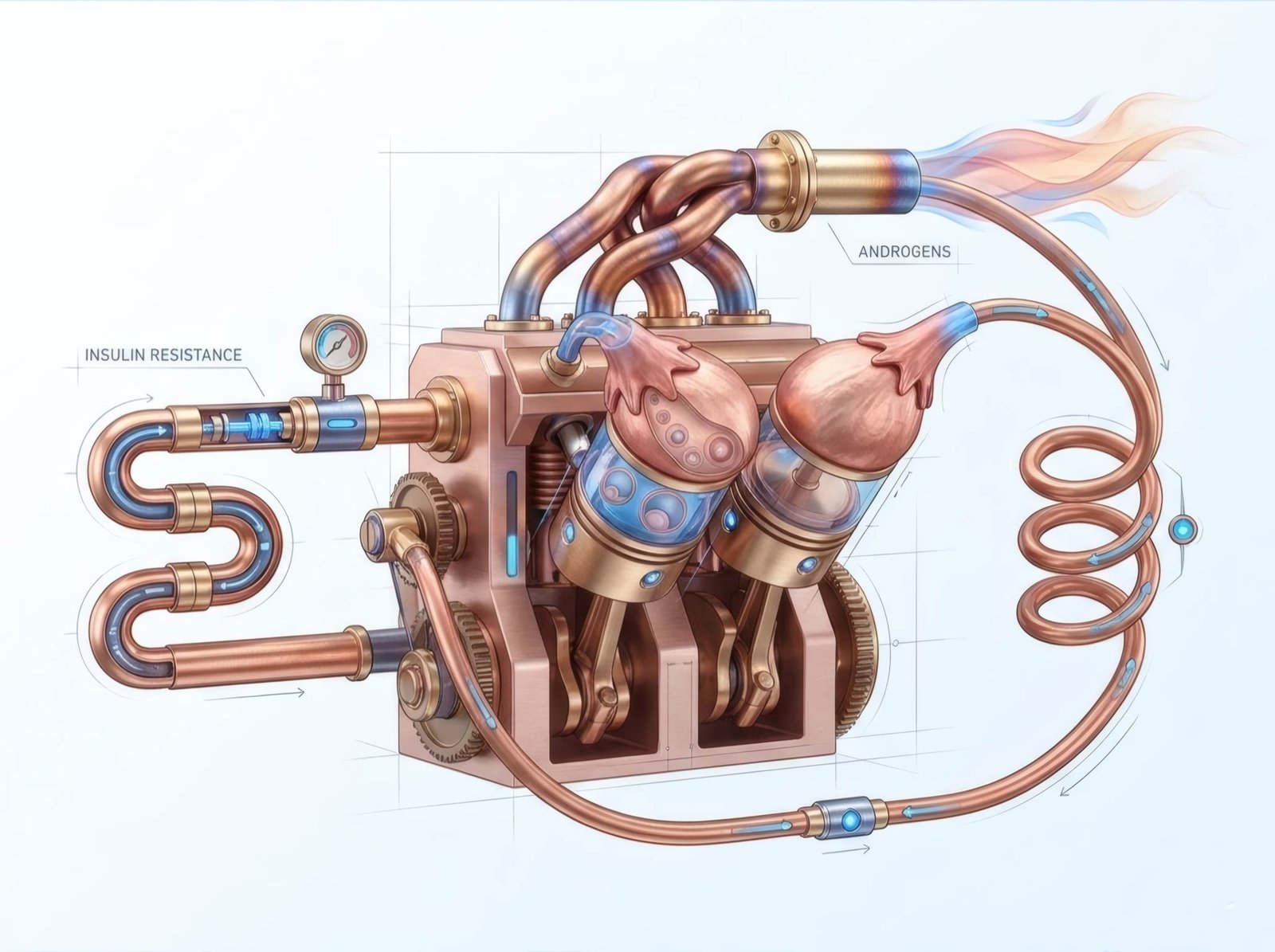
How PCOS Connects
Understanding the Engine
The core of PCOS is a loop, and every treatment on this page targets one of its arrows. Start with insulin resistance — present in the majority of PCOS patients including the lean, often compensated by high insulin levels that look 'normal' on a fasting glucose test. That hyperinsulinemia acts directly on the ovaries (which are densely insulin-responsive): it drives the theca cells to overproduce androgens — testosterone and its precursors — and simultaneously suppresses the liver's SHBG (sex hormone-binding globulin), raising the free, active androgen fraction. The elevated androgens disrupt follicle maturation: many follicles begin, none dominates, ovulation becomes irregular or absent — the 'string of pearls' on ultrasound.
The loop closes through consequences. Androgen-driven central fat deposition (the classic 'PCOS belly') worsens insulin resistance. Irregular cycles mean progesterone deficiency — unopposed estrogen — with endometrial consequences (Chapter 3). And the metabolic half of the syndrome runs its own long game: PCOS carries substantially elevated lifetime risks of type 2 diabetes, gestational diabetes, and cardiovascular disease — which is why management is lifelong metabolic care, not just cycle regulation. The name says 'ovary'; the treatment says 'metabolism.'
- Rotterdam diagnosis (2 of 3): irregular or absent ovulation; clinical or biochemical hyperandrogenism; polycystic ovarian morphology on ultrasound — with mimics excluded.
- Insulin resistance: present in the majority — including lean patients — and often invisible on standard fasting glucose; the engine's fuel line.
- Hyperandrogenism: hirsutism, acne, scalp hair thinning, and/or elevated androgens on labs — the visible face of the loop.
- PCOS phenotype spectrum: from classic (all three criteria) to ovulatory and non-hirsute variants — one name, several presentations.
- The long game: elevated type 2 diabetes, gestational diabetes, dyslipidemia, and cardiovascular risk — the reason management is decades-long.
The 1935 Paper and the Name That Outlived Its Understanding
In 1935, Stein and Leventhal described seven women with amenorrhea, hirsutism, and enlarged polycystic ovaries — and for six decades the condition bore their names, treated largely with ovarian wedge resection, a surgery aimed at the organ that the disease only uses as its stage. The 'cysts' were named, the ovary was blamed, and the metabolism went unexamined.
The modern inversion took decades of endocrinology: the follicles are stalled, not cystic; the ovary is responding — correctly — to insulin signals it never evolved to regulate; and the effective treatments (metformin-class, lifestyle, insulin-sensitizing approaches) target the fuel line, not the cylinders. The 2003 Rotterdam consensus formalized the criteria, and the 2023 international guideline completed the reframe: PCOS is a metabolic condition with reproductive expression — which is precisely why this page shares so much biology with our diabetes and fatty-liver pages.
Diagnosis is clinical: 2 of 3 Rotterdam criteria with mimics excluded (TSH, prolactin, and androgen testing to rule out thyroid and adrenal causes). Beyond diagnosis, two monitoring sets matter for decades: metabolic (HbA1c or fasting glucose + insulin where available, lipids, blood pressure — annually; PCOS carries several-fold elevated diabetes risk) and endometrial (cycles consistently longer than ~90 days warrant a physician conversation about progesterone-induced withdrawal and endometrial protection). And planning pregnancy? The conversation starts before trying — PCOS pregnancies carry elevated gestational-diabetes and preeclampsia risks, and the fertility plan (letrozole first-line) is a specialist collaboration, not a shelf.
The 'cysts' in PCOS aren't cysts at all — they're follicles that started and stalled, dozens of them, each one waiting for an ovulation signal that keeps getting drowned out. Your ovary isn't broken; it's receiving orders from an over-signaling pancreas.
- Up to 70% of women with PCOS are undiagnosed — the lean phenotype and mild presentations escape the stereotype.
- Insulin resistance is present in most PCOS — including normal-weight patients — and often invisible on a standard fasting glucose test.
- Losing 5–10% of body weight can restore ovulation in many overweight patients — one of medicine's highest-leverage percentages.
- PCOS's lifetime type 2 diabetes risk is several-fold elevated — metabolic care is the condition's long game, whatever the fertility timeline.