What is Erectile Dysfunction?
A vascular event that fails — and a cardiac warning sign wearing a different symptom.
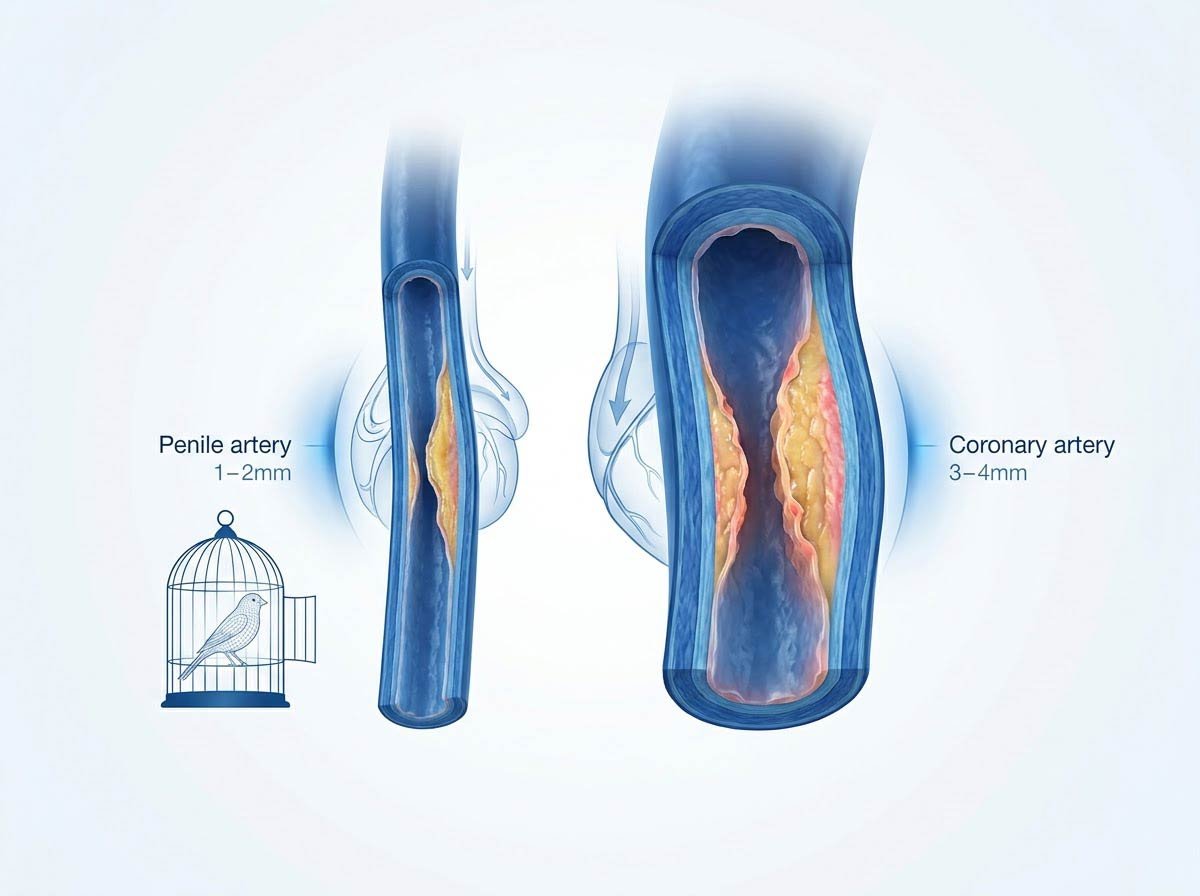
Erectile dysfunction — the consistent inability to achieve or maintain an erection sufficient for satisfying sex — affects roughly half of men aged 40–70 to some degree, with prevalence rising steeply each decade. It is hydraulic machinery run by the cardiovascular system: an erection requires arterial inflow, sinusoidal expansion, and venous compression, all orchestrated by nitric oxide signaling on a healthy endothelium. Which is why this page opens with its most important sentence: in men over 40, ED is frequently the first visible sign of cardiovascular disease — the penile arteries (1–2 mm) narrow from atherosclerosis years before the coronary arteries (3–4 mm) cause symptoms. ED precedes cardiac events by an average of 3–5 years. It is treatable — and it deserves to be treated as data, not just as a symptom.
How Erectile Dysfunction Connects
Understanding the Hydraulic Event
An erection is a vascular event of impressive engineering. Sexual signaling (nerve or psychogenic) releases nitric oxide in the penile arteries and chambers; NO relaxes arterial smooth muscle, inflow opens wide; the twin corpora cavernosa — sponge-like chambers of smooth muscle and sinusoids — fill; and as they expand against the tough surrounding sheath (tunica albuginea), the small veins running between them are compressed shut, trapping the blood. Rigid erection = full inflow + locked outflow. Three things can fail the system: the supply (atherosclerotic arteries that cannot dilate — the most common cause over 40), the signal (nerve damage from diabetes, surgery, or spinal injury), or the performance anxiety that suppresses the psychogenic signal — sympathetic override constricting exactly what must dilate.
The famous epidemiology comes from the Massachusetts Male Aging Study: complete ED in roughly 5% of 40-year-olds rising to 15% of 70-year-olds, with the risk factors of vascular disease — smoking, diabetes, hypertension, dyslipidemia, inactivity — predicting ED years before they predicted cardiac events. The Princeton Consensus formalized the clinical consequence: a man presenting with vascular ED and no cardiac history deserves a cardiovascular risk assessment, not just a prescription. The same endothelium lines every artery a man owns; the small ones testify first.
- Vascular ED: impaired arterial inflow from endothelial dysfunction and atherosclerosis — the dominant cause over 40, and the cardiac-warning variant.
- Psychogenic ED: performance anxiety, stress, depression — sudden onset, situational, morning erections preserved (Chapter 3's diagnostic key).
- Neurogenic ED: nerve-signal failure — diabetic neuropathy, pelvic surgery (prostatectomy), spinal cord injury, multiple sclerosis.
- Hormonal ED: low testosterone's honest role — it diminishes libido and the frequency of erections; it does not typically block an otherwise intact hydraulic system (Chapter 3).
- Medication-induced: some antidepressants, beta-blockers, thiazides — a review-worthy cause with a physician, never a self-adjustment.
The 3–5 Year Warning: The Montorsi Studies
In the early 2000s, Italian cardiologist Piero Montorsi and colleagues noticed a pattern cardiology had overlooked: men presenting with coronary artery disease reported ED onset an average of 2–3 years before their cardiac symptoms — and in some cohorts, men with ED had a substantially higher rate of subsequent cardiac events. Subsequent studies across populations consolidated the finding: ED precedes acute coronary events by roughly 3–5 years on average.
The mechanism is the artery-size principle. Atherosclerosis is diffuse — the same disease process affects all vessels — but symptoms arrive on a size schedule: the 1–2mm penile arteries cannot compensate when their endothelium fails, while the 3–4mm coronaries still flow through early narrowing. The penis is, quite literally, the canary in the cardiovascular coal mine: the first pipe to show the pressure.
New, persistent ED (three months or more) deserves two conversations: the urologist or primary care visit for the condition itself — and within it, the cardiovascular risk assessment the Princeton Consensus recommends (blood pressure, lipids, glucose/HbA1c, smoking status, risk scoring). Bring the honest history: onset speed (sudden suggests psychogenic; gradual suggests vascular), morning and nocturnal erections (preserved points away from vascular), medications, and cycling habits. And the single most important medication fact to carry: if nitrates are ever prescribed for your heart, PDE5-inhibitor use becomes a dangerous combination — every physician and pharmacist you ever see must know you take ED medication.
Healthy men have 3–5 erections every night — during REM sleep, on autopilot, no stimulation required. Morning erections are the residue of the last one. Their presence or absence is one of medicine's cheapest diagnostic tests: intact nights point the search to the mind; silent nights point it to the vessels.
- ED precedes coronary events by 3–5 years on average — the smaller arteries testify first.
- PDE5 inhibitors (sildenafil-class) work in roughly 70% of men overall — and specifically require the nitric oxide a healthy endothelium provides.
- The Massachusetts Male Aging Study: ED prevalence rises from ~5% complete at 40 to ~15% at 70, tracking vascular risk factors exactly.
- Pelvic-floor muscle training improved erectile function in randomized trials — including a trial where ~40% of men regained normal function in 6 months (Chapter 4).