Inside the living wiring.
What is the nervous system — and why does the body's electrical network outnumber its people a thousand-fold in connections?
The nervous system is the body's internet: ~86 billion neurons joined by ~100 trillion synapses — a living electrical network that senses, decides, and commands at speeds up to 120 meters per second. It runs in four divisions: the central (brain + spinal cord — our brain page's territory), the peripheral (the somatic wiring of sensation and movement), the autonomic (sympathetic and parasympathetic — the autopilot that runs heart, gut, and glands; the adrenal page's fast clock), and the enteric — the gut's own half-billion-neuron network, the 'second brain' that makes 90–95% of the body's serotonin (our gut pages' story, told from the wiring end). The design principle this page teaches: speed through insulation — myelin, the fatty sheath that lets signals leap between gaps, is what makes a fast network possible, and its maintenance (B12), its attack (MS), and its dying-back (neuropathy) are three of the field's great disease stories.
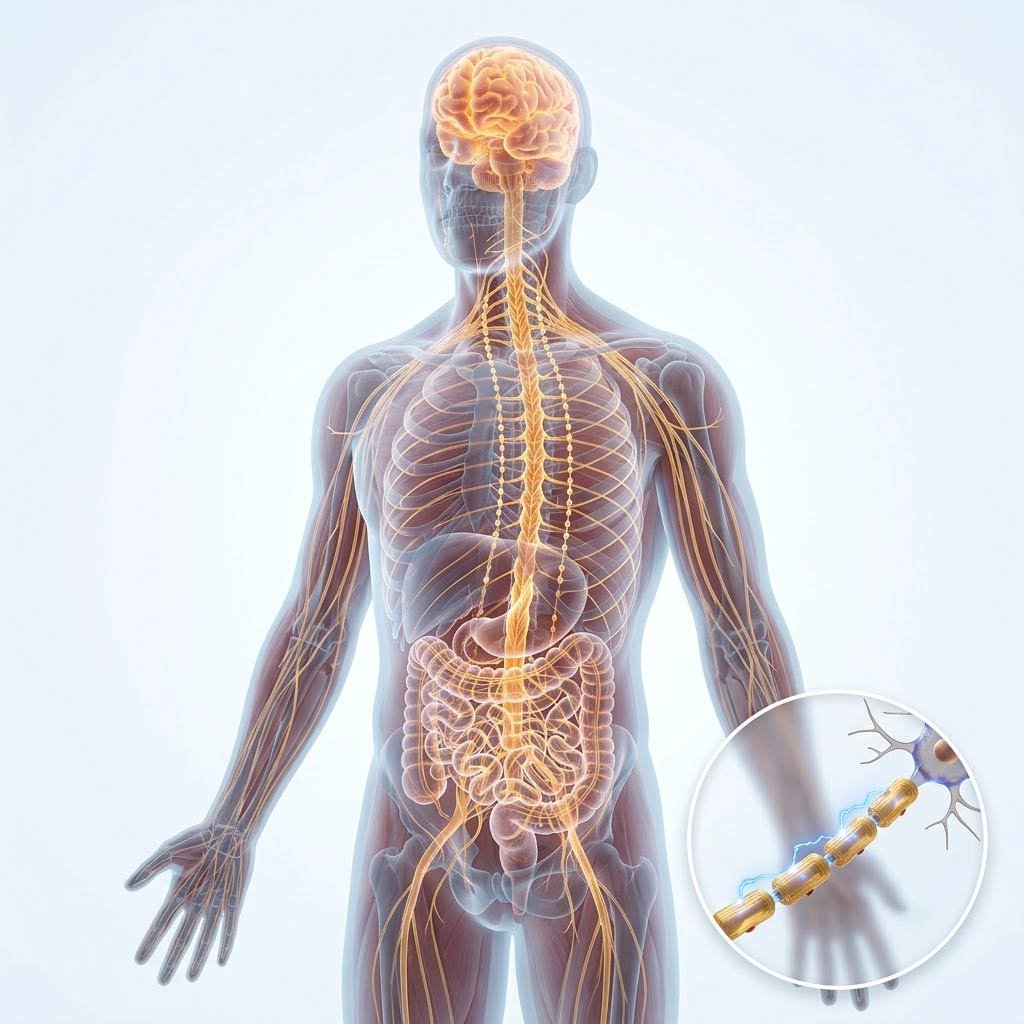
The architecture: the neuron (the signaling unit — dendrites receiving, an axon transmitting, a synapse delivering), myelin (the fatty insulation wrapped by Schwann cells in the periphery and oligodendrocytes in the CNS — the speed multiplier), the four divisions (central, peripheral somatic, autonomic sympathetic/parasympathetic, and enteric), and the chemistry (glutamate the accelerator, GABA the brake, serotonin, dopamine, acetylcholine, and norepinephrine the modulators). The whole network runs on ~20% of the body's glucose and oxygen budget — the price of being electric.
The Anatomy of Signal and Insulation
The neuron is a cell built as a wire. Dendrites gather incoming signals; the soma integrates them; the axon — sometimes a meter long for a nerve reaching from spine to toe — carries the output as a self-regenerating electrical pulse, the action potential; and the synapse converts the electrical arrival into chemical release: neurotransmitters crossing a 20-nanometer gap to open the next cell's gates. The elegance is the all-or-none discipline — the pulse doesn't fade with distance; it regenerates at full strength at every step, from cortex to fingertip. And the network's scale is its function: not the 86 billion cells but the 100 trillion connections, each tunable, is where learning, memory, and habit live.
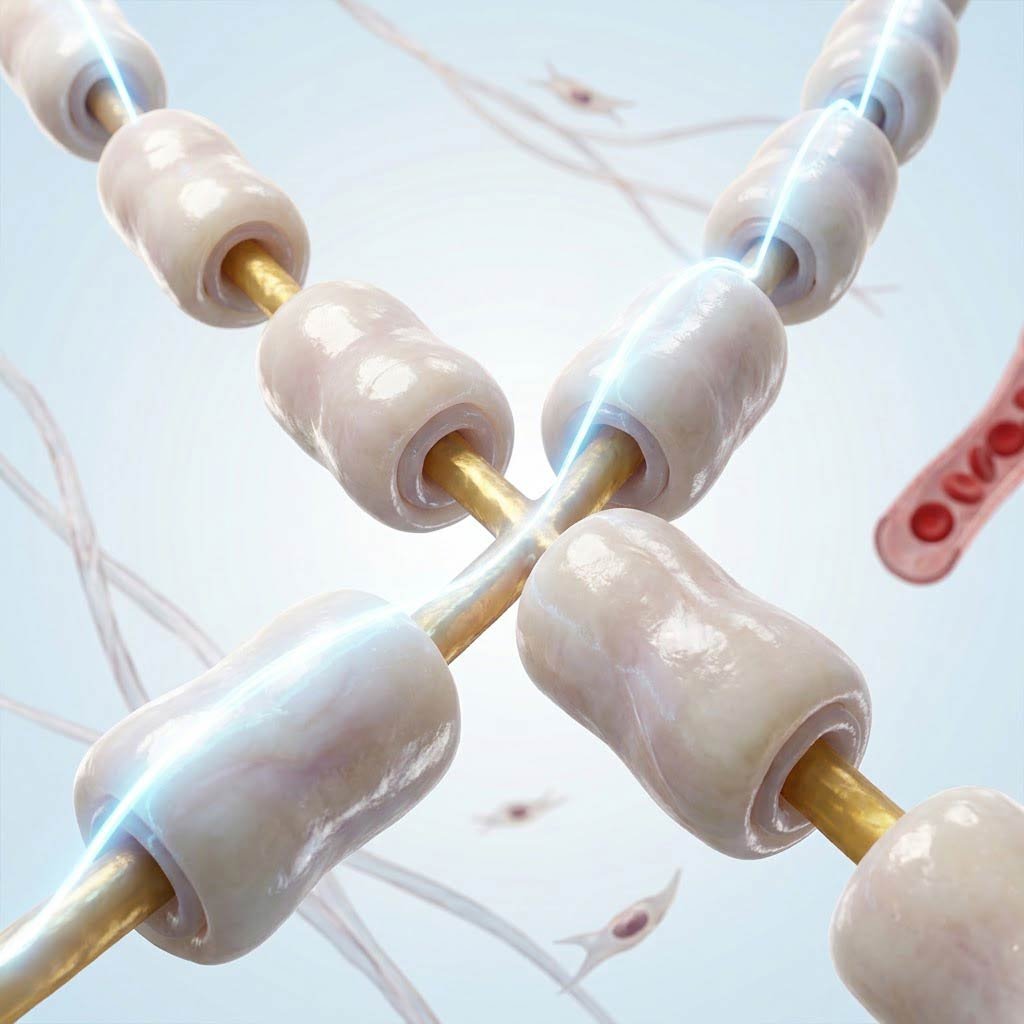
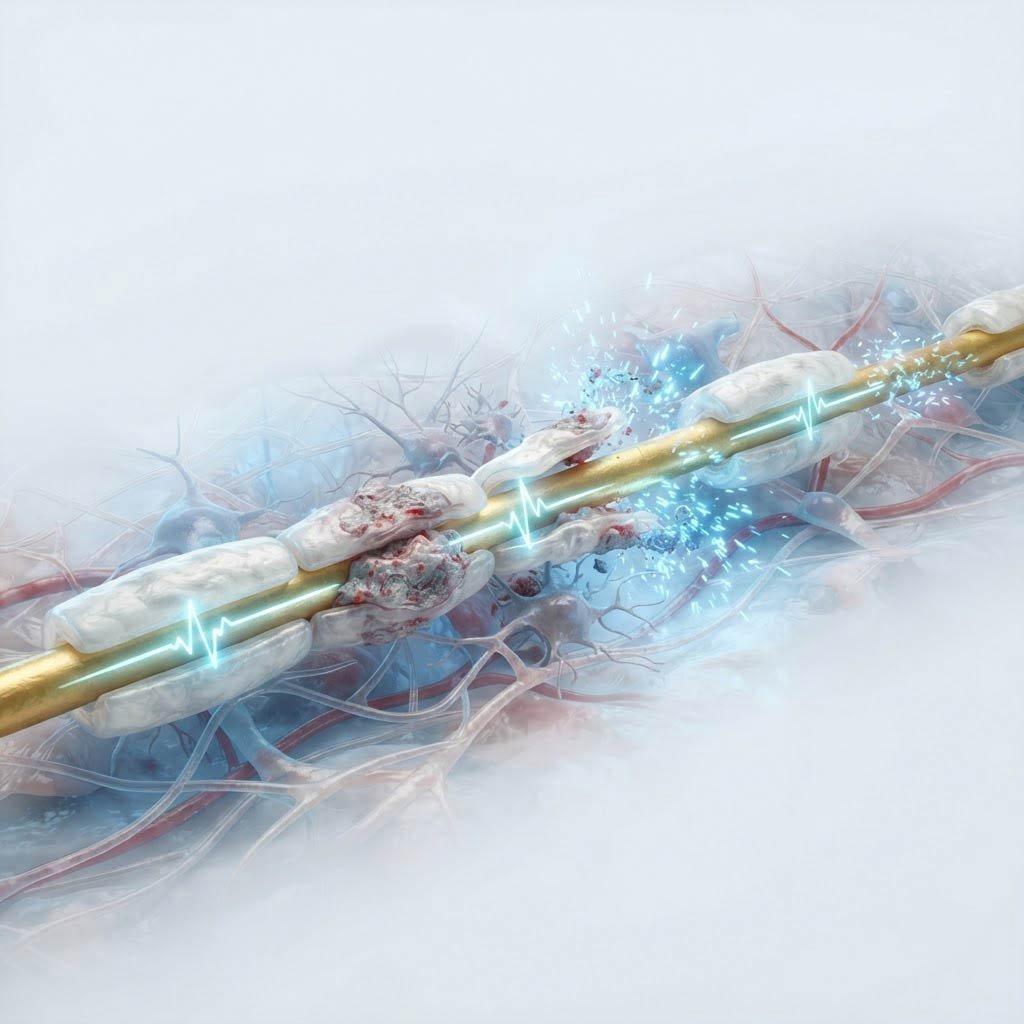
The speed story is the insulation story. A bare axon conducts at ~0.5–2 m/s — a crawl; the same fiber wrapped in myelin conducts at up to 120 m/s — a hundred-fold acceleration, achieved by letting the signal leap between the sheath's gaps (the nodes of Ranvier) in a relay called saltatory conduction. The insulation is maintained by living cells (Schwann cells peripherally, oligodendrocytes centrally) and by the nutrients the estate teaches: B12 for the sheath's maintenance (its deficiency = the degenerated cord and peripheral nerves of our blood page's story), and the fats the sheath is built from. When the immune system attacks the insulation — multiple sclerosis — the signal shorts, slows, and fails at scattered plaques: numbness, vision loss, weakness that comes and goes. The disease is the insulation; the disability is the speed.
The four divisions assign the network's jobs. The somatic system is the conscious wiring — sensation in, movement out, the neuromuscular junction as its final synapse (our muscles page's vulnerable point). The autonomic is the autopilot — sympathetic (the sprint system: pupils, heart, airways) and parasympathetic (the rest-and-digest system: the vagus nerve's slow channel), the balance our anxiety and adrenal pages teach. And the enteric nervous system — the gut's own 500-million-neuron mesh with its own reflexes, its own neurotransmitters, and its serotonin factories — is the network's most independent division: the 'second brain' that our gut-brain-axis topic carries, and the reason the gut and the mood talk constantly. The divisions are one system; the page teaches them as four rooms of the same house.
The Neuron
The signaling unit — a cell built as a self-regenerating wire
Myelin
The insulation — the hundred-fold speed multiplier the diseases target
Glutamate & GABA
The accelerator and the brake — the system's master duality
The Enteric Mesh
The second brain — half a billion neurons, 90% of the body's serotonin
The Wiring's Rules — and Its Failure Modes
Four economies of the network explain the diseases of Chapter 2 and the shelf of Chapter 4:
- Nerves die from the ends inward: the longest fibers fail first when the network is starved — the reason diabetic and B12-deficiency neuropathy both begin in the toes (the 'length-dependent' glove-and-stocking pattern), and the reason a foot exam is a nerve exam: the wiring's health is read from the farthest wire.
- Chemistry is concentration and balance, not volume: glutamate (excitation) and GABA (inhibition) are the master duality; serotonin, dopamine, norepinephrine, and acetylcholine are modulators that tune whole systems. The psychiatric medications work on these dials — and the supplement aisle's claims to 'boost serotonin' run into the estate's standing truth: you cannot outpatient-engineer a system this regulated with a bottle (the adrenal page's lesson, neurochemistry edition).
- The network has no pain sensors of its own — mostly: brain tissue is insensate (the reason awake neurosurgery exists), but the coverings, vessels, and peripheral nerves hurt abundantly — the reason headaches are meningeal/vascular, not 'brain pain,' and the reason neuropathy's burning is the nerve itself misfiring, not the tissue it serves.
- Plasticity is lifelong but expensive: the network rewires with use — the rehabilitation science behind stroke recovery and the learning science behind habit — and the price is paid in energy, sleep (the overnight consolidation and clearance our sleep pages carry), and time. The plastic brain is the hopeful fact; the gradual timetable is the honest one.
You are a 100-trillion-connection network running on a fifth of your body's fuel, insulated for speed, balanced between an accelerator and a brake, and wired to a second brain in your gut. The wiring maintains itself — feed it, sleep it, and guard the insulation.