Inside the tube.
What is the gut — and why is one tube also a brain, an ecosystem, and an immune organ?
The gut is a 9-meter tube from mouth to anus — and simultaneously three more things nobody told you. It is a second brain: ~500 million neurons embedded in its walls, enough to run digestion without asking the one in your head (our IBS page teaches this wiring). It is an ecosystem: ~38 trillion bacteria, mostly in the colon, carrying 3.3 million genes to your ~20,000 — a metabolic organ you didn't build and can't replace, only feed. And it is an immune interface: the one-cell-thick barrier between your bloodstream and everything you swallow, patrolled by ~70% of your body's immune cells. Understanding the four systems — tube, brain, ecosystem, barrier — explains every condition and every product in this library's gut family.
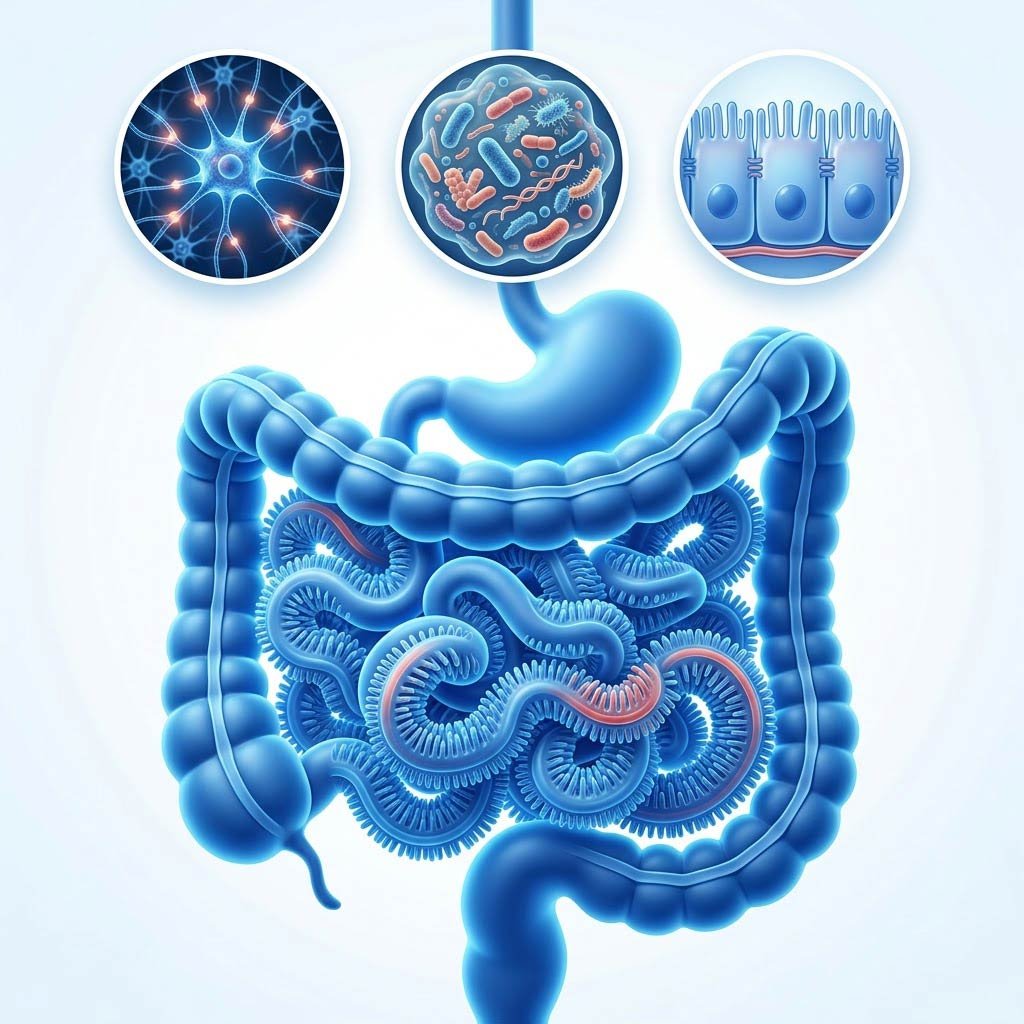
The tube's stations: the esophagus (delivery), the stomach (a 1.5-liter acid-churning pouch — our acid-reflux page's territory), the small intestine (six meters of villi-lined absorption surface, ~30 m² — where nutrients cross into blood), and the colon (1.5 meters of water-reclamation and microbiome habitat — the ecosystem's headquarters).
The Anatomy of Absorption
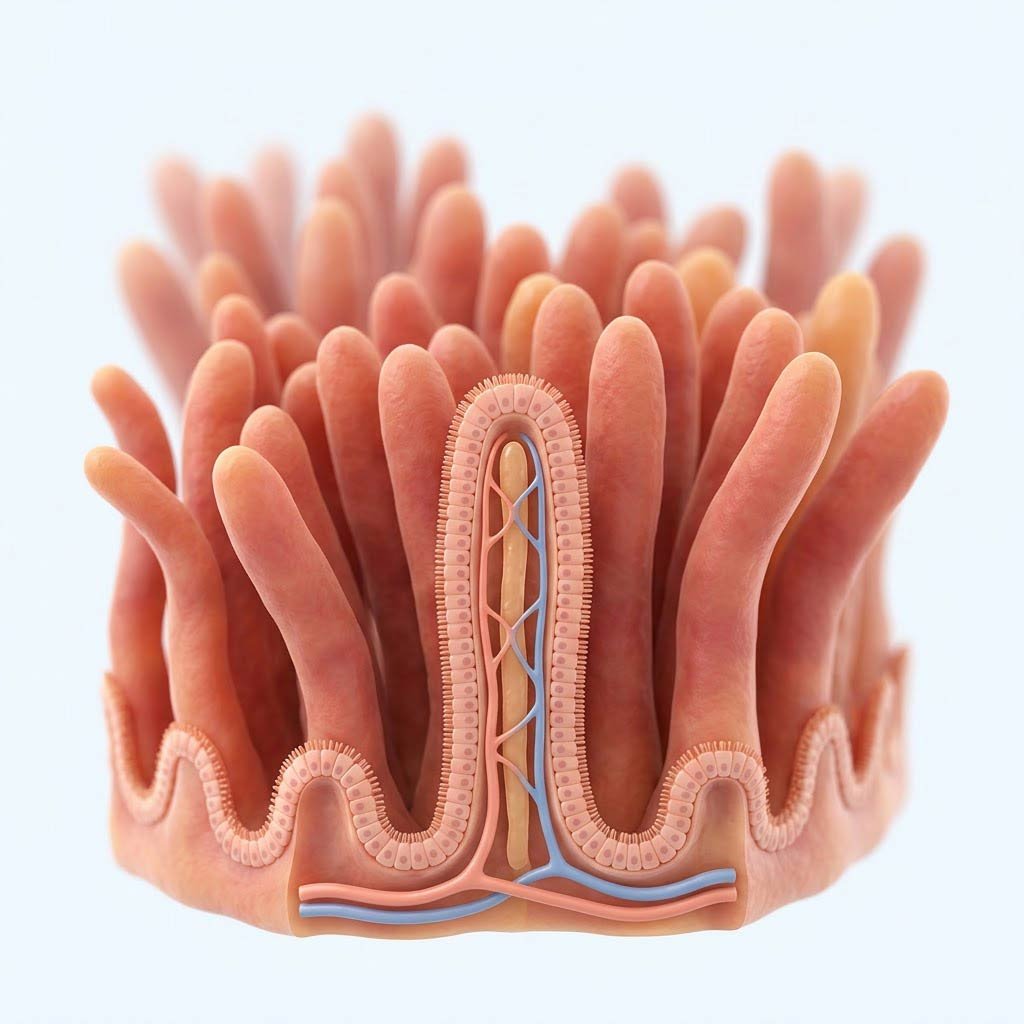
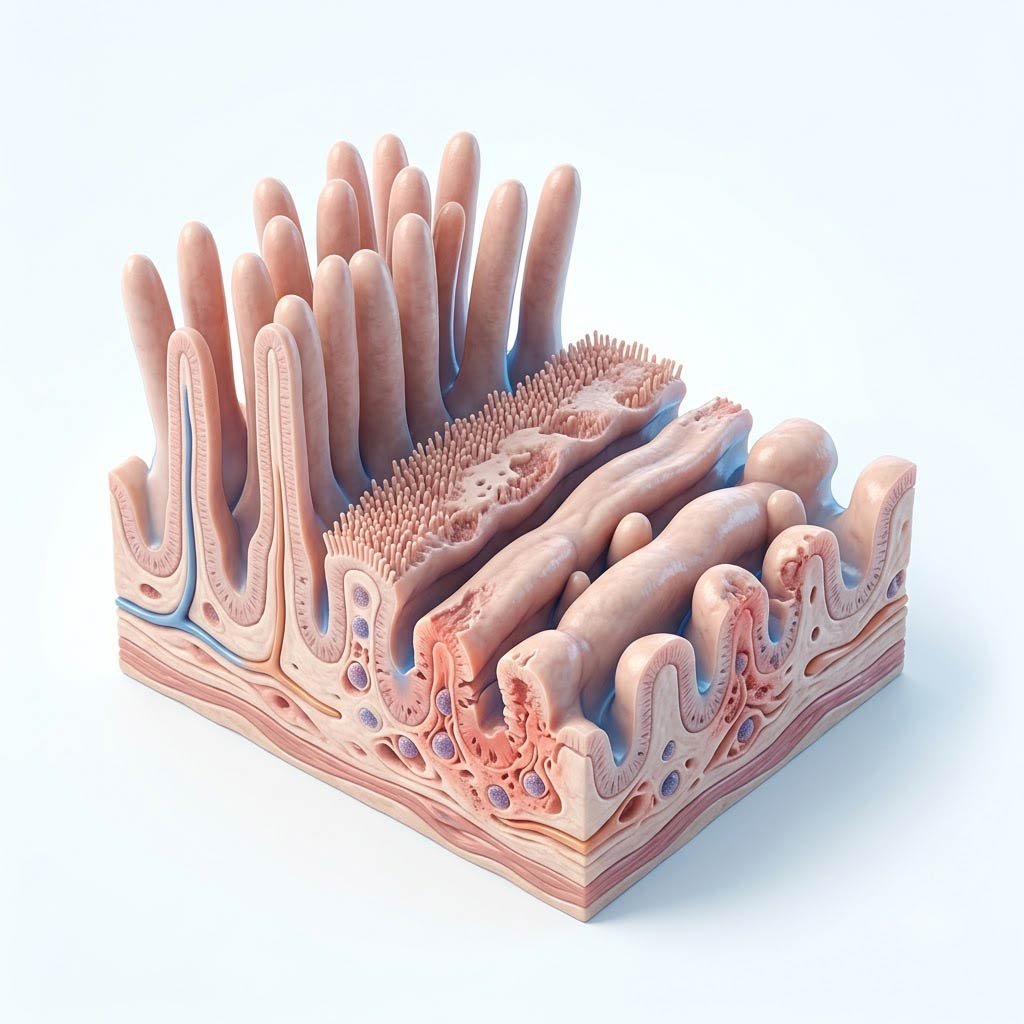
The small intestine is the tube's working surface, and its architecture is the point: the lining is folded into villi, each villus covered in microvilli — folds upon folds multiplying a six-meter tube into ~30 square meters of absorption surface. Each villus contains a capillary and a lymphatic (lacteal) for transporting what crosses; the whole surface renews itself every 3–5 days, the fastest-turnover tissue in the body. The comparison images show what happens when that architecture is attacked: celiac disease's immune assault flattens the villi, collapsing the surface area and producing the malabsorption — iron, B12, folate — that our anemia page traces back through this door.
The colon is a different organ with a different job: it reclaims water and electrolytes from 1–2 liters of fluid daily, and it houses the ecosystem. The colon's bacteria ferment the fiber your enzymes can't digest, producing short-chain fatty acids — the microbiome's currency, fueling the colon's own cells and signaling body-wide. This is why fiber feeds the gut in both directions: bulk and water-regulation mechanically, SCFAs metabolically. The tube and the ecosystem are one system — you can't nourish one without feeding the other.
Stomach
The acid pouch — pH ~1.5, protein churn, the reflux barrier
Villi (Small Intestine)
The absorption surface — folds on folds, renewed every 3–5 days
Colon Microbiome
The ecosystem's headquarters — 38 trillion residents, 3.3M genes
Enteric Nervous System
The second brain — 500 million neurons, digestion on autopilot
The Barrier — The One-Cell Gate and the Honest 'Leaky Gut' Story
Between everything you swallow and your bloodstream sits a single layer of cells, held together by tight junctions — the most selective gate in the body:
- The barrier is real and load-bearing: one cell thick, it admits digested nutrients while excluding bacteria, toxins, and undigested proteins — the gate that keeps the ecosystem in its lane. ~70% of the body's immune cells sit behind it, a garrison proportionate to the threat.
- Permeability is a real phenomenon: increased intestinal permeability is documented in celiac disease, active IBD, and NSAID injury — the tight junctions loosening under disease or damage, measurable in research settings. The biology exists.
- The wellness-industry version is the myth: 'leaky gut syndrome' as a diagnosis explaining fatigue, brain fog, and everything else — diagnosed by unvalidated tests and treated with proprietary protocols — is not a clinical entity. The honest framing: permeability is a mechanism in specific diseases, not a stand-alone diagnosis with a shelf cure.
- The vagus nerve is the diplomatic cable: the gut sends more signals TO the brain than the brain sends down — our anxiety and depression pages teach the upward traffic; our IBS page teaches the two-way loop. The second brain reports constantly, and the mood listens.
- The migrating motor complex — the gut's housekeeper: between meals, sweeping electrical waves clean the small intestine every 90–120 minutes. Its disruption (the IBS-SIBO connection) is one reason meal spacing matters more than the gut folklore admits.
Your gut is a 9-meter tube containing a brain — 500 million neurons — an ecosystem of 38 trillion organisms, and 70% of your immune system, all behind a barrier one cell thick. You are, mechanically, a donut with sensors: the tube's inside is outside your body, and the gate between is the whole game.